Showing posts with label Daniel Schneider. Show all posts

Tuesday, December 29, 2015

Cannon Fodder: Making the Grade + Hot Chili


MAKING THE GRADE
(R, Cannon Films, 104 mins., theatrical release date: May 18, 1984)

HOT CHILI
(R, Cannon Films, 86 mins., released in August 1985)

Now here's a movie which you won't find discussed in Mark Hartley's Electric Boogaloo: The Wild, Untold Story of Cannon Films. Actually, I've seen two of them, and they're both thudding attempts by Golan-Globus to cater illicitly to the pubescent teenybopper set. They're both very loosely based on their earlier The Last American Virgin, and they were just as day-late and dollar-short, too.

Why Making the Grade isn't included in Electric Boogaloo, even in a passing two-second interval, is astounding. Another relic of Cannon's disastrous association with Metro-Goldwyn-Mayer, you'd think Hartley would've paid this one a little more mind since the topic was broached. This one also spawned the careers of Judd Nelson, just a year before his induction into the Brat Pack, and Andrew Clay Silverstein, whose character is named "Diceman" as an omen of his later notoriety.

Yes, this was the film that gave you Andrew "Dice" Clay. Reactions may vary, but suffice to say there are no naughty nursery rhymes anywhere in the film. Perhaps if there were, Hartley and Brett Ratner would've jumped on that opportunity. God knows my image of Ratner is hardly different to that of the Diceman.

Besides, if you're going to make a shrine to the Eighties, then what better clip to highlight than Clay's show-stopping goof on a jazzercising John Travolta? Even without Frank Stallone on the soundtrack, that moment is golden. What, were the makers of Electric Boogaloo afraid they'd play up the kitsch too much?

Initially titled "The Last American Preppie" in a bald attempt to capitalize on that Boaz Davidson job, despite neither him nor any of the cast (physical or musical) returning to the fold, Making the Grade is another bog-standard row between the stuffy rich and the snazzy poor of our educational system. You've seen this done many, many times, whether you were there in '84 or not. There comes a point where you as a filmgoer feel like one of these sub-Animal House underachievers, being held back so as to endure the same canned anarchy and tedious characterizations over and over again without ever feeling like you've learned a damn thing.

Dana Olsen, the sitcom writer who'd go on to pen The 'Burbs, assumes the poor man's Bill Murray position as Palmer Woodrow III, the living embodiment of both snob AND slob. Smarmily secure in his own arrested development and the shame it brings his wealthy family, Palmer's flunked out of six boarding schools in three years and is threatened with losing his inheritance if he doesn't graduate his senior year at Hoover Academy. Rather than cancel his semester overseas, Palmer buys himself an impostor when he meets Eddie Keaton (Judd Nelson), a youthful hustler running away from $3,700 in gambling debts.

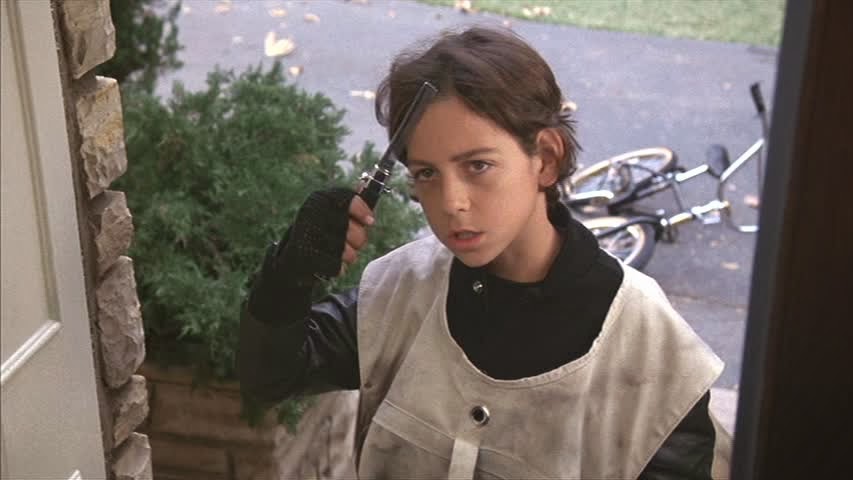
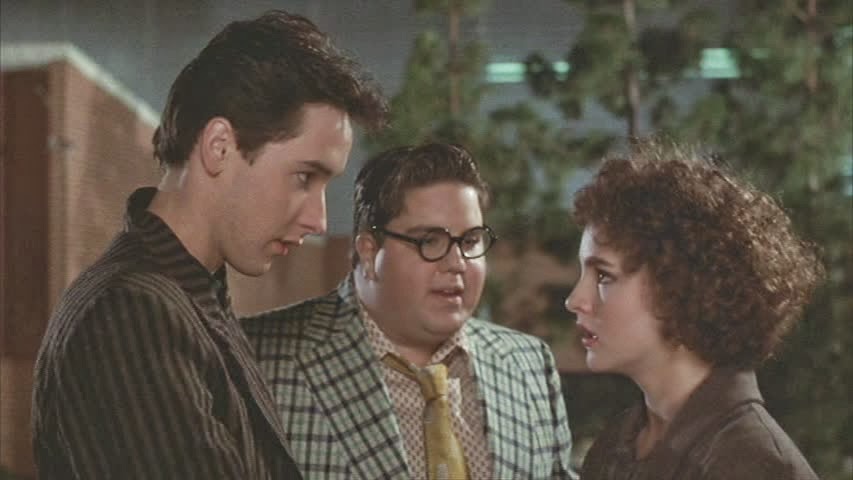
So it's off to Preppie High for Eddie, where he confronts the atypical melee of boors and bores. There's the geeky roommate (Carey Scott) who is also Palmer's best friend, agreeing to mentor Eddie for a healthy lump sum. There's principal antagonist/king of the campus Bif (Scott McGinnis) and his would-be girlfriend/founder's daughter Tracey (Jonna Lee), who fancies Eddie for his salt-of-the-gutter charisma. There's a ragtag faculty comprised of hapless dean Mr. Harriman (Gordon Jump), corpulent lacrosse coach Wordman (Walter Olkewicz) and memory-deprived Professor Mueller (Ray Hill). And finally, there's the neurotic fat kid known only as Blimp (Daniel Schneider), socially awkward and severely overemphasized.

Dorian Walker, whose only other directing credit was the campy Teen Witch ("Top that!"), can't even be counted on to give this movie a serviceable flow. The movie seems to shuffle its scenarios, conforming to the episodic ordinariness of its genre with brazen apathy. Chestnuts like the school social, the loud party and the "romantic" sex scene just seem plopped in to satisfy the producers' demands, and screenwriter/producer Gene (Treasure of the Four Crowns) Quintano strains to adapt them to the then-current vogue. More often than not, it's just dead silly, like when Eddie shows off his Breakin' prowess (note that the only black person in the cast is Palmer's sassy maid) as the live band launches from a limp cover of "My Sharona" to a song by Reflex, the one-hit wonders behind "The Politics of Dancing," despite not having a synthesizer player! (Imagine Reeves Nevo & The Cinch from Fast Times at Ridgemont High suddenly turning into A Flock of Seagulls.)

The result is as schizophrenic as expected of a Golan-Globus exploitation, yet crushingly formulaic and half-baked. What may work in a fast-paced action movie like Ninja III: The Domination becomes stultifying in a teen movie, and this movie's constant switching of gears from raucous (the return appearance of Palmer, which may as well suggest surrender) to proselytizing (Eddie's inexplicable personality shift into a stereotypical Ivy League killjoy) registers as incompetence. The only plus here is that Nelson, Olsen and Clay do not want for one-liners: "I don't even know you and you're breakin'my heart," Eddie raps at Tracey, before admitting "I've only felt that way about Pia Zadora." But despite all of their combined sarcasms, Making the Grade uses the cheapest of primer to paint by numbers.

One of the major idiosyncrasies of Cannon Films is that they were inches ahead of the game (Breakin') and miles behind the curve, as Making the Grade demonstrates. You'd think that the previous year's Risky Business and the concurrently-released Sixteen Candles would've refined Cannon's coarse stance on teen movies. But Quintano is on the same mean streak as his predecessors in the teensploitation field. He thinks it's charming to hear Coach Wordman, who is introduced in the presence of trashy women, speak contemptibly of wallflowers as "woof-woofs" and "dogs." He falls back on Blimp being humiliated by Aryans with argyles or, at the height of condescension, stuffing his face at the commencement ceremony. Even the wanton nudity reeks of arch disdain, which in this film is the dominant style of humor.

At least The Last American Virgin had the brevity of a 90-minute runtime, whereas Making the Grade is a veritable cramming session at 100 minutes. Despite the lack of chemistry between Nelson and Olsen, the credits suggest Palmer and Eddie would return for a sequel, "Tourista." This never officially happened, nor did a planned sequel to Virgin which would've had the male leads cross paths with Cannon regular Sylvia Kristel (Lady Chatterley's Lover, Mata Hari) in an exotic locale, but I believe Golan & Globus followed-up both movies in spirit with William Sachs' phenomenally worthless Hot Chili.

Since three of the four main players from Virgin went on, like Judd Nelson, to way better things in 1985 (Monoson in Mask, Antin in The Goonies, Franklin in Better Off Dead opposite Dan "Blimp" Schneider), Hot Chili's only encore appearance is from perennial third-wheeler Joe Rubbo. And since the premise involves four boys' summer vacation to Mexico, it's as close to "Tourista" as Cannon would ever get.

The big problem here is that whatever marginal graces Davidson's cult favorite possessed, in performance and photography, are completely lost here. All that's left are the tackiness and tastelessness.

WASP-ish hero Ricky (Charles Schillaci in his only movie credit), buddy Jason (Allan Kayser, the bully from Night of the Creeps) and bickering nebbishes Arney (Rubbo) & Stanley (Chuck Hemingway, who appeared in My Science Project and Neon Maniacs before dying young in 1996) arrive south of the border on a work program at a resort hotel, the Tropicana Cabana. Though the manager, Esteban (Jerry Lazarus), is a soul-sapping dictator, they have high hopes to indulge their yen for sex and booze which are immediately stoked by the presence of another degraded Virgin alumnus, Louisa Moritz, here squeaking like Betty Boop as she struts about in nothing but an apron.

Hot Chili basically goes through the dopily titillating motions from this point onward. Ricky takes music lessons from a naked cellist (Bea Fiedler). Stanley carries a snooty guest's luggage all around the hotel, even ending up in a bullfighting ring, while the film is sped up a la Benny Hill and cartoon sound effects augment the chipmunk voices. Tawny blonde veteran Taaffe O'Connell brandishes a dildo in Ricky's face, claiming it's something "all boys want." And then she and the boys straight-up rehash the Carmela gangbang from Virgin, complete with Rubbo's apprehensive face and the unwanted appearance of an irate lover.

And the less said about Ricky's letters-to-mother narration, the better.

Skinny dipping, strobe lights, dressing in drag, belching, meat thermometers in delicate areas, breasts toppling out of their dresses, under-the-table foot penetration. Hot Chili is a compilation of the Lemon Popsicle series' greatest hits, and calls into question why company man Boaz Davidson didn't demand a writing credit opposite William Sachs and Menahem Golan given how many derivations are on display. All that's missing is his smug chauvinist moralizing.

Even if you despised The Last American Virgin, you'll miss the compositional skill of Adam Greenberg, the fresh-faced casting of Lawrence Monoson & Diane Franklin and the fluke assemblage of simpering CHR staples. All Hot Chili serves you are four bland actors on auto-pilot, predominantly revolting mise en scène and one patronizing, puerile gag after another. Not even as flavorful as store-brand mayonnaise let alone cayenne peppers.

This is perhaps the worst movie Sachs has ever commanded, even more dire than The Incredible Melting Man and Galaxina. Hot Chili is only recommended to completists of either Cannon Films or Joe Rubbo, and even they will wish for a Palmer Woodrow III to provide the snarky commentary Hot Chili truly craves. Mark Hartley was right to let this one rot in peace.


Sunday, December 22, 2013

Enchantéd, Part VI: Better Off Dead...


Enchantéd: A Retrospective Tribute to Diane Franklin

VI. Better Off Dead... (1985)
(PG, Warner Bros. Pictures)


Now, here's an 1980s nostalgia trip worth the ringing of the tubular bells...


The CBS daytime game show Press Your Luck is one of those rare entities (see also: any iteration of Double Dare) where I actively rooted for the contestants to lose, simply because of the Whammies. The more prizes you amassed in the course of your spins, the more painful it was to hit a Whammy and watch them all get taken away. But to add insult to injury, an animated vignette would pop up in which a Whammy would experience some form of violent humiliation straight out of a "Looney Tunes" short or taunt you under the guise of a famous caricature. Paul Revere, The Beatles and Boy George ("Who would ever hurt a Whammy?") were among the many personalities satirized in the name of sadism.

One of the key animators of the Whammies would go on to have a fruitful career in children's television, but in between that he was a burgeoning filmmaker in the post-John Hughes era of teen-friendly capers. That man is Savage Steve Holland, a young California college student who had a bit of a death wish despite his WWF opponent nickname. When his high school sweetheart dumped him as a means of advancing her status, Holland was so defeated that he tried to hang himself, fashioning a noose from an extension cord tied around a water pipe. Having second thoughts didn't help as he fell through the garbage can he was standing on, causing a flood which nearly drowned him.

Holland made this the crux of a short film which aimed for sympathy but was greeted as a comedy. And thus, the impetus for one of the most feverishly-adored cult comedies of the 1980s, Better Off Dead...

Fresh off his starring debut in Rob Reiner's The Sure Thing, it allowed John Cusack another opportunity to carry a film with his droll, sharp presence. Better Off Dead... also scored a coup in casting Curtis Armstrong, previously seen in colorful supporting roles in both Risky Business and Revenge of the Nerds, to continue his offbeat path towards cult stardom. It had a score composed by English musician Rupert Hine, whose production work on albums by The Fixx and Howard Jones were successful enough that both artists loomed over the oh-so-Eighties soundtrack (listen during the climactic duel for a piece of music which closely resembles a reggae remix of Animotion). There were enough beloved gags and one-liners which fans have quoted to the point of delirium, none more so than the dreaded cry "I want my two dollars!"

But the biggest takeaway I got from Better Off Dead... was this: I was in L-O-U-V-R-E with Diane Franklin, the single most stunning woman of any film I had watched in my vast teenage logbook of cinema. 

Don't get me wrong...I'm impartial enough to avoid the mere "fan boy" tag just by processing the films of hers which I've revisited, and admitting that quite a few are problematic. I couldn't take The Last American Virgin all that serious or diverting as a lot of people make it out to be. Perhaps it's because I've seen the first four Lemon Popsicle films, and Boaz Davidson's constant wringing of sour grapes and his thin, exploitative approach to writing/directing is proof enough that he was better suited to being the Israeli Roger Corman. Amityville II: The Possession gets points for Lalo Schifrin's creepy score, earnest performances and a willingness to be more gonzo than Stuart Rosenberg's original, but it's tasteless and derivative to a fault. The murder mystery Deadly Lessons is tame even by TV-movie standards. The clearest victor thus far in this retrospective is Summer Girl, which is a juicier melodrama than any of the ones I just mentioned and quite the model of economy, professionalism and guiltless entertainment.

I got more from the evenly lowbrow Second Time Lucky than The Last American Virgin in terms of why I not only find Diane a "babe," but just an undervalued actress, in general. Despite Franklin's emotional investment and sex appeal, Karen too easily blended into the movie's childishly sexist attitude, treated with no less scorn than Rose, or the three girls from the opening, or that hooker with VD. That movie had no innocence to lose, and I ended up despising all of the anemic, uniformly unlikable main characters way before the brutal climax, thus sending me into early detachment. It's not like Patricia Montelli or Cynthia Ricks or even Eve in Eden. In Second Time Lucky, once you get past any issues of objectification or backdated ideologies, you can actually marvel at Diane's range and bask in her commitment to the many incarnations of Eve, especially her perky, humorous Thelma Todd/Jean Harlow surrogate Evie Sands.

The Last American Virgin just feels so coldly cynical at heart, which is definitely not what I get from Better Off Dead... Savage Steve Holland has slapped together a movie from the same bleak aspects of teen life, particularly the sting of rejection at such a vulnerable age. The biggest difference is that here, you don't end up contracting any self-pitying disdain, but some better form of catharsis. Holland can laugh off the notion of snuffing himself, for God's sake, and he wants you to find the same self-deprecating, affirmative outlet in this pre-Heathers blast of suicidal farce.

And who better to make you feel so completely at ease than the most luminous transfer student in the history of cinema herself, Monique Junet?

Or, for that matter, Lane Meyer. Cusack's disavowal of this film is the stuff of legend, and in interviews, Holland openly admitted how badly it burnt him out. In a nutshell: Holland met Cusack by recommendation of Henry Winkler, one of the executive producers of The Sure Thing, and the attitude during filming was purely of good vibes and trust. Cusack got along well with the filmmaker and fellow actors, and by contractual obligation, was all set to play the lead in One Crazy Summer, which distributor Warner Bros. gave to Holland out of faith thanks to some well-received test screenings of his debut. Better Off Dead... screened again on the set of Summer for cast and crew, and that's when Cusack got mad. Leaving after twenty minutes, Cusack eventually told Holland that he felt tricked, and was no longer willing to trust him anymore. 

To this day, I'm not sure if Cusack has fully buried the hatchet, despite concessions to the surprising endurance of Better Off Dead... in Hot Tub Time Machine in the exhaust fume asphyxiation gag Rob Corddry engages in as well as a certain catch phrase involving not just a dime, but twenty of them.

Holland's faith was further shaken when Better Off Dead... actually began its theatrical run (wide release date: October 11, 1985), greeted with total indifference by filmgoers and outright contempt by critics. Holland made only one more feature with How I Got into College (1989) before carving out his niche as a regular writer and director for Disney and Nickelodeon programs. Better Off Dead... instead found a more sympathetic audience through VHS and cable, myself included.

Looking back at the day I first saw this in my elementary school prime, I was more than happy to see Cusack in another movie after having absorbed The Sure Thing through videotape. And he was like my matchmaker, seeing as how both Monique Junet and the lady who played her never escaped my heart, even in the wake of my own personal despondency.

------------------------------------------------------------------------------------------------------------

Cusack plays Lane Meyer, who is so totally enamored with six-month squeeze Beth (Amanda Wyss, fresh off A Nightmare on Elm Street) that he apparently raided her vast photo album library and adorned every square foot of his bedroom with his findings. Already, this is the second Cusack movie in a row that begins with reminders of Rod Stewart's video for "Infatuation." The obsessive joke goes even further when Lane's wardrobe closet is stuffed with hangers that bear his girlfriend's likeness! But since it's teenaged John Cusack, he's actually more well-adjusted than such psychotic devotion entails.

If anything, the rest of the Meyer household is the suburban equivalent of Danvers. Al Meyer (David Ogden Stiers, fantastically flabbergasted) is perpetually tormented by newspaper-tossing hellion Johnny Gasparini (Demian Slade), constantly having to replace his garage door windows to the point of irreversible insanity. Jenny (Kim Darby, in the flipside of her logical Summer Girl materfamilias) is what we like to call a "Greendale Wife," something even worse than Stepford, based on her questionable culinary choices, where every entrée comes out disgustingly turquoise, from the boiled bacon for breakfast to some form of raisin gruel at suppertime which scares Lane straight at one point by turning into The Blob. And his little brother Badger (Scooter Stevens)...well, let's say he's Al Goldstein trapped in the body of Alfred E. Neuman.

The only sane thing to do is get out of the house and onto the snowy mountains for a little skiing action, Lane's favorite past time. Alas, the new captain of the ski team is a bohunk by the name of Roy Stalin (Aaron Dozier), the only man who has lived to brag about conquering the dreaded K-12. Wager a guess as to how Beth feels about him compared to Lane? Yep, Beth flocks to Roy and sends Lane into a self-destructive depression, which would be enough except that Lane has other reasons to worry besides just being dumped.

For one, that Johnny kid has come to collect his $2 fee and won't take "no" for an answer, especially not from Lane Meyer. Two, a pair of Chinese brothers (one mute, the other speaking only in "Howard Cosell") keep popping up at the worst possible time to challenge Lane to drag races, with frequent disastrous results. And three, he's captured the fancy of the foxy French exchange student Monique Junet (Diane Franklin), and with her the insufferable presence of her hosts and next door neighbors the Smiths, the clinging Ricky (Dan Schneider), who fits that "fat kid with glasses who eats paste" type which the earlier Cusack wiseass Walter "Gib" Gibson predicted, and his nasally-voiced mother (Laura Waterbury).

Like the manifest destiny of Gib and Alison from The Sure Thing, it's inevitable that Lane wises up to his renewed purpose through his solidarity with fellow outsider Monique, who reveals both her fractured English and yearning to see Dodgers Stadium in a fit of Ricky-induced rage (in a word: testicles). If she can help fix his junky ‘67 Camaro to mint condition, she can certainly give Lane all the reason to get over Beth, or at least encourage him to make good on a race with Roy down the K-12. Like any predetermined path, the trick is how writer/director Holland (or is that Mr. Savage?) chooses to get there.

The solution: imagining a universe just a little north of Toontown. Holland pushes the scattered, situational plot into creative levels of live action caricature (the hand-drawn fairy tale prologue is a fitting harbinger of the man's style) and makes exaggerations of virtually every character and encounter. It's a funhouse mirror view of adolescent angst more perpetually Dada than the most incidental John Hughes aside, as the impromptu Frankenstein homage involving a claymation hamburger miming Van Halen's "Everybody Wants Some" shows. Lane's sullen perception of the world carrying on around him turns everyone around orbit into strangers, with the emphasis placed on "strange." From the overeager algebra students of one Mr. Kerber (Vincent Schiavelli) to the troglodyte basketball jocks he unwittingly enrages by hitting on their main squeeze Chris Cummins (Tina Littlewood) to his spazzy best friend Charles De Mar (Curtis Armstrong), Lane is stuck in a rut typical of the mixed-up, shook-up teenage boy, allowing Holland to keep the embellished schadenfreude running hot.

The supporting cast find their own kooky niches in the process. Dan Schneider as Ricky Smith makes his mama's boy nerd equal parts ogre and oddball, his wallflower presence at a Greendale High social showcasing the film's most inspired physical performance. The recently departed Laura Waterbury relishes in her Fran Drescher-style whine and intrusive congeniality, her uproariously embarrassing Christmas morning gesture to Monique another token of madcap treasure. Aaron Dozier is lovable to hate as the unctuous main bully, Roy Stalin, in that he plays the role to the absolute hilt, locating more vainglorious timing than your average blonde butthole from many a teen comedy. The reliably jovial Curtis Armstrong does Dudley Dawson 2.0 essentially, busted down from toking Wonder Joints to snorting snow and gelatin ("I can't even get real drugs here!"), but not to be overlooked are Fast Times at Ridgemont High alumni Amanda Wyss and Vincent Schiavelli making good in a more comical capacity.

Imagine the show tune-squawking car ride from The Sure Thing extended to 90 loopy minutes, which isn't all that dreadful since John Cusack navigates the madness with one-legged hangdog aplomb. The grounded, innate charisma of both him and Diane Franklin allow for some semblance of sanity and sweetness. Franklin remains a find, boundlessly wry and whimsical in a performance that should have brought on bigger and better things, but those international language lessons ("I think all you need is a small taste of success...") proved selective. That's a shame, because she's every bit as soulful and smart as Cusack, though the sole blockbuster in her resume, Bill & Ted's Excellent Adventure, found her in a comparatively minor "love interest" role which was nowhere near close to the iconic, incandescent Monique Junet. And I will be lauding her comedic skills even more when I next delve into TerrorVision.

There was something in Monique Junet which enraptured me endlessly. Behind the over-sized coats and vests was a genuine spark which ignited serious wildfires in my romantic imagination. I fantasized about her cuddling next to me in the middle of Dodgers Stadium in my Dick Tracy sleeping bag when I was younger. I still manage to dream about her now!?! Monique Junet inspired me to feel something so raw and close to the bone, I feel it's a misnomer to call it merely a crush.

Apparently, multi-instrumental mogul and first-time composer Rupert Hine was also spellbound, as he wrote two dizzying, synth-oriented love themes around Monique Junet, the regularly-reprised "Arrested by You" (which was later covered by Dusty Springfield, to my eternal surprise) and "With One Look (The Wildest Dream)," the latter featuring guest turns from vocalist Cy Curnin and guitarist Jamie West-Oram, members of The Fixx. Even Howard Jones' "Like to Get to Know You Well," a mere bonus track on his Dream Into Action LP, is one poppy, sloppy French kiss by proxy. Having previously had a minor hit with "Misplaced Love" in 1981, which would've been at home on the soundtrack to The Last American Virgin, Hine's behind-the-boards prolificacy on the pop charts meant his fingerprints are all over the official soundtrack, even as a co-writer and producer on tracks from Berlin ("Dancing in Isolation"), Martin Ansell (the ski slope romance of "Shine") and Thinkman ("Come to Your Rescue"), the latter essentially Hine operating under a pseudonym. His only considerable absence is on the two tunes given to actress/singer E.G. Daily (Dottie from Pee Wee's Big Adventure, another inventive oddity from the same year), who is the featured entertainer at the new year's dance party.

Mr. Savage's aesthetic choices don't always match the density of his absurd imagination, and credit must go to editor Alan Balsam (Revenge of the Nerds) for allowing some form of disciplined, consummate structure. The recurring gags, chiefly Lane's tumbling down the K-12, come across as repetitive because the camera doesn't quite approach these with any fresh perspectives, a letdown considering Holland's background necessitates storyboarding. Moments tend to be overtly static when close-ups or P.O.V. angles would've added to the comedy. And the film doesn't have the distinct visual pop of an actual cartoon, even when the hamburgers start to rock out and the French fries do Busby Berkeley routines. To be fair, Holland manages a few impressive moments with Lane being hunted down by Johnny and his minions on the way home from the dance, as well as when Monique finally becomes the rightful coach Charles was too distracted to handle. Those scenes have real vigor on a technical level.

Better Off Dead... continues to endure as an anomaly in its genre, which means Holland deserves a great deal more credit than Cusack wasn't willing to offer. Had Airplane pilots Zucker-Abrahams-Zucker actually sent up the teen comedy at the height of its dominance, this is close to what you'd picture it being. Holland's total generosity towards his actors and easygoing silliness in the face of endless, demeaning odds is more commendable and refreshing than simply expecting you to have fun in the presence of venal, carefree idiots. It's free of pretension, animosity or even civilization, which is how Savage Steve lives up to his nickname. Now, if only he had been named Nick...

------------------------------------------------------------------------------------------------------------

Available on Blu-Ray through CBS Video/Paramount, Better Off Dead... is a budget release in the tightest sense. Despite an upconverted 5.1 DTS-HD MA audio mix for a film that screams dual-channel stereophonic, its 1080p 1.78:1 widescreen image is clipped from the original aspect ratio, and should've been given a judicious remastering. The real crime is that there are still no special features, although they did provide us a theatrical trailer complete with the old Warner Bros. logo. In lieu of a welcome making-of retrospective, let me direct you to a très bien Moviefone article which includes commentary from Savage Steve Holland, Diane Franklin, Curtis Armstrong, Aaron Dozier, and Amanda Wyss, who reveals a proposed alternate title which makes that Heathers comparison even clearer.