ROADSIDE PROPHETS
(R, Fine Line Features, 96 mins., theatrical release date: April 3, 1992)
Stranded at the intersection of Easy Rider and Repo Man is where you'll find Roadside Prophets, a cross-generational shaggy dog story which fires all of its guns at once yet never explodes into space.
Abbe Wool, co-writer of Alex Cox's sophomore gem Sid & Nancy, makes her feature debut here and is clearly bucking for a quirky social satire on the level of Cox's earlier film, which was simultaneously one of the funniest and most far-out movies of its decade. She doesn't quite reproduce Cox's outsider wit and cohesion, leaving Roadside Prophets to eat the dust of that intergalactic '64 Chevy Malibu.
Compared to the last tragically hip indie project on my reviewing log, Inside Monkey Zetterland, Wool's film is not without some welcome detours.
First and foremost is the casting of John Doe and Adam Horovitz, respectively of X and the Beastie Boys. As a devout fan of both acts, these punk rock icons carry their personalities from the stage to screen with integrity. Doe seems to be inhabiting the working class zero he once drawled about in "The Have Nots," the closing track from his flagship band's 1982 album Under the Big Black Sun. Meanwhile, the ever-adenoidal Horovitz is playing the fool in a broad reprisal of the troubled teen role with which he made his acting debut in 1989's Lost Angels.
Doe is literally an average Joe, as in Joe Mosely, whose Harley chopper is the only thing that gets him through life as a factory employee still paying thousands in alimony. Joe's used to the routine of cold coffee and hazardous conditions after six years of slaving, but has mercy on first-day coworker Dave Coleman (David Anthony Marshall). The two immediate friends ride out to a strip joint for refreshment, but Dave is distracted by an arcade machine which just as promptly ends their union.
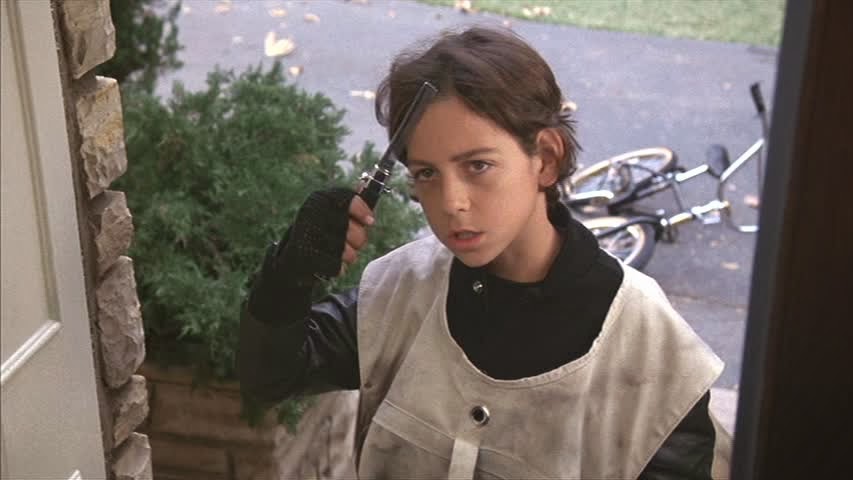
Joe takes it upon himself to have the deceased Dave cremated and embark on a pilgrimage to what he misconstrues as the Nevada town of El Dorado, home of Dave's favorite casino. With the help of a faceless personnel clerk, Angie, who pesters him for a date in exchange for covering up his absence from work, Joe hits the road but keeps running afoul of a reckless boy who walks across rooftops with Roman candles in his hands, trailing Joe every mile of the journey.
The kid is Sam (Horovitz), an orphan on a mission of his own which involves lodging only at Motel 9 rest stops, ostensibly as a company inspector. Joe reluctantly accepts Sam's shadowy companionship after the youth buys a vintage Triumph Bonneville. En route to El Dorado, the duo meet a host of aged counterculture oddballs, from a farmer who philosophizes about "transcendent reality" (Timothy Leary) to a dine-and-dash bandit who claims to be "Symbionese" (John Cusack) to a hookah-smoking hermit interested in martyred Roman gladiators who were actually "Utopian saints" (David Carradine).
Other, more on-the-level strangers include a gas-n-sip owner (Arlo Guthrie) well-versed in prehistoric fish, a hotel-managing Negro (Harry Caesar) who bemoans a life not fully lived whilst sharing a bottle of Wild Turkey with Joe, and a soulful erotic dancer named Labia Mirage (Jennifer Balgobin) who is working her way to the Yukon.
These assorted outsiders seem to be byproducts of halcyon revolutions, what with the stunt-casting of people like Dr. Leary and Mr. Guthrie as well as Abbe Wool's penchant for ribbing the slogans and scenes they stand for. John Cusack's character, Caspar, is introduced in a '50s-themed greasy spoon which the green-eared Sam takes at face value as an incredible simulation instead of the tacky nostalgia totem it is. Caspar winks through his eye patch when he announces his nationality and, after pigging out on a 12-course meal, he bolts for the exit screaming "Free food for the poor!"
Those who loudly and proudly announce that they stand for something, man, turn out to be some degree of overbearing eccentric, whether it be the isolated, interracial radical couple (Bill Cobbs as Oscar, Lin Shaye as Celeste) with an incorrigible sense of gallows humor over their wasting away from cancer and AIDS or the authority figures (Barton Heyman as a sheriff, Stephen Tobolowsky as a park ranger) who are laughably hyper-responsible. Meanwhile, the middle-aged Don Quixote and the adolescent Sancho Panza roam towards their uncertain destination, and if they don't quite make it as father/son surrogates, at least they'll be drinking buddies by the time they get to Ely.
Wool's film falters often as a comedy, particularly in handling the dim-witted apathy of Sam, whose knowledge of past presidents is gained from magazine covers but whose frequent dismissal of the rogues gallery as "insane" seems too weak to be humorous. It's tough to also forgive the repetitive nature of the episodic script, even though allowances must be made given its road-bound genre. The supporting characters keep piling up to the degree where you wish Ms. Wool would've allotted Joe and Sam some time to stop and smell the cactus flowers.
Such a reprieve would be welcome because, unlike Inside Monkey Zetterland or (even worse) Wild Hogs, Abbe Wool doesn't fixate on her navel or go for the low in comedy. This is essentially a playful, humanistic reversal of Easy Rider that has a Zen-like core. Though she sets up expectations to knock them down (turns out Dave may have been chemically-impaired about the whole "getting lucky" endorsement), Wool's smart enough to make a ruggedly handsome straight man of John Doe (previously seen in Road House and Great Balls of Fire); the X-man can fire off a laconic quip to rival Hugh Jackman. And if you're in the right mood and can sense the self-deprecation behind the King Ad-Rock's bravado (he can do the Jerry Lewis, after all), Mr. Horovitz is appealing company, too.
Jennifer Balgobin, who played the petty thief/lover Debbi in Repo Man, makes a welcome reappearance alongside such fellow Cox repertoire players as Biff Yeager (the barkeep at Shipwreck Joey's), Patti Tippo (as the casino cashier) and Dick Rude (Duke from Repo Man, here playing in a lounge act alongside Manny Chevrolet and Flea).
As for the cameo appearances, a glowering David Carradine makes the richest impression as a forest friar. It's no surprise to see John Cusack in these surroundings, as it's his propensity to juggle loony character work with more accessible projects (Tapeheads preceded his career-defining role in Say Anything), and he's the most live-wire of the kooky cast. But the walk-ons from Timothy Leary and Arlo Guthrie are over before you register them, thus less successfully handled.
Wool plants better existential jokes in the margins of scenes, like a droll newscast on a militant mailman who letter bombs Planned Parenthood clients ("Long live the unborn!") or a ghostly golf gang consisting of accident-prone leathernecks, that bolster the movie's basic philosophy of freewheeling tolerance. John Doe wails it himself in the opening credits number, "Beer, Gas, Ride Forever": "Why can't people get together?"
(Other artists on the soundtrack are, naturally, Doe's X-wife Exene Cervenka and The Beastie Boys. Also included are The Pogues and Pray For Rain, who both contributed to the score for Sid & Nancy, as well a couple other Repo Man vets).
Another asset of Wool's is DP Tom Richmond, who does for the expansive Southwest deserts and city streets what he did for the snowy war fields in A Midnight Clear. The movie may or may not be serious in reviving the spirit of '69, but Richmond's lens captures a mythos of its own.
This makes it all the smoother for Roadside Prophets to be admired as a character-friendly dramedy that, despite its allegorical anemia, is mildly entertaining for another "life's a journey" morality fable.
Enchantéd: A Retrospective Tribute to Diane Franklin
VI. Better Off Dead... (1985)
(PG, Warner Bros. Pictures)
Now, here's an 1980s nostalgia trip worth the ringing of the tubular bells...
The CBS daytime game show Press Your Luck is one of those rare entities (see also: any iteration of Double Dare) where I actively rooted for the contestants to lose, simply because of the Whammies. The more prizes you amassed in the course of your spins, the more painful it was to hit a Whammy and watch them all get taken away. But to add insult to injury, an animated vignette would pop up in which a Whammy would experience some form of violent humiliation straight out of a "Looney Tunes" short or taunt you under the guise of a famous caricature. Paul Revere, The Beatles and Boy George ("Who would ever hurt a Whammy?") were among the many personalities satirized in the name of sadism.
One of the key animators of the Whammies would go on to have a fruitful career in children's television, but in between that he was a burgeoning filmmaker in the post-John Hughes era of teen-friendly capers. That man is Savage Steve Holland, a young California college student who had a bit of a death wish despite his WWF opponent nickname. When his high school sweetheart dumped him as a means of advancing her status, Holland was so defeated that he tried to hang himself, fashioning a noose from an extension cord tied around a water pipe. Having second thoughts didn't help as he fell through the garbage can he was standing on, causing a flood which nearly drowned him.
Holland made this the crux of a short film which aimed for sympathy but was greeted as a comedy. And thus, the impetus for one of the most feverishly-adored cult comedies of the 1980s, Better Off Dead...
Fresh off his starring debut in Rob Reiner's The Sure Thing, it allowed John Cusack another opportunity to carry a film with his droll, sharp presence. Better Off Dead... also scored a coup in casting Curtis Armstrong, previously seen in colorful supporting roles in both Risky Business and Revenge of the Nerds, to continue his offbeat path towards cult stardom. It had a score composed by English musician Rupert Hine, whose production work on albums by The Fixx and Howard Jones were successful enough that both artists loomed over the oh-so-Eighties soundtrack (listen during the climactic duel for a piece of music which closely resembles a reggae remix of Animotion). There were enough beloved gags and one-liners which fans have quoted to the point of delirium, none more so than the dreaded cry "I want my two dollars!"
But the biggest takeaway I got from Better Off Dead... was this: I was in L-O-U-V-R-E with Diane Franklin, the single most stunning woman of any film I had watched in my vast teenage logbook of cinema.
Don't get me wrong...I'm impartial enough to avoid the mere "fan boy" tag just by processing the films of hers which I've revisited, and admitting that quite a few are problematic. I couldn't take The Last American Virginall that serious or diverting as a lot of people make it out to be. Perhaps it's because I've seen the first four Lemon Popsicle films, and Boaz Davidson's constant wringing of sour grapes and his thin, exploitative approach to writing/directing is proof enough that he was better suited to being the Israeli Roger Corman. Amityville II: The Possession gets points for Lalo Schifrin's creepy score, earnest performances and a willingness to be more gonzo than Stuart Rosenberg's original, but it's tasteless and derivative to a fault. The murder mystery Deadly Lessons is tame even by TV-movie standards. The clearest victor thus far in this retrospective is Summer Girl, which is a juicier melodrama than any of the ones I just mentioned and quite the model of economy, professionalism and guiltless entertainment.
I got more from the evenly lowbrow Second Time Lucky than The Last American Virgin in terms of why I not only find Diane a "babe," but just an undervalued actress, in general. Despite Franklin's emotional investment and sex appeal, Karen too easily blended into the movie's childishly sexist attitude, treated with no less scorn than Rose, or the three girls from the opening, or that hooker with VD. That movie had no innocence to lose, and I ended up despising all of the anemic, uniformly unlikable main characters way before the brutal climax, thus sending me into early detachment. It's not like Patricia Montelli or Cynthia Ricks or even Eve in Eden. In Second Time Lucky, once you get past any issues of objectification or backdated ideologies, you can actually marvel at Diane's range and bask in her commitment to the many incarnations of Eve, especially her perky, humorous Thelma Todd/Jean Harlow surrogate Evie Sands.
The Last American Virgin just feels so coldly cynical at heart, which is definitely not what I get from Better Off Dead... Savage Steve Holland has slapped together a movie from the same bleak aspects of teen life, particularly the sting of rejection at such a vulnerable age. The biggest difference is that here, you don't end up contracting any self-pitying disdain, but some better form of catharsis. Holland can laugh off the notion of snuffing himself, for God's sake, and he wants you to find the same self-deprecating, affirmative outlet in this pre-Heathers blast of suicidal farce.
And who better to make you feel so completely at ease than the most luminous transfer student in the history of cinema herself, Monique Junet?
Or, for that matter, Lane Meyer. Cusack's disavowal of this film is the stuff of legend, and in interviews, Holland openly admitted how badly it burnt him out. In a nutshell: Holland met Cusack by recommendation of Henry Winkler, one of the executive producers of The Sure Thing, and the attitude during filming was purely of good vibes and trust. Cusack got along well with the filmmaker and fellow actors, and by contractual obligation, was all set to play the lead in One Crazy Summer, which distributor Warner Bros. gave to Holland out of faith thanks to some well-received test screenings of his debut. Better Off Dead... screened again on the set of Summer for cast and crew, and that's when Cusack got mad. Leaving after twenty minutes, Cusack eventually told Holland that he felt tricked, and was no longer willing to trust him anymore.
To this day, I'm not sure if Cusack has fully buried the hatchet, despite concessions to the surprising endurance of Better Off Dead... in Hot Tub Time Machine in the exhaust fume asphyxiation gag Rob Corddry engages in as well as a certain catch phrase involving not just a dime, but twenty of them.
Holland's faith was further shaken when Better Off Dead... actually began its theatrical run (wide release date: October 11, 1985), greeted with total indifference by filmgoers and outright contempt by critics. Holland made only one more feature with How I Got into College (1989) before carving out his niche as a regular writer and director for Disney and Nickelodeon programs. Better Off Dead... instead found a more sympathetic audience through VHS and cable, myself included.
Looking back at the day I first saw this in my elementary school prime, I was more than happy to see Cusack in another movie after having absorbed The Sure Thing through videotape. And he was like my matchmaker, seeing as how both Monique Junet and the lady who played her never escaped my heart, even in the wake of my own personal despondency.
Cusack plays Lane Meyer, who is so totally enamored with six-month squeeze Beth (Amanda Wyss, fresh off A Nightmare on Elm Street) that he apparently raided her vast photo album library and adorned every square foot of his bedroom with his findings. Already, this is the second Cusack movie in a row that begins with reminders of Rod Stewart's video for "Infatuation." The obsessive joke goes even further when Lane's wardrobe closet is stuffed with hangers that bear his girlfriend's likeness! But since it's teenaged John Cusack, he's actually more well-adjusted than such psychotic devotion entails.
If anything, the rest of the Meyer household is the suburban equivalent of Danvers. Al Meyer (David Ogden Stiers, fantastically flabbergasted) is perpetually tormented by newspaper-tossing hellion Johnny Gasparini (Demian Slade), constantly having to replace his garage door windows to the point of irreversible insanity. Jenny (Kim Darby, in the flipside of her logical Summer Girl materfamilias) is what we like to call a "Greendale Wife," something even worse than Stepford, based on her questionable culinary choices, where every entrée comes out disgustingly turquoise, from the boiled bacon for breakfast to some form of raisin gruel at suppertime which scares Lane straight at one point by turning into The Blob. And his little brother Badger (Scooter Stevens)...well, let's say he's Al Goldstein trapped in the body of Alfred E. Neuman.
The only sane thing to do is get out of the house and onto the snowy mountains for a little skiing action, Lane's favorite past time. Alas, the new captain of the ski team is a bohunk by the name of Roy Stalin (Aaron Dozier), the only man who has lived to brag about conquering the dreaded K-12. Wager a guess as to how Beth feels about him compared to Lane? Yep, Beth flocks to Roy and sends Lane into a self-destructive depression, which would be enough except that Lane has other reasons to worry besides just being dumped.
For one, that Johnny kid has come to collect his $2 fee and won't take "no" for an answer, especially not from Lane Meyer. Two, a pair of Chinese brothers (one mute, the other speaking only in "Howard Cosell") keep popping up at the worst possible time to challenge Lane to drag races, with frequent disastrous results. And three, he's captured the fancy of the foxy French exchange student Monique Junet (Diane Franklin), and with her the insufferable presence of her hosts and next door neighbors the Smiths, the clinging Ricky (Dan Schneider), who fits that "fat kid with glasses who eats paste" type which the earlier Cusack wiseass Walter "Gib" Gibson predicted, and his nasally-voiced mother (Laura Waterbury).
Like the manifest destiny of Gib and Alison from The Sure Thing, it's inevitable that Lane wises up to his renewed purpose through his solidarity with fellow outsider Monique, who reveals both her fractured English and yearning to see Dodgers Stadium in a fit of Ricky-induced rage (in a word: testicles). If she can help fix his junky ‘67 Camaro to mint condition, she can certainly give Lane all the reason to get over Beth, or at least encourage him to make good on a race with Roy down the K-12. Like any predetermined path, the trick is how writer/director Holland (or is that Mr. Savage?) chooses to get there.
The solution: imagining a universe just a little north of Toontown. Holland pushes the scattered, situational plot into creative levels of live action caricature (the hand-drawn fairy tale prologue is a fitting harbinger of the man's style) and makes exaggerations of virtually every character and encounter. It's a funhouse mirror view of adolescent angst more perpetually Dada than the most incidental John Hughes aside, as the impromptu Frankenstein homage involving a claymation hamburger miming Van Halen's "Everybody Wants Some" shows. Lane's sullen perception of the world carrying on around him turns everyone around orbit into strangers, with the emphasis placed on "strange." From the overeager algebra students of one Mr. Kerber (Vincent Schiavelli) to the troglodyte basketball jocks he unwittingly enrages by hitting on their main squeeze Chris Cummins (Tina Littlewood) to his spazzy best friend Charles De Mar (Curtis Armstrong), Lane is stuck in a rut typical of the mixed-up, shook-up teenage boy, allowing Holland to keep the embellished schadenfreude running hot.
The supporting cast find their own kooky niches in the process. Dan Schneider as Ricky Smith makes his mama's boy nerd equal parts ogre and oddball, his wallflower presence at a Greendale High social showcasing the film's most inspired physical performance. The recently departed Laura Waterbury relishes in her Fran Drescher-style whine and intrusive congeniality, her uproariously embarrassing Christmas morning gesture to Monique another token of madcap treasure. Aaron Dozier is lovable to hate as the unctuous main bully, Roy Stalin, in that he plays the role to the absolute hilt, locating more vainglorious timing than your average blonde butthole from many a teen comedy. The reliably jovial Curtis Armstrong does Dudley Dawson 2.0 essentially, busted down from toking Wonder Joints to snorting snow and gelatin ("I can't even get real drugs here!"), but not to be overlooked are Fast Times at Ridgemont High alumni Amanda Wyss and Vincent Schiavelli making good in a more comical capacity.
Imagine the show tune-squawking car ride from The Sure Thing extended to 90 loopy minutes, which isn't all that dreadful since John Cusack navigates the madness with one-legged hangdog aplomb. The grounded, innate charisma of both him and Diane Franklin allow for some semblance of sanity and sweetness. Franklin remains a find, boundlessly wry and whimsical in a performance that should have brought on bigger and better things, but those international language lessons ("I think all you need is a small taste of success...") proved selective. That's a shame, because she's every bit as soulful and smart as Cusack, though the sole blockbuster in her resume, Bill & Ted's Excellent Adventure, found her in a comparatively minor "love interest" role which was nowhere near close to the iconic, incandescent Monique Junet. And I will be lauding her comedic skills even more when I next delve into TerrorVision.
There was something in Monique Junet which enraptured me endlessly. Behind the over-sized coats and vests was a genuine spark which ignited serious wildfires in my romantic imagination. I fantasized about her cuddling next to me in the middle of Dodgers Stadium in my Dick Tracy sleeping bag when I was younger. I still manage to dream about her now!?! Monique Junet inspired me to feel something so raw and close to the bone, I feel it's a misnomer to call it merely a crush.
Apparently, multi-instrumental mogul and first-time composer Rupert Hine was also spellbound, as he wrote two dizzying, synth-oriented love themes around Monique Junet, the regularly-reprised "Arrested by You" (which was later covered by Dusty Springfield, to my eternal surprise) and "With One Look (The Wildest Dream)," the latter featuring guest turns from vocalist Cy Curnin and guitarist Jamie West-Oram, members of The Fixx. Even Howard Jones' "Like to Get to Know You Well," a mere bonus track on his Dream Into Action LP, is one poppy, sloppy French kiss by proxy. Having previously had a minor hit with "Misplaced Love" in 1981, which would've been at home on the soundtrack to The Last American Virgin, Hine's behind-the-boards prolificacy on the pop charts meant his fingerprints are all over the official soundtrack, even as a co-writer and producer on tracks from Berlin ("Dancing in Isolation"), Martin Ansell (the ski slope romance of "Shine") and Thinkman ("Come to Your Rescue"), the latter essentially Hine operating under a pseudonym. His only considerable absence is on the two tunes given to actress/singer E.G. Daily (Dottie from Pee Wee's Big Adventure, another inventive oddity from the same year), who is the featured entertainer at the new year's dance party.
Mr. Savage's aesthetic choices don't always match the density of his absurd imagination, and credit must go to editor Alan Balsam (Revenge of the Nerds) for allowing some form of disciplined, consummate structure. The recurring gags, chiefly Lane's tumbling down the K-12, come across as repetitive because the camera doesn't quite approach these with any fresh perspectives, a letdown considering Holland's background necessitates storyboarding. Moments tend to be overtly static when close-ups or P.O.V. angles would've added to the comedy. And the film doesn't have the distinct visual pop of an actual cartoon, even when the hamburgers start to rock out and the French fries do Busby Berkeley routines. To be fair, Holland manages a few impressive moments with Lane being hunted down by Johnny and his minions on the way home from the dance, as well as when Monique finally becomes the rightful coach Charles was too distracted to handle. Those scenes have real vigor on a technical level.
Better Off Dead... continues to endure as an anomaly in its genre, which means Holland deserves a great deal more credit than Cusack wasn't willing to offer. Had Airplane pilots Zucker-Abrahams-Zucker actually sent up the teen comedy at the height of its dominance, this is close to what you'd picture it being. Holland's total generosity towards his actors and easygoing silliness in the face of endless, demeaning odds is more commendable and refreshing than simply expecting you to have fun in the presence of venal, carefree idiots. It's free of pretension, animosity or even civilization, which is how Savage Steve lives up to his nickname. Now, if only he had been named Nick...
Available on Blu-Ray through CBS Video/Paramount, Better Off Dead... is a budget release in the tightest sense. Despite an upconverted 5.1 DTS-HD MA audio mix for a film that screams dual-channel stereophonic, its 1080p 1.78:1 widescreen image is clipped from the original aspect ratio, and should've been given a judicious remastering. The real crime is that there are still no special features, although they did provide us a theatrical trailer complete with the old Warner Bros. logo. In lieu of a welcome making-of retrospective, let me direct you to a très bien Moviefone article which includes commentary from Savage Steve Holland, Diane Franklin, Curtis Armstrong, Aaron Dozier, and Amanda Wyss, who reveals a proposed alternate title which makes that Heathers comparison even clearer.
"I was a freshman at a small southwestern college. I never thought these letters were real until a few days ago, I had an experience that changed my mind. I just had to share it with you..."
There was a reason I never felt satisfied being a writer at Epinions.com, an online shopping site which I used to find my voice as a film reviewer ever since attending Apache Junction High. It had to do with my enthusiasm for communicating my thoughts on movies, which often had me typing what seemed to many like full-fledged dissertations instead of mere buying guides. I can't even begin to count how many comments I received from impatient readers despite consensus votes of "very helpful." You could say I was unconsciously preparing myself for the sleepless, soul-crushing hell that is writing your thesis, but I just knew what I liked and unleashed the filter. I couldn't have cared less how long it took you to read it, so long as you understood my position and learned something out of it. So there I was in early August of 2003, with three DVDs from a recent trip to Best Buy. Two of them are movies which accrued huge cult followings thanks to the presence of star names in promising breakout roles, the other I picked up for free mainly due to a breath-robbing crush on its lead actress carried over from my elementary days. I'm talking, of course, about Rob Reiner's The Sure Thing (1985), Martha Coolidge's Valley Girl (1983) and Boaz Davidson's The Last American Virgin (1982). The first and third titles hold a very personal significance because if I hadn't seen one on VHS numerous times as a boy, then I wouldn't have realized that my inamorata would come back to thrill me at the close of my adolescence as she did when it began. It was Lane Meyer and Monique Junet of Better Off Dead..., themselves, worlds apart in movies of contrasting attitudes regarding teenagers. I'm still reeling from my recent decision to focus on the career of the woman who made my Greendale-by-way-of-Paris heartthrob so deeply integral to my childhood, especially now that I realize just how loveable Diane Franklin is in person. I feel as though I need a warm-up before I even begin to make some kind of objective reunion, so I've chosen to give a second Epinion to The Sure Thing, the other 1985 romantic comedy featuring the leading man of Better OffDead... Nobody in my family other than me had the fortitude to find entertainment from Rob Reiner's debut This Is Spinal Tap, a shaggy, side-splitting satire of over-the-hill rock stars. And yet, it was my sister who introduced me to Reiner's third film, the exquisitely poignant Stand by Me, which I still hold up as his zenith. C'est la vie! The Sure Thing, therefore, is the proverbial middleweight in hindsight, an obvious attempt at updating Frank Capra's 1934 romantic farce It Happened One Night, which netted all five of the major Academy Awards, for the 1980s slobs vs. snobs/teenaged sex comedy market. I was so cozily familiar with The Sure Thing over the years that of all three of the titles I mentioned shopping for, that was the one I was most eager to have in my library. John Cusack, not unlike Lawrence Monoson of Virgin, was a true life teenager at the time of filming. Although he had previously appeared in bit parts (Class, Sixteen Candles), being cast in the main role meant Cusack had to be legally emancipated and placed under the custody of producer Roger Birnbaum (Henry Winkler is credited as an executive producer). But it was Reiner who nurtured his natural talents and is responsible for unleashing the first beloved John Cusack alter ego of the decade, Walter "Gib" Gibson. Sure, Gibson is typically concerned with sex, libidinous enough to compete with the post-Porky's crowd, but he's introduced striking out twice with a ready-made speech about a "cosmic Adam and Eve," solemnly licking his senior year wounds in the company of his dim-witted best friend Lance (Anthony Edwards). The two budding freshmen go their separate ways upon graduation, with Lance heading to California and Gib opting for the Ivy League, where his bad luck streak continues unabated. It could be because Gib decides to make a move on the worst possible prey, Alison Bradbury (Daphne Zuniga), an overly prim preppie who lives her life as dictated by her schedule instead of her instincts. After tricking her into a study session to keep him from flunking English, and eventually being rejected with a swift kick while he's down, Gib is further demonized by Alison when their vivacious professor Taub (Viveca Lindfors) reads Gibson's saucy Penthouse letter aloud in class. Lance calls Gib on the verge of winter break offering mercy in the form of a hot, nameless blonde (Nicollette Sheridan) who bears the titular description, her uncomplicated desirability telegraphed in the opening credits via a sexy, string bikini-clad sunbathing montage to the tune of Rod Stewart's "Infatuation" (was Kay Lenz unavailable for the role?). Gib darts out looking for convenient transportation and winds up accepting the same carpool that Alison has claimed for the same westbound destination, where she will be reunited with her equally stuffy fiancé Jason (Boyd Gaines). Naturally, the two spar with each other to the point where they break the will of their flagrantly chipper, musical-mauling hosts (Tim Robbins and Lisa Jane Persky, ace scene-stealers) and are left to fend for themselves. A reluctant friendship forms between Gib and Alison as they endure all manner of on-the-road hardships ranging from skeevy redneck drivers to utter destitution, as the slovenly but sensitive Gib wears down Alison's defenses. But by the time they make it to Los Angeles, Gib's unspoken intentions insult Alison's intelligence in a less superficial way, and the next time their paths cross means it's time for decisions to be made. The Sure Thing thrives on the diametric synthesis of John Cusack and Daphne Zuniga, both cast principally on Reiner's own whims about the kind of personalities he felt most intriguing to follow. Gib is a boor, but far from a bore, a motor-mouthed scholar of constellations and comfort food (pork rinds and cheese balls, washed down fittingly with beer) yet so quick-witted and absent of malice in his charisma that he's hardly an outright creep. He's precocious enough to fool bartenders into serving him double bourbons, but has enough wounded soul in his eyes to mix right in with the hapless geezers in his company, enjoying a festively inebriated sing-along of "The Christmas Song" ("Chestnuts roasting on an open fire..."). Alison, meanwhile, is naturally beautiful but resigned to her own studious form of security. She's completely justified in mistrusting Gib initially, even after he apologizes for his priggish persuasion, but could definitely benefit more from the companionship of such a misled but mirthful opposite number. Alison gets along with Gib with relative ease, given that she enjoys a good swoon at Graceland or a game of car window peek-a-boo ("Come to mama, boys!"). Like some bizarre inverse of the "Manic Pixie Dream Girl" trope, which has been applied to Monique from Better Off Dead..., it takes a Gib to loosen up Alison to the point where not just can she shotgun a can of beer like a pro, but also to feel the kind of legitimate disappointment that could conceivably lead to bookish barriers. It's amazing to see Cusack, the master of droll and deceptive comic invention, reach highlight reel gold so early on. His first memorable monologue is a guilt trip Gib lays on Alison in an indoor pool, bellyaching about his tragicomic prospects as a college failure beginning with the shame of his parents to his eventual imprisonment and insolvency: "And then one day, they find me, face down, talking to the gutter, clutching a bottle of paint thinner. And why? Because you wouldn't help me in English, no! You were too busy to help me, too busy to help a drowning man!" Never has a character getting soaking wet felt like such a hilarious punch line. Reiner captures this with a typically unbroken shot, representing the kind of lightly confident touch and trust in his actors that would reap dividends with even younger stars on his next project. There are tons of other throwaway quips ("Did you know that Nietzsche died of syphilis?"), deadpan reflexes and full-blown set pieces ("I'm talking about a total maniac!") that need to be seen to be believed for anyone in the dark about Cusack's innate humor. Zuniga, meanwhile, is just as beguiling despite her rough demeanor, countering Cusack's rakishness with all the seasoned frustration of a jaded spouse before letting some well-earned giddiness seep in, especially when Alison feigns pregnancy as an advantage to hitching (it'd be fruitless for her to bare her gams Colbert-style given she went topless purely for fun). She has a few priceless reactions, especially the disheartened realization that her father's credit card is to be used only in emergency situations, like the one she and Gib are currently in. Steven Bloom and Jonathan Roberts' screenplay (which Bloom leadenly revived in 1998 with the Paul Rudd/Reese Witherspoon vehicle Overnight Delivery, never mind the fact that the team co-wrote the 1998 Jack Frost with Michael Keaton) has more zip and wit than the normally base forbears in the horn dog pound of youth-oriented comedy, and Reiner obliges by eking out consistently appealing supporting work from the great Viveca Lindfors (her philosophy: "Make love in a hammock!"), Anthony Edwards as Lance ("Every relationship starts with a one-night stand"), Joshua Cadman as Gib's bulky but seductive roommate Jimbo, George Memmoli & Sunshine "Cowboy Guy" Parker as the amiable barflies Gib befriends, and a young Nicollette Sheridan, whose character is essentially thankless (her Sure Thing's kicked to the curb without much dignity) but not without a certain spark, one which was better ignited on the small screen as Edie Britt from Desperate Housewives. (Interestingly, aside from Tim Robbins, one of Gib's football friends is another frequent Cusack collaborator Steve Pink, co-writer of both Grosse Pointe Blank and High Fidelity, and director of Hot Tub Time Machine). There are so many keen nuances to be discovered (notice how Robbins' Gary Cooper's clothes are, indeed, color-coordinated) and nuggets of disarmingly uproarious dialogue (repulsed by his Hawaiian party get-up, Gib jests that he ought to just "shave my head and join a Polynesian monastery") that The Sure Thing proves bountiful with each repeat viewing. Bloom and Roberts' plot may be structured with sound reliability and slavishness, but there was no point in time more kind to Rob Reiner than the 1980s, and he's every bit as perceptive and playful as prime John Hughes. The movie earns its emotional wavelengths and pretenses to realism by not letting the juvenilia fully overwhelm its intelligence. It's traditionalist and fittingly quirky in all the right ways, a balance even Hughes often strained to perfect. The Sure Thing doesn't condescend for an inch, making all 3000 miles of its lovelorn trek an utter delight. "...It was a movie, that's all. A movie like any other movie. A movie like no other movie."
MGM's DVD release of The Sure Thing was, like Valley Girl, given the royal treatment. However, whereas Deborah Foreman was sadly absent from the interview-based supplements on Girl, both Cusack and Zuniga as well as Reiner, Birnbaum, Sheridan (who dominates the few outtakes included as hidden menu features), the screenwriters, the casting directors, and more appear to discuss the experience of making the film. The real treat is seeing Cusack so misty-eyed and humble after all these years in regards to his respect to Reiner, unlike the next director he'd go on to work with. There are four featurettes in total, plus a pop-up trivia track, original theatrical trailer and a solo Rob Reiner audio commentary which is quite somnambulent, for lack of a better word. Sheridan's frank, funny presence is missed right from the get go, as her lotioning montage was curiously directed not by Reiner, who got too nervous to handle it, but cinematographer Robert Elswit.