Showing posts with label 1983. Show all posts

Sunday, June 30, 2019

Mountaintop Motel Massacre


MOUNTAINTOP MOTEL MASSACRE
(R, New World Pictures, 95 mins., theatrical release date: March 14, 1986)

In one of his earliest stand-up routines, Patton Oswalt revealed what he considers the greatest movie title ever: "Texas. Chainsaw. Massacre." The beauty of it, as opposed to the mealy-mouthed romantic comedies in the mainstream, was how you envisioned a free movie playing in your own head based on those three words. But the most substantial element for me is the word "massacre" alone, because it has been the perfect hook for B-movie entrepreneurs, especially thanks to Tobe Hooper's film: Massacre at Central High, Drive In Massacre, Mardi Gras Massacre, The Slumber Party Massacre, Microwave Massacre, Women's Prison Massacre, etc. etc. Just affixing "massacre" to any object or setting fires up the projector in the mind, which is great for the imagination but also troublesome knowing the concept has already been made tangible. This is where the burden of expectations comes in.

Hooper's film worked far beyond most people's mental image of a Texas Chain Saw Massacre, and a few of the mercenary examples listed above were pretty much as straightforward. Yet in the summer of 1986, the novelty of "[fill in the blank] Massacre" wore off thanks to Hooper's official sequel to his decade-old trendsetter. But there was another pretender from earlier that year thanks to New World Pictures, who picked up a regional horror film from Louisiana (premiere date: July 15, 1983), commissioned a new finale and shipped it out for wide release with "massacre" tacked onto its original title.

The result was MOUNTAINTOP MOTEL MASSACRE, and it's not just the title which tipped me off to the debt that all movies with "Massacre" at the end owe to Tobe Hooper. The film itself strikes me as the type of movie Hooper could've made near the mid-80s were he not spending Golan-Globus' money, with mundane characters in foreboding rural environs getting picked off by a deranged loner. His 1976 follow-up to The Texas Chain Saw Massacre, Eaten Alive, itself took place at a bayou lodge and featured a scythe as a notable murder weapon.

Jim McCullough Sr. was the director, instead, his second feature effort following Charge of the Model T's and once again working from a script by his boy Jim Jr. These were filmmakers more of the Charles B. Pierce mould, as Jim Sr. produced (and Jim Jr. wrote) the Boggy Creek-style Creature from the Black Lake around the time Hooper was making Eaten Alive. But compared to not only Pierce, who kept a more active resume and worked with recognizable actors (Ben Johnson, Michael Parks, Jessica Harper), but even Don (Nightbeast) Dohler, the McCulloughs never amassed much of a wide-reaching legacy, although Vinegar Syndrome are seeking to at least give Mountaintop Motel Massacre a new lease on life.

A lack of ambition is likely more of a nuisance than the slasher they have concocted for this particular massacre movie. She is Evelyn Chambers (Anna Chappell), a former inmate of the Arkansas State Mental Hospital from July 1978 to January 1981, and one who obviously didn't receive the best possible rehabilitation as Evelyn carves up both her daughter and a baby rabbit in a fit of madness. With her husband unexplainably dead and her daughter's murder (she was caught holding a séance to communicate with daddy) written off as a gardening accident, Evelyn tends desk at the Mountaintop Motel on a convenient dark, stormy night that brings in all manner of customers/victims.

Aside from the typical young couple looking for a honeymoon suite and the reliable preacher and carpenter types, one of the waylaid travelers is an advertising exec from Memphis named Al (Will Mitchell) who turns out to be the hero. But in the grand tradition of Tom Atkins, horny ole Al picks up two nubile coeds, cousins Tanya and Prissy (Virginia Loridans, Amy Hill), and deceives them into believing he's really the owner of Columbia Records. Tanya is more gullible than Prissy, natch, but they perform a meek rendition of Kristofferson's "Help Me Make It Through the Night" regardless until Prissy catches on for good and is hacked up in the bathroom by Evelyn.

This murder doesn't occur until nearly an hour into the film, as the McCulloughs do the slow burn shuffle by having Evelyn attempt to disorient her tenants with roaches, rats and even a rattler for the newlyweds. It's only after the occupants refuse to go back into the rain that the deranged Evelyn, who is scurrying about in the basement and popping up from beneath trap doors, starts screeching "Away, Satan!" and planting her scythe into the bodies of her guests.


When New World Pictures distributed Mountaintop Motel Massacre at the end of the slasher boom, they hedged their bets fabulously with the very one-sheet pictured atop this review. Dig that tagline, in particular. Sadly, the actual film is less the campy hoot the studio promises and more, all-too-fittingly, garden variety. Joseph Wilcots (Roots) provides slicker cinematography than one would expect from a film that cries out for a grungy treatment, but otherwise he's one of the few people in the crew who distinguishes himself in any regards. The atmosphere is willing, but the plot is weak even by the standards of the genre.

I wish I could give Evelyn the benefit of the doubt as a villain, and to credit Anna Chappell for a committed performance. Her only other film role, surprisingly, was in Robert Mulligan's The Man in the Moon (1991), famous for introducing a 14-year-old Reese Witherspoon. But there is nothing in the script to give Chappell any depth of character beyond the type of role already owned by Nancy Parsons. It's the usual trite motivations, from voices in the head to religious fanaticism, and they don't add up to a fearsome, let alone pitiable, personality. You never really worry for any of her victims, either, with the possible exception of the black carpenter, Crenshaw (Major Brock), and that's because his dialogue is ripe with jive, especially when he monologues his uneventful escape from the premises. This is the closest the McCulloughs come to humor.

At some point, you'd figure the characters would learn the value of safety in numbers, especially since their antagonist is hardly Pamela let alone Jason Voorhees. But they tend to split up and wander off half-cocked into Evelyn's lair all too predictably, and the reason for their isolation is nothing more than feeble. You also got to hand it to our nominal hero, Al: he's so lasciviously committed to duping the girls that he ignores the value of the working car phone in sending out for and responding to any help in dealing with the mentally ill mass murderer, the fallen tree blocking the road or the snake-bitten honeymooner.

Mountaintop Motel Massacre continues Vinegar Syndrome's tradition of reviving regional horror titles people would have otherwise missed, such as Disconnected or Horror House on Highway 5. I can't recommend it as much as I do either of those other, stranger obscurities, both of which have gone out-of-print following the same Halfway to Black Friday 2019 sale which offered Mountaintop Motel Massacre as an exclusive release. Without the creeping dread and sordid abandon of Tobe Hooper (or even the cornpone playfulness of Motel Hell), this family affair is just another dull saw sans teeth.

Mountaintop Motel Massacre isn't so much raw as it is perpetually dark, a point driven home by Vinegar Syndrome's spanking new 2k transfer from the original 35mm elements. The tacked-on ending sticks out even more after watching this top-notch visual presentation, which brings out the best in its source negative and presents consistent accuracy in terms of color saturation, facial/clothing details and those ever-important black levels. Looking back further in my evaluation, I do also have to credit Drew Edward Hunter's production design for the underground passageways of the motel; like the film, it's nothing original or particularly engaging, but it looks spooky enough to deserve a better film. Wish the DTS-HD MA 2.0 track made me feel more affection for Ron Di Iulio's score, but the best I can say is that the musical-box keyboard tones are as crystal as the dialogue.

Two still galleries, one devoted to behind-the-scenes photos and the other a short gathering of news articles (less extensive than Lust in the Dust, to be true), and the original theatrical trailer are included alongside the usual packaging perks (slipcover, reversible artwork). Other than that, extras are limited to two appealing interviews with Mr. Hunter and assistant cameraman David Akin. Hunter's recollections are carried over from the UK BD release by 88 Films, and it covers childhood influences, getting discovered at a haunted house exhibit, various props and drawings he fashioned from the script, and the eventual reshoot. Akin recalls being plucked from Texas video school by McCullough Sr. and discusses his working relationship with Joe Wilcots and is more candid about the distribution demands of New World. We still don't get to see the original cut of Mountaintop Motel which debuted that night in July 1983 in Opelousas and played the next year in Jackson, Mississippi, which would've certainly boosted my recommendation of this combo-pack release if not the film.


Friday, November 17, 2017

American Nightmare + Visiting Hours


AMERICAN NIGHTMARE
(R. Pan-Canadian Film Distributors, 88 mins., Canadian release date: Mar. 8, 1983)

VISITING HOURS
(R, 20th Century Fox, 105 mins., U.S. theatrical release date: May 28, 1982)

I think it's aboot time I tackled some early 1980s Canuxploitation, including one which was a certified Video Nasty. And they do have a few things in common, particularly the presence of both Michael Ironside, the balding, scowling king amongst Canadian B-actors, and Lenore Zann, who managed to survive a career in trashy thrillers with ample amounts of voiceover work and Democratic representation for the government of Nova Scotia. There's also a lot of women being threatened with knives, if that happens to floot your boot.

If you remember that Black Christmas was a North American (read: north of the American border) production way before Halloween and Friday the 13th, then it becomes less peculiar that the slasher boom that was birthed by Carpenter and Cunningham was dotted by flicks which wore their maple leaves on their sleeve. My Bloody Valentine is at the top of my list, and David Cronenberg was undoubtedly a rising talent in the field. And then there was Paul Lynch, who was inspired by Halloween producer Irwin Yablans to make his own festive murder mystery with Laurie Strode herself in the cast, given that she was shooting Terror Train concurrently.

The result was Prom Night, the Canadian horror blockbuster of 1980 and the lynchpin for Paul Lynch's subsequent career as not only director, but also as a producer. So in addition to helming 1982's Humongous, Lynch financed American Nightmare in 1981 with Anthony Kramreither, producer of Humongous, to the sum of CAD $200,000. The film's producer, Ray Sager, was Lynch's assistant director on Humgongous and many of the other big Canadian horror films at the time, including Terror Train and My Bloody Valentine. Its screenwriter, John Sheppard, would be employed by Lynch again when it came time for Olivia d'Abo vehicles Bullies, featuring Bernie Coulson from The Accused, and Flying, which starred some kid who was in a lot of forgotten Canadian films from the mid-‘80s. I think his name was...Keanu?(!)

Composer Paul Zaza, the workhorse that he was, tinkled this out between My Bloody Valentine and whatever Bob Clark project he'd go on to score. And in addition to Ironside and Zann, I noticed the rapist from Humongous, Page "The Hitchhiker" Fletcher, playing Zann's moralist fiancé who gets interrogated by Ironside at the moment his girlfriend is prime killer bait. American Nightmare, which is often trumpeted as a Canadian giallo for those in the know, is an exploitation film whose topic is essentially exploitation. When the brother of a missing 18-year-old prostitute seeks police assistance, Sgt. Frank Skylar (Ironside) decides to let her closest friends die without any hope for protection. When said hooker's closest friend tries out for a hostess gig on a fundraising telethon, the producer demands she drop her skirt and snap off her blouse. And the truth of the girl's disappearance involves so many skeletons in the family closet that one of the more repulsive is preserved on Betamax.

The opening scene leaves us no doubt that Tanya Kelly (Alexandra Paul: Christine, Baywatch) the street name of teenage runaway Isabelle Blake, was brutally murdered by her last client despite a phone call warning her to get the hell out. So despite the Hardcore similarities when Eric (Lawrence S. Day: How Sleep the Brave) comes investigating based on a frightened letter from his estranged sister, this isn't Schrader. Tanya's slayer conveniently stalks about her squalid, graffiti-strewn apartment waiting to pick off her roommates as they return home from the strip joint they all perform at, the Club 2000. The cops are hardly concerned with the girls' safety, preferring to see them as the dregs of society, so they're easy pickings. Even the friendly transvestite next door, Dolly (Larry Aubrey: The Vindicator), inadvertently helps by not only leading the killer to the strippers' place of employment, but returning to the apartment even after one girl has been murdered there and the heroine, Louise Harmon (Lora Staley: Risky Business, Summer School), has fled after discovering the killer broke into Dolly's own room.

Eric, taking time off from his famous lot as pianist, comes to Louise for answers regarding his sister, but they are resentful of each other to melodramatically defensive extremes. Louise is such a hardened cynic, she blows off the fact that Tanya/Isabelle has been missing for 48 hours by saying "They come and they go." She assumes the blandly concerned Eric is another prudish scold and indignantly blows him off. When he tries to reconcile following the framed-as-suicide murder of Andrea (Claudia Udy: Joy), it's Eric who gets offended by Louise's decision to audition for his father Hamilton Grant's (Tom Harvey: Strange Brew, Scanners II: The New Order) telethon. Mr. Grant runs a charity program for needy children called Uni-Save, yet drove both Eric and Isabelle out of their childhood home.

Such a pussycat is Eric that he has to say he's sorry to Louise twice ("You come to a funeral to apologize?"). It isn't until Eric rips a mugger's ear off in self-defense that they both cop to feeling scared. Louise even treats him to one of her routines at the Club 2000 as well as something much better than a lap dance in a motel room. Now Eric has the sack to confront Tanya's hotheaded pimp, Fixer (Michael Copeman: The Fly, Gnaw: Food of the Gods II), for possession of the videocassette revealing what became of his sister that the killer is trying so viciously to conceal.

American Nightmare is the proto-Stripped to Kill, developing an endangered community of erotic dancers including a topless juggler as well as Lenore Zann's memorable Tina, who straddles a pitchfork as she absorbs the leery energy of the red lights. Zann, it has to be said, may have beaten Amanda Wyss to the punch as a blonde damsel-in-distress. The movie threatens to establish her as the female star by offering us an intimate argument with Page Fletcher's Mark, who hopes to marry her out of this seedy environment. Louise doesn't factor until the first scene in the ladies' dressing room, and even then she seems like an ancillary character. Zann has a tremendously fragility on her face when she scrambles for eyeshadow, ignoring Mark's further points of lovesick contention. And Tina's showdown with the killer in the empty bar, set to gleefully taunting whispers as she pops the safety corks off her stage prop, is easily the film's sterling moment.

Lenore Zann gives the film's most sensuous, compelling performance. It's no surprise director Don McBrearty (Coming Out Alive) recycles her devil-may-care stage show for a brief reprise once he's exhausted all other avenues for T&A. Second best is Larry Aubrey's Dolly, who play-acts as one of the girls without going the full monty and whose panic is the least pharmaceutically-induced and the most endearingly humorous. Lora Staley is charismatic enough, but poor Lawrence Day (not to be confused with Lawrence Dane) dredges up memories of Scanners' lead Stephen Lack in that all of his screen presence is contained within his eyes. As for the eternal Darryl Revok, "Mike" Ironside, he cuts his dependably imposing swath largely because the make-up crew have left untouched that blister-like scar above his left cheek. Playing the insensitive if gritty detective without that fanatical menace, Ironside doesn't steamroll over the rampant sleaziness of the rest of the film. 


American Nightmare was shot on 16mm in late 1981 but didn't surface on the Toronto streets where it was filmed until March of 1983. Its U.S. release the following year was straight to video via Media Home Entertainment. Michael Ironside didn't get to capitalize on his Scanners infamy until a full 16 months later when Visiting Hours premiered theatrically with major distribution clout from 20th Century Fox. By that point in 1982, a Canadian import called Porky's became the studio's biggest success story and, as Roger Ebert once put it, the era of the "Dead Teenager Movie" gave way to the "Horny Teenager Movie," equally low-rent and just as heavily criticized for sexism but with different aims.

Produced by the same team behind Cronenberg's splodey-head sleeper, Filmplan's Pierre David and Victor Solnicki, Visiting Hours corralled Oscar-winner Lee Grant (Shampoo) and returning Star Trek captain William Shatner and marked the English language debut of French-Canadian director Jean-Claude Lord (The Vindicator, Mindfield). It was part of a brief blip of body count films located in hospitals (Halloween II, X-Ray) and an even bigger trend involving adult female celebrities in jeopardy (The Howling, The Fan, The Seduction). But what gave Visiting Hours its everlasting charge is the fact that it was seized by those limey gatekeepers of morality and tacked onto that notorious list of 72 allegedly obscene Video Nasties.

Turns out they just didn't like protracted scenes of knives being swept up against the half-naked bodies of pretty girls. Go figure.

Grant plays Deborah Ballin, a firebrand telejournalist who is rebuking speculation that a woman who shot her husband in self-defense faked her own tokens of domestic abuse. Shatner is her pushover producer and lover, Gary Baylor, who considers pulling the heated debate to avoid a libel suit. And Ironside's Colt Hawker apparently works as the studio's janitor and is not too pleased with Ballin's crusade for women's rights. Ballin comes home to find Hawker dressed in her jewelry and mad with homicidal rage, having already slaughtered her maid. He delivers one nasty knife wound and jettisons her out of a dumbwaiter, but she is saved when Baylor arrives to find her crawling on the floor in agony.

Thus sets up, to quote Frank Cotton from Hellraiser, "the cat-and-mouse shit" to come, with Colt Hawker taking time out from his fitful pursuit of bedridden Deborah Ballin, who is awaiting surgery in time for her follow-up interview concerning the battered wife on trial, to assault Lenore Zann's frizzy-haired Lisa after picking her up at a diner. He also endeavors to menace overworked nurse and single mother of two Sheila Munroe (Linda Purl: Crazy Mama, The High Country), who catches Hawker exiting the building after claiming two more victims, including an old woman whom the resentful psycho subjects to first-degree euthanasia, snapping photographs of her asphyxiating face. Screenwriter Brian Taggert throws in plenty of pat psychology for the burly misfit, from framed letters spewing vitriol at every minority to an ignoble father who was scalded with hot oil when Hawker was a boy and now lives in a rest home.

American Nightmare and Visiting Hours are indeed similar films not just in the pairing of Michael Ironside and Lenore Zann. They are both painfully outside attempts at sensationalizing social pathologies, courting those patrons of the arts who smuggle liquor in their raincoats whilst catcalling the nubile actresses on screen and cheering on their vile tormentor. They aren't developed enough for subversion or lingering criticism, kind of like the race-baiting Fight for Your Life. American Nightmare threatens to undo itself with every strip club interlude Don McBrearty serves up, but it does have small moments like the ones with Zann's Tina and Dolly the scared transvestite that humanize the deviant casualties. And the murder mystery plot outline affords it curiosity and anticipation.

Visiting Hours, meanwhile, is like a glossy rehash of Nightmares in a Damaged Brain with elements of Peeping Tom and The Fan mixed in. The post-Psycho swath of disturbed loner bloodbaths seem to run together if you dwell on them too much, and whatever earnestness the film conveys about "repressed hostility" (which another pundit talks about within ear's reach of the antagonist) is moot given that every woman Colt confronts is reduced to whimpering docility by his sick, self-righteous vengeance. Michael Ironside is a fine actor who can freshen up a routine villain with some welcome sarcasm (Watchers) or playfulness (Total Recall) or guilt (Hello Mary Lou: Prom Night II) or glazed hamminess (Destiny to Order). But with one fleeting exception where he cracks in the hospital's basement, Colt Hawker is basically a human bogeyman, the Shape of Halloween II without the costume, allowed unfettered powers of access and infiltration not limited to Ms. Ballin's operating room. Nobody at all can deduce his overwhelming presence save for Lisa, who trashes Hawker's room in retaliation and notices Sheila's face enshrined in his closet hit list.

Hawker's methodical prowess, epitomized by his self-mutilating last ditch effort to gain entry into the hospital, is stretched to the breaking point even further thanks not only to incessant stretches of pronounced victims creeping along unsafe houses, but also the bumbling way in which he fails to finish off Ms. Ballin every time he gets into that hospital. It's worth noting that he fails to kill Ballin, Lisa and even Sheila because these combined blunders drag the movie out to 105 minutes, during which time Taggert offers a few inconsequential lambs Hawker does successfully butcher, such as a meddling nurse and a gabby fellow with gallstones (R.I.P. Harvey Atkin: Meatballs, Funeral Home).

American Nightmare, for as shoddy as it gets, has the courage of its guttural convictions, whereas Jean-Claude Lord and the name cast he shepherds are a professional lot who seem to be squandering their talents. Lee Grant becomes more shrill with every scene, William Shatner seems like a complete and total afterthought and Michael Ironside coasts on his remorseless death‘s head glare. Lord is a more competent cameraman than either Rick Rosenthal or Boaz Davidson, but his occasionally tense set pieces would've had more power were they not attached to Brian Taggert's redundant, rudderless script. Taggert would go on to write the cheeky man vs. rat flick Of Unknown Origin, which was far more assured and also boasted richer contributions from director George Pan Cosmatos and star Peter Weller, but he's also responsible for Poltergeist III, another by-the-numbers spook show ripe with nefarious plot holes and teeth-rattling repetitions of character's names ("Carol Anne! Carol Anne!") where a decent story should've been.

Putting aside its memorable one-sheet poster art, Visiting Hours should itself be hooked up to a life support machine. And after having reviewed it twice in my lifetime ("Lenore Zaan?" "Video Nasties last?" Jay-sus!), I suggest we pull the plug.


Wednesday, May 31, 2017

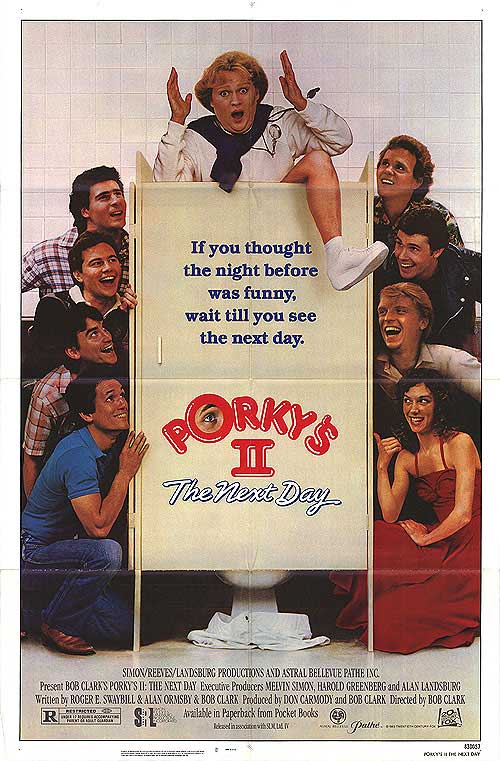
Porky's II: The Next Day + Old Fashioned + 'I Know Where I'm Going!'

PORKY'S II: THE NEXT DAY
(R. 20th Century Fox, 98 mins., theatrical release date: June 24, 1983)

Beyond epitomizing the teen sex farce when it became the surprise hit of 1982, Porky's may also be the definitive prankster comedy of its decade. The problem many had at the time was that those japes were mostly at the expense of females, with the safest male target being Pee Wee, the gullible runt with the bird chest and growth chart. Making a sop to social consciousness in the presence of Jewish teen Billy and his pitiful antagonist Cavanaugh, such finger-wagging mired the hormonal momentum, especially with Lassie and the Shower Scene around the bend. In the meta-defensive Porky's II: The Next Day, the victimizing mantle shifts from Billy (Scott Colomby), who now takes greater part in the foolishness, to John Henry (Joseph Running Fox), the Seminole student on the sidelines who has been cast as Romeo for a Shakespeare-themed class project. Before you can say "Moral Majority," along comes a much wider net of deplorables (religious fanatics, graft-crazed commissioners, Klansmen), alongside bad ol' Balbricker (Nancy Parsons), for Angel Beach's resident miscreants to catch with their pants down.

Bob Clark, whose A Christmas Story was waiting for the coming winter, is somehow operating even broader than the last sty, Not only is the prejudice subplot here a nonentity, but Porky's II doesn't climax so auto-destructively, instead allowing the girl to have all the fun. She is, naturally, Wendy Williams (Kaki Hunter), the one whom the boys all say is the campus bicycle but actually takes a shine to Pee Wee Morris (Dan Monahan). Not that their consummation on the bus has done much for his incredulity, as his attempt to settle the score for that Cherry Forever incident goes very familiarly wrong. Her confessional doesn't even dissuade Pee Wee from leveling the same unfounded suspicion towards a band geek immediately afterwards. But away from their peers, Wendy does talk more sense than the interchangeable sausage party. Even Billy (Mark Herrier), cast as "big fairy" Oberon, has to play straight man to his moronic buds, although you can still count on Meat (Tony Ganios) to thrust his lower weight even while in tights.

Luckily for Clark (and his two fellow writers, including longtime collaborator Alan Ormsby), the uptick in amiability offsets the exaggerated arrogance and hypocrisy of their straw enemies, chief among them Reverend Flavel (Bill Wiley), who tests even the timid principal's (Eric Christmas) patience when they trade indecent passages from both the Bard and the Bible. It doesn't freshen the smutty humor, recycled beat for beat from its predecessor, or encourage Clark to direct with a lighter touch. But like the original, there are a few undeniable elements which escape Clark's belaboring expertise, from the abovementioned literature slam to an impromptu replacement for Billy's defective sword to Wendy's show-stopping jailbait incrimination scheme. Stirring greater havoc with gag boas and breasts in a five-star restaurant than the boys do by scalping and stripping the Kartoon Klan, Kaki Hunter obliterates the subgenre's rosy-palmed loyalty to the He-Man Womun Oglurs Club.


OLD FASHIONED
(PG-13, Freestyle Releasing, 115 mins., limited release date: Feb. 6, 2015)

Beware the kind of quaint romance pitched at the intellectual capacities of Reverend Flavel and the Angel Beach boors. Porky's II painted its barn-door strokes in a manner that suggested Bob Clark reeling from the critical smack downs of his earlier smash. Old Fashioned was released on Valentine's Weekend 2015 as a Christian-friendly alternative to Fifty Shades of Grey, despite the whips-and-chains eroticism in the mainstream being no less passé than the amateur pornography, sexist radio DJ and Manic Pixie Dream Girl used to spice up its spiritual contender. Whatever the opiate of the masses, Rik Swartzwelder is oblivious to the naked truth that his ideals of courtship are as toxic as the Stephenie Meyer/Marquis de Sade drivel he's rebuking. And it's not like he is witty enough to make like Wendy Williams and quote the wisdom of Groucho Marx to mitigate his autumnal frostiness.

Clay Walsh (Swartzwelder) is basically to his sleepy Ohio town what Johnny from the The Room was to his San Francisco burg, although he dabbles in antiques rather than accounting. And Clay's a reactionary scold with serious intimacy problems, which he tries to sermonize as an Abstinence Pledge. So when runaway eccentric Amber Hewson (Elizabeth Roberts) rents the room above his carpentry shop, the frigid Clay tests his domineering philosophies in his courtship of Amber. When her stove breaks, she is sent outside until Clay has finished maintenance. Clay consults a needling, traffic light-themed guide book to determine their compatibility during their dates. He even tests Amber's efficiency in slicing up pears into baby food. Swartzwelder wants us to believe these are gateways to true love, yet the vacant chemistry between these opposites and Clay's validated self-righteousness allows for Swartzwelder to recoil from romance as much as he does sexuality.

Drearily formulaic when it's not transparently demagogic, Old Fashioned slogs on for nearly two arduous hours on rote "boy loses girl" drama, tedious moments of solitude, lifeless side characters with no bearing on any of the plot (including Clay's elderly aunt and third banana black friend), and numerous heavy-handed, one-sided potshots against modern day impurity. Not that references to silent movies and Sleepless in Seattle in any way justify the stultifying portentousness. It's the vanity that kills: Swartzwelder writing clunky dialogue (read: worst proposal ever), deifying himself in the name of "folksiness" and looking/acting like a suicidal Jeff Daniels clone is a lousy advertisement for chivalry. I came into Old Fashioned hoping for innocent erotomania and was rewarded instead with passive-aggressive egomania, a love story whose target audience I imagine composed solely of now and future cat ladies (perky doormat Amber included) and dog dudes.


'I KNOW WHERE I'M GOING!'
(Unrated, Universal Pictures, 91 mins., U.S. theatrical release date: August 9, 1947)

You want old fashioned? Go right to the source. 'I Know Where I'm Going!' is every pound and pence the charmer Swartzwelder's spew isn't. Michael Powell & Emeric Pressburger rapturously weave folkloric imagery and local color in a wartime tonic that still plays on the heartstrings 70 years later. Having demonstrated forward motion ever since infancy, Joan Webster (Dame Wendy Hiller) takes the next leap by marrying into wealth. This means trekking out to Kiloran, an island on the Scottish Hebrides, to wed Lord Bellinger, thereby getting hitched to his Consolidated Chemical Industries in the process (a notion made even more hilarious in dreamtime). An impenetrable fog and furious gale winds sidetrack Ms. Webster from boarding the last boat to her destination, so she is stuck on the Isle of Mull in the raffish company of naval administrator and Kiloran laird Torquil MacNeil (Roger "Colonel Blimp" Livesey).

A bond develops between Webster and MacNeil as they gaze out from across-the-way windowsills, take separate places at lunch tables and eavesdrop on a Ceilidh, a Gaelic wedding anniversary jamboree. The Archers (Powell & Pressburger) are more enraptured with the scenery and its well-drawn inhabitants than setting an agenda or spelling out the unlikely union until where it counts, in a surprise finale where a curse on MacNeil's family is confronted head-on by the wary laird. Along the way are such "magical realist" touches as the phone booth nearby a crashing waterfall, the fantastical use of model trains navigating the Tartan hills to bridge Webster's journey and, most awesomely, a treacherous whirlpool nicknamed Corryvreckan.

Hiller and Livesey, both invaluable, flesh out their roles to match Erwin Hiller's singularly evocative cinematography (locations scouted by Powell himself), with Webster less of a grating stock socialite and more a wayward dreamer who can count beams on the ceiling to achieve her prayers but could stand to count her blessings. MacNeil is princely in all the right ways, too, discerning the difference between being poor and having no money. The Archers also show impeccability in casting such secondary players as Pamela Brown (as Catriona Potts, a lonely bride who shepherds goats and skins rabbits with ease), C.W.R. Knight (as Col. Barnstaple, a proud falconer who names his prize eagle after MacNeil) and George Carney as Joan's father/banker, who is about the same age as Lord Bellinger (heard briefly in the voice of Norman Shelley). There's even a wee Petula Clark as a studious girl who reflects Webster's headstrong qualities.

'I Know Where I'm Going!' got lost in the shuffle among the Archers' more ambitious productions (even Scorsese didn't get around to it until he was in the midst of Raging Bull), but it tames the wild appetite for intelligent, tactful and wistful romance in a way most of today's Hollywood pictures as well as their opportunistic faith-based indie ilk cannot. Take the highland over the low, and you'll get to paradise before thee.


Tuesday, May 9, 2017

Private School


PRIVATE SCHOOL
(R, Universal Pictures, 89 mins., theatrical release date: July 29, 1983)

In my review of Mischief, a passing reference was made to a movie called Private School. For some godforsaken reason, I chose to revisit it in the hopes that I didn't have to use a two-word review that could sum up whatever appeal the movie had, which in '80s teen sex comedies tend to be as flimsy as the women's garments. And now I feel safe in dispatching this one with my original blunt, no-frills description:

Privates, Cool!

Thanks for your time, I'll be here all week. Don't forget to tip the concierge and happy trails.

Maybe Mischief really was a passion project for Noel Black, because nothing in Privates, Cool...I'm sorry, Private School indicates a genuine filmmaking effort from all involved. Based on what I read in old newspaper clippings, this isn't even Noel Black's baby at all. Instead, you can place/blame whatever auteur tendencies are to be gleaned on the producer, Tel Aviv-born R. Ben Efraim. After making a mint on Private Lessons, this one-man Golan-Globus wannabe reportedly market-researched the hell out of his follow-up, going so far as to cater to "live teenage audiences" directly. To quote Universal Pictures' press kit, as relayed by Skip Sheffield of the Boca Raton News, Efraim deployed "the most sophisticated principles of testing and evaluation in all phases of production."

Yeah, right. Fancy terms for condescension aren't endearing to me even if I want nothing more than a 50-minute sizzle reel of T&A padded out for box-office legitimacy. Hardbodies had more of a sense of humor in its advertising blitz than this, not to mention better dialogue and direction.

For all I know, the motherfucker who produced Mitchell may as well have been influenced by his fellow Israelis when Lemon Popsicle was breaking big in Hebrew Land, which of course led to The Last American Virgin. Private School is a retread of that low landmark rather than the Sylvia Kristel-is-My Tutor antics of Efraim's previous smash, only without the clinical attention paid to the act of intercourse, not to mention the subsequent abortion and betrayal. Efraim apparently willed into being a transparent ogling party, and based on the high volume of female flesh on show, I doubt he reached out to adolescent girls one whit.

All you need to know about Efraim's legitimacy can be summed up by his three most outstanding credits which followed: Private Resort, Private Lessons 2, Private Lessons: Another Story. I'm sure a scientific cross-section of Skinemax viewers helped him fulfill that potential.

The only thing Privates...Private School has going for it is song which heralds the opening credits, Harry Nilsson's "You're Breaking My Heart." Ten years prior, the rakish iconoclast who popularized such couplets as "Everybody's talkin' at me/I don't hear a word they're sayin,'" "I can't live/If living is without you" and "You put de lime in de coconut/You drank 'em bot' up" reacted to romantic disappointment in a decidedly profane yet pithy act of subversion, with George Harrison's slide guitar egging him on. Such a gloriously rude anthem makes an ideal choice to kick off some Animal House-worthy antics, but Private School never proves as inspired as that one solitary musical cue.

(Rick Springfield, The Stray Cats, Bow Wow Wow, Trio, and Vanity 6 are the other name attractions on the soundtrack, with Sam the Sham & The Pharaohs' "Li'l Red Riding Hood" the sole oldie.)

Instead, we get a trite series of conflicts between boys and girls, young and old, all of them tedious louts. The female students of Cherryvale Academy defy their repressed headmistress, get peeped at by the male students of Freemount Academy and everyone unites for a PTA pool party where a limousine loudspeaker broadcasts some salacious distraction. Alleged scribes Dan Greenburg & Suzanne O'Malley rehash way too many exhausted clichés under the pompous notion of "fun" (the one hurdle these prurient '80s teen romps constantly trip over). The imbecilic anarchy unwittingly becomes its own form of fascism.

There's a sex education class presided over by a listless Sylvia Kristel, whose juvenile name is the only designation of any laughter, not that it delivers. There's Ray Walston making a fool of himself in ways Amy Heckerling deigned not to do. There's the unbilled Martin Mull as a jabbering drugstore clerk who complicates a routine over-the-counter request for condoms (they were available on the shelves in the early '80s, for Christ's sake!). There's lanky Matthew Modine as Jim in love with Phoebe Cates' Christine, plotting out a romantic weekend of virginal conjugation (Cates gets to play innocent and sing, but her presence is just another bust). And, of course, there's Betsy Russell as Jordan, the class exhibitionist out to wreck things for the happy couple when she's not being pestered by Jim's buddy, Bubba (Michael Zorek), who appears to be hitting it off nicely with Christine's rebellious friend Betsy (Kathleen Wilhoite) whenever he's not sating his excruciating voyeurism.

Yes, the spank-tacular sight of Betsy Russell on horseback with her blouse open is meant to be an act of sabotage, an attempt to lure Jim all for herself with those teacup nipples. But what to make of a scene later when Jordan corners loverboy himself after he turns up as part of a drag-dressing stunt with Bubba and dork Roy (Jonathan Prince)? Vamping and undressing and raising the thermostat to drive him crazy, you'd think she'd make the most of what would appear to be having Jim delivered on a silver platter. Nah, it never gets amusingly bitchy or erotic, just leery and lame. Jordan's a dim bimbo in such a constant state of undress that when she's supposed to be truly humiliated, it never registers.

Good for sales of Vaseline, though!

Porky's and Mischief sure look like perfect 10s compared to the mindless, endless, useless peek-a-boo of Privates, Cool. Flunk this shit.


Wednesday, May 3, 2017

The Lords of Discipline


THE LORDS OF DISCIPLINE
(R, Paramount Pictures, 102 mins., theatrical release date: Feb. 18, 1983)


Donald "Pat" Conroy passed away last year, leaving behind a beloved literary back catalog which was reliable for prestige filmic adaptations (The Great Santini, The Prince of Tides). This year, Bill Paxton died far younger, his colorful legacy as a character actor including such nostalgic totem poles like Aliens, Weird Science, Twister, and my personal favorite, Near Dark. And here I am to talk about the movie version of Conroy's 1980 novel The Lords of Discipline, with Paxton in a supporting role. I would like to take a moment before this review to honor both men.

Pat Conroy's second fictional tome and subsequent film version continues a theme of The Great Santini, that of achieving manhood in the face of brutal tradition and Deep South dysfunction. Whereas Santini was inspired by the familial ties that bind, specifically the strained relationship between Conroy and his father Donald Sr. (a decorated veteran of Korean War whose Marine pride morphed into a bleak form of paternal torture), The Lords of Discipline focused on Conroy's schooling at Charleston, SC's military academy The Citadel.

For this particular translation, screenwriters Thomas Pope and Lloyd Fonvielle seize upon the senior year shame Conroy had based upon the knowledge of corrupt power plays involving senior cadets which began in 1907 at a renowned military college. The Lords of Discipline takes celluloid form as a conspiracy-based thriller about a form of intramural horror which takes idealistic would-be soldiers and intimidates them into lifelong trauma at best.

Ben Meecham of Santini sought to overcome a form of generational cruelty, whereas Will McLean tries to persevere faced with institutionalized savagery. David Keith aces the lead role of Will following supporting work in The Great Santini, in which he played the racist tormentor Red, as well as An Officer and a Gentleman. The scene is 1964 at the Carolina Military Institute, where English major Will arrives for his graduate year in good-humored style, reuniting with his three roommates and close friends. One of them, Tradd (Mitchell Lichtenstein), is an effete yet cultured confidante who trusts Will enough to give him a spare key to his family mansion and an anytime welcome. Another is Pignetti (Rick Rossovich), a bull-necked bruiser who's a real puppy dog on the inside, making a grand entrance by roughing up one freshman "knob" for the sin of talking vulgar about his sweetheart Teresa, and right to her framed photograph.

Will also meets again with his salty but dignified mentor Col. "Bear" Berrineau (Robert Prosky), who is still molding the military brat by assigning Will a debt-repaying operation he is hesitant to accept. Turns out a stringy African-American boy named Pearce (Mark Breland) has damned the color lines and arrived at the Institute, which is bound to shake up the hornet's nest among the student body. Bear entrusts Will, who refuses to fall in line with the rigorous abuse of his peers even on Hell Night, to ensure Pearce is given a fair shake as a knob, running interference if necessary.

What Will soon discovers is that a Klan-like cabal of roughnecks known mythically as "The Ten" are plotting to drive Pearce out of the academy by any means necessary, be it bodily harm or even murder. And if he's to take a stand, chances are it means questioning his loyalty to the brass ring on both his finger as well as that which is in command of the school. 

The Lords of Discipline bears the liberal-minded hallmarks of an Alan Parker melodrama (Mississippi Burning, Midnight Express), but the director here is fellow Brit Franc Roddam, who made a simplistically affecting coming-of-age tale out of Pete Townshend's rock opera Quadrophenia. Working with both an American cast and subject matter (although filmed in Brighton because no U.S. school was flattered by the location scouting), there is an outsider's sense of sensationalism which stands in stark comparison to the rawer slice-of-life elements in Quadrophenia.

For the first half, Roddam actually excels in depicting the testosterone-mad atmosphere of dominance which is a military academy. The film opens with one solitary freshman (Matt "Max Headroom" Frewer) running toward the quad and getting berated by three of the most unctuous student taskmasters in the senior class, among them future space grunts Michael Biehn as Alexander and "Wild" Bill Paxton himself (that's seriously how he's credited here) as Gilbreath. These same junior martinets later force Pearce to do pull-ups whilst training a sword at his scrotum (all bids are closed at that point as to who at least half of The Ten really are). In between these are some well-acted and colorfully-written camaraderie between Will and his more even-minded if prejudiced roomies, the background a symphony of drill sergeants operating the ringers.

The story that develops inevitably requires Will to confront not just The Ten, but also the complacency and callousness of his friends and teachers. On the one end is Col. Berrineau, who owns up to his virulent racism but in no uncertain terms keeps faithful to the code of honor in which all men are equal in the need for defending America. Less tolerant than even the Bear is boyish Tradd, who plays Mozart in his study to the consternation of his manlier-than-thou father, but who speaks in the haughty, bigoted tones of a plantation owner. Even after The Ten drives a white student, a frail butterball named Poteete (Malcolm Danare), to suicide, Tradd shrugs off the tragedy with the indifference of a Southern Belle out to lunch.

Poteete's shell-shocked demise is even glossed over by the headmaster, Gen. Durrell (G.D. Spradlin), as an accident during "parachute descent" exercises. The senior class and their commandants turn up with candles outside the door of Poteete's parents and ease their grief with a rousing choral rendition of "Dixieland," all the while the victimized Pearce lays in his bunker without as much hope for peace as his dead roommate.

Will convinces Tradd, Pignetti and paisan pal Santoro (John Lavachielli) to help him get to the bottom of things, which places a strain on their close-quarters friendship. But once Will witnesses the awful truth for himself about "the hole" (The Ten's secretive house of pain), the insularity of the environment suddenly chokes the narrative and compounds logistical flaws in a hamfisted attempt to sanctify a battle between white knights and black masks. Even though the shameful developments continue in Will's pursuit of justice, they don't really bear the gravitational weight of one student's loss and another's silent suffering, never mind acknowledging any kind of wider world outside the barracks.

Chalk it up to simple-minded screenwriting misconduct on the part of Pope & Fonvielle, because Franc Roddam at least tries to make the proceedings as urgent and unsettling as he possibly can. He knows how to capture eerie dichotomies, like when Pearce confides to Will within shouting distance of their enemies in the church, lifting his shirt to reveal the numbers "1-0" carved into his back. The performances he coaxes from David Keith, Rick Rossovich and Robert Prosky in particular are grounded above and beyond the call of duty, alleviating the hysteria with some badly-needed humor (a sidelined Judge Reinhold also makes a likeable wiseass as Macabbee). Mark Breland and Malcolm Danare suffer well as the whipping boys, whilst Mitchell Lichtenstein, Michael Biehn and Bill Paxton do the Gestapo routine with gusto, although Lichtenstein's Tradd is betrayed by the script to be a whiny turncoat instead of a genuinely conflicted insider.

In terms of cast and filmmaker, The Lords of Discipline never accrues enough demerits to merit the dreaded Walk of Shame one of Will's friends has to endure. Still, this amiably disturbing if unbalanced period piece never fires off all of its 21 guns.

Finally, seven trivial thoughts in the wake of my first screening:

1) Judge Reinhold, fresh off Fast Times at Ridgemont High, makes for one all-American booger ("I always knew you were corn-holing your roommate, you little pissant!"). Funny seeing him and Paxton together knowing they both were called into active duty in the wartime video for Pat Benatar's "Shadows of the Night." I still recommend Vice Versa, screw whatever the man who made Yoga Hosers has to say.

2) Biehn, Paxton and Rossovich would regularly work together again in various groupings. The trio would reunite in The Terminator and Navy Seals, whereas the six-time team of Paxton & Rossovich tie into my Diane Franklin retrospective by virtue of Deadly Lessons, the TV movie released in the same year as The Lords of Discipline.

3) Malcolm Danare is kind of an unsung hero among chubby 1980s personalities, even more so than Joe Rubbo. Danare played a literal heavy in Christine from '83 (with Robert Prosky, who also later starred in Gremlins 2), and even had a minor role in the blockbuster Flashdance, but gave his best performance as the know-it-all Caesar in the hidden gem Heaven Help Us a couple years later. He must have gotten along well with David Keith, who remembered Danare for his directorial debut with The Curse (1987), where Danare played Wil Wheaton's wicked stepbrother.

4) According to his IMDb bio, Rossovich is "considered one of the nicest people to work with, and a devoted family man." I'll miss him eventually as much as I do Paxton, if that's any indication, as well as for his role opposite Steve Martin and Daryl Hannah in Roxanne. Watch out for him in Top Gun and Streets of Fire.

5) Mitchell "Tradd" Lichtenstein went on to play a closeted Vietnam soldier in Robert Altman's filmed play of Streamers, co-starring Matthew Modine and David Alan Grier. In 2007, he made like a lot of frustrated actors and crossed over into writing/directing with the vagina dentata goof Teeth. He also directed Parker Posey, Demi Moore and Ellen Barkin in 2009's less-acclaimed Happy Tears. Still more imaginative and provocative than Steven Antin.

6) Mark Breland is of course known as the former World Welterweight Champion with five Golden Gloves and a great pro boxer record of 35-3-1, including 25 knock-out victories. He rolls with the punches as Pearce, but I think he could take out his white co-stars flawlessly, even Gilbreath and Pignetti.

7) Franc Roddam's mainstream career took a sharp nosedive in 1985 after he reteamed with Gordon "Ace Face" Sumner and one of the writers of the Lords of Discipline script for The Bride (Sting, Stangk, Stunk!). In the aftermath of the overlooked War Party and the pretty vacant K2 (with Michael Biehn in the lead), he's now content with a long career as writer for the Masterchef TV franchise. At least I'll always have the Criterion release of Quadrophenia to remind me of his (and Sting's) former glory.

Monday, January 18, 2016

Cannon Fodder: Revenge of the Ninja


REVENGE OF THE NINJA
(R, Cannon Films/MGM/UA, 90 mins., theatrical release date: September 16, 1983)

"Eureka!" After reviewing six movies for this Cannon Films series, I've struck crude.

Yes, Golan & Globus have a deathless reputation for vulgarity, and I'm not going to deny that much of what I've seen has been excruciating. But the part of me that can appreciate entertaining trash, including a couple of Tobe Hooper's mid-1980s work-for-hire projects bankrolled by Cannon, enjoys Revenge of the Ninja for what it is. I think I've found my first official "guilty pleasure" of the bunch.

And boy, should I feel ashamed, because Revenge of the Ninja is a doozy with a capital F.

In case you don't know, Menahem Golan himself directed 1981's Enter the Ninja, which clearly wanted to be a B-movie introduction to the ancient Japanese practice of ninjitsu. Going back to the DVD commentary for 42nd Street Forever, Volume 3: Exploitation Explosion, which I previously invoked in The Happy Hooker Goes Hollywood, schlock scholar Chris Poggiali mentions that it was originally called "Dance of Death" and was a self-scripted vehicle for Mike Stone, a martial arts icon on the level of Chuck Norris and Bruce Lee. The production was shut down and everyone, including Stone and director Boaz Davidson, were fired, and Golan hired Italian superstar Franco Nero to take over the lead role (Stone was re-hired to be Nero's stuntman).

Even with the combined star power of Nero, British sex symbol Susan George and American journeyman Christopher George, all three of them were officially slumming by 1981. Enter the Ninja instead broke through Sho Kosugi, a Tokyo-born black belt who officially became the "Master" of his practice and the lynchpin of Cannon's entire series of Ninja action quickies, the second of which is Revenge of the Ninja.

Cannon, of course, were not the first to adapt intense physical combat for the grindhouses of the world. Warner Bros. imported The Shaw Brothers with 1973's Five Fingers of Death and also distributed Enter the Dragon, both kicking off the chop-socky craze which sent shock waves throughout low-budget cinema. By 1985, Cannon were grooming Michael Dudikoff as the "American Ninja" and Dragon director Robert Clouse directed Gymkata for the Warners, which incidentally turned out to resemble what would happen if Enter the Ninja was made for a major studio.

In Golan's dreary film, Kosugi took a supporting role as Hasegawa, the arch-enemy of Nero's noble Cole ("He is NO NINJA!") who would be hired by Christopher George's Venarius to assassinate the heroes. These foes were color-coordinated to match their personalities of "white ninja" and "black ninja." Naturally, Hasegawa is vanquished and Cole achieves vengeance for the murder of his war buddy Frank Landers.

Sam Firstenberg, who was the other assistant director on Operation Thunderbolt besides Davidson to become an in-house director for Cannon in the 1980s, takes the reins here and delivers the relentless fighting and skewering which Golan tamed for Enter the Ninja. Revenge of the Ninja is beginning-to-end violent in that vicariously seedy manner which may not make the critics rave (and I'm feeling pretty half-hearted on this, myself), but gets the job done for boisterous patrons of all-night Sonny Chiba marathons.

Yes, this is a movie which Christian Slater's Tarantino-born action nerd from True Romance might love.

The setup is "Lone Wolf & Cub at Utah": after his family is gruesomely ambushed on his sacred family cottage, noble ninja Cho Osaki (Kosugi) spirits his mother (Grace Oshita) and newborn son Kane away to Salt Lake City (which I suppose is meant to double for L.A. based on the bear flag) at the behest of his friend Braden (Arthur Roberts). Cho hangs up his swords and shurikens to open a doll museum, unaware that his business partner Braden will eventually be smuggling heroin inside these trinkets with intent to unload for Eye-talian mob boss Caifano (Mario Gallo). Or at least until Caifano stiffs Braden on a full payment in advance and orders his goombah squad to intimidate Braden away from shopping around.

Incensed, Braden calls upon his extensive ninjitsu studies to declare war on Caifano's crew, assassinating picnicking henchmen and one-eyed informants with the same tools Cho has sworn off. Lt. Dime (Virgil Frye) and martial arts-trained officer Dave Hatcher (Keith Vitali) try to persuade Cho into helping them crack the case, but it will naturally take a few shady twists of fate, including the kidnapping of Kane (now a kindergartener played by Sho's real-life son, Kane Kosugi), to snap Cho out of his pacifism and confront Braden in a one-on-one battle: "Only a ninja can stop a ninja."

Cannon productions have gained cult renown for being brazenly ludicrous, and Sam Firstenberg is responsible for many of these "highlights," including Ninja III: The Domination and Breakin' 2: Electric Boogaloo. Revenge of the Ninja doesn't skimp on the insanity, from the violent prologue which lingers over the massacre of women and children to a pair of hilarious fight scenes pitting Braden's blonde moll, Catherine (Ashley Ferrare), against the father-and-son Osakis. The first, in which she attempts to seduce Master Cho, prompts this glorious exchange:

Cho: "If you want to work out, you forgot to wear pants."
Cathy: "You really think I forgot?"

Later on, after Braden activates the hypnotic eyes of his metal mask, Cathy is forced to capture Kane, who resists with instinctive force. This leads to plenty of cartwheels, high kicks and even a staff duel between them, with lots of chuckle-inducing abuse aimed towards Kane. He wins the battle with help from a concealed blade, sparing Cathy's life, but she carries him off to Braden, regardless, like an irate market patron carting off her colicky child.

To list further outlandishness would risk spoiling the entire movie (there are two gangs of Benetton bullies who oppose the Osakis), as Firstenberg tries to spare us any dull moments. Knowing he has a bona-fide craftsman in Sho Kosugi, Revenge of the Ninja is pumped full of risky stunts and sparring contests. There are tawdrier elements thrown in for spice, such as the slasher-style murder of Caifano's nephew and his girlfriend as they screw in a hot tub (they are killed in such a position that it would require a jackhammer to separate them), but Revenge of the Ninja is at its best throwing Kosugi into stamina-siphoning danger whenever the threadbare plot threatens to hit a patch.

Kosugi's stoic demeanor is easily the most interesting aspect of the film acting-wise, as is the perverted glee of Professor Toru Tanaka as he piles on Cathy. The rest of the cast is either blandly competent or outright amateurish between physical feats.

Because this is a case of Israeli opportunists seizing upon Japanese culture, Revenge of the Ninja isn't as cartoonish as Shogun Assassin or The Story of Ricky, which are even bloodier and ballsier distillations of individual honor. Firstenberg is aware that he's making a glorified comic book of an action movie, but there's still a leaden quality to characterization and plot progression that demands more ingenuity than he and writer James R. Silke can manage.

This is still an improvement over Enter the Ninja, though, on the basis of its liveliness, if not its aesthetics. This is a movie where young and old, American and Oriental, male and female, black, white and Latino, are counted on to raise a kung fu fist. Sho ‘nuff!


Sunday, January 18, 2015

Of Unknown Origin


OF UNKNOWN ORIGIN
(R, Warner Bros. Pictures, 88 mins., theatrical release date: November 24, 1983)

You have to respect the audacity of a major studio like Warner Bros. back in the early 1980s. Whereas all of their competitors were clamoring to capitalize on the slasher movie boom launched by the success of Paramount's Friday the 13th series, the company rolled out a steady stream of genre movies that didn't revolve around horny adolescents getting hacked to bits by rotting bogeys. Ignoring Eyes of a Stranger from 1981, Warner released anything but the typical Dead Teenager Movie, be they anthology films (Creepshow, Twilight Zone: The Movie), adult psychodramas (Altered States, The Hand) or nature's revenge sagas.

That latter subgenre was surprisingly prevalent for Warner, especially with Stephen King's Cujo, Aussie import Russell Mulcahy's hog wild Razorback and not one but two Canadian productions involving killer rats. The first was the loose James Herbert adaptation Deadly Eyes, which was directed by the same man who made the Joe Don Baker vs. mad mongrels obscurity The Pack for Warner Bros. back in the 1970s.

Apparently seizing upon a non-existent trend, the studio followed the April Fool's Day debut of that film with Of Unknown Origin in late autumn of 1983. Compared to Robert Clouse's predecessor, this particular chiller seemed scaled back and somewhat riskier in several regards. For one, Deadly Eyes depicted a horde of homicidal rodents of the legendary "Dachsunds dressed in rat costume" variety running amok around Toronto. Secondly, that film's screenwriter Charles H. Eglee made no secret about his derivations from John Sayles' script for Piranha, and indeed the multiple subplots involving love triangles, political greed and steroid-polluted grain dates it as a relic of the post-Peter Benchley school of schlock you could call Jaws-ploitation.

Thirdly, as the presence of a Bruce Lee screening in that film makes plain, Clouse was an established journeyman filmmaker whose career was launched by Lee's posthumous Enter the Dragon, securing him steady work for both the Warners and Hong Kong production outfit Golden Harvest for many years, including Deadly Eyes.

Of Unknown Origin, meanwhile, differs not only from Deadly Eyes but also the prior likes of Willard and Ben in that there is but one lone furry foe to deal with instead of a swarm of them. And it ain't no upholstered dog, neither. The screenplay by Brian Taggart, also based on a published novel called The Visitor by Chauncey G. Parker III, confines the action to a single building instead of loosing it on the city at large. And instead of a successful American filmmaker, Canuck impresarios Pierre David and Claude Héroux tapped an unknown European by the name of Yorgo Pan Cosmatos in his first cross-Atlantic project. Best known as George P. Cosmatos to the Anglican public, he would later go on to make a name in the United States with the Stallone collaborations Rambo: First Blood Part II and Cobra.

Also thrown into the mix was an up-and-coming actor named Peter Weller in his first lead role, following an acclaimed turn as Diane Keaton's new beau in Alan Parker's domestic drama Shoot the Moon. Subsequent roles as Buckaroo Banzai, RoboCop and William Lee (from Cronenberg's film version of Naked Lunch) turned Weller into a reluctant genre icon, but his characterization of proud businessman Bart Hughes here is pretty meek compared to the more forceful personalities of his later fan favorite characters. There's still a sardonic intellect and stoic tension to be admired in Weller, and although the lack of wider location use smells of staginess, Weller is a bracing presence who remains collected within the confined spaces of the narrative.


The resulting film is like a cross between Herman Melville and Hanna-Barbera, with Weller playing the Tom to the sewer-dwelling Jerry and taking repeated thwacks to his equilibrium in the process. The movie opens with Bart Hughes seeing off his gorgeous wife Meg (Shannon Tweed, hardly modest in her pre-soft core debut) and cutesy son Peter (Leif Anderson) as they leave for vacation to visit her father out in Vermont. The workaholic Bart stays behind to focus on the grain deal he's excelling at for his Manhattan trust company post, only to learn that he's been reassigned with a bank branch merger which could signal instant promotion and a hearty raise, provided he meets his two-week deadline.

The newfound privacy in his self-renovated brownstone ought to clear up Bart's anxieties about the sudden transfer, but he is startled by the leaking water pipe behind the dishwasher. The plumber he hires, Cleve (Louis Del Grande), deduces that the marks on the busted vein could have come from an army of mice, or at least one iron-toothed rat, something Bart scoffs at but takes heed of anyway when he starts placing mousetraps that are soon mangled beyond repair. Cleve tells him that whatever he's dealing with possess a frightening survival instinct, and may God help Bart if that rat turns out to have babies.

Bart also starts to show signs of distress at his bank office, taking lunch breaks to research the history of rat infestations and voicing his knowledge at a dinner party, almost as a rebellion against the grain project being taken over by his insidious rival James Hall (Kenneth Welsh). Bart's boss Eliot Riverton (the ever-prolific Lawrence Dane) and faithful secretary Lorrie Wells (Jennifer Dale) watch with shock at his increasing instability, and as the battle of wits between Bart and the vermin escalates, complete with ransacked pantries and mutilated kitties, Bart becomes a fanatical yuppie Ahab who must finally take matters in his own hands.

Cosmatos' direction is a tricky mix of the somber and silly, stylistic enough to effectively portray the rat as a shadowy menace capable of a few uncomfortable surprises (you might think twice before you ever lift your toilet cover again) but also drawn out to ludicrous degrees. It's all designed to illustrate Bart's slow-burning insanity and the violent deconstruction of his civilized demeanor, and there are even a couple of domestic nightmares and allusions to Moby Dick and The Old Man and the Sea. But the plot progresses with lackadaisical leisure, to the point where even the proverbial final straw is rendered mundane.

But maybe that's part of why the movie works as well as it does, its anti-supernatural gravity, urban ennui and pervading isolation going against the typical community-minded terror of its brethren. It's a character piece first and foremost more than a mere string of shopworn shock, kind of like Roger Christian's overlooked and astute The Sender (1982) which benefited from a multi-dimensional lead performance by Kathryn Harrold. In that regard, Peter Weller's performance is all the more entertaining and credible, his constant lapses in mood from enervation to nonchalance consistently amusing given how economical the conflict is.


The film grasps at metaphor by depicting Bart's frustrations at work ("This isn't a trust company, it's the court of Louis XIV") as a parallel to the rat chase which consumes him. The dinner party spiel, where he prattles off a series of queasy statistics and cultural idiosyncrasies involving rats, is the cornerstone of his alienation from his stuffy social standing. Eventually, in the midst of his mania, he delivers an ultimatum to his manager, who demands he sort out his affairs at home, and nearly makes a pass on his typist, a cursory nod to the allure of "while the cat's away" infidelity. The latter aspect has no true repercussions, though, and comes across as padding.

Beyond that, Cosmatos ratchets up the tension between homeowner and home wrecker, employing a diversity of POV shots, split-diopter widescreen framing and some excellent camera tracking to break up the monotony. But there comes a point where Bart makes such blunders as sending a stray cat in to do his bidding, leaving a check for an exterminator which is duly clawed or fishing in his townhouse's model for a steel trap (thus fulfilling the meager gore quota after it snaps) that the film grows repetitive in the worst way. Of course, it's all in service of the nutty final ten minutes, where Bart gears up in miner garb and augments a baseball bat with sharp objects to violently swat at the rat and thus destroys his architectural pride and joy.

Of Unknown Origin may not have been as easily marketable as Deadly Eyes or earlier animal attack films like Piranha, Tentacles or Ants! The trailer itself grandstands to a degree where it could be misconstrued as yet another Amityville film. Maybe it's a result of the film's inherent dryness, as it is far from the broad comedy of the later Mousehunt and less sensationalist than any of Pierre David's other horror co-productions. Yet Cosmatos' foreign sensibilities do work to his advantage here, especially compared to the hackneyed slickness of his subsequent Stallone actioners. And in Peter Weller's infallible commitment, Cosmatos has hit the rare jackpot in championing character over carnage. Let this be unknown no more.