Showing posts with label box-office bomb. Show all posts

Friday, August 12, 2016

Under the Cherry Moon


UNDER THE CHERRY MOON
(PG-13, Warner Bros. Pictures, 98 mins., theatrical release date: July 2, 1986)

The year is 1986: The Golden Raspberry Awards, in its seventh year of existence since a group of armchair critics declared Can't Stop the Music to be the nadir of 1980, has tabulated its first tie vote. This ceremony, which has since persisted in piggybacking off the Oscars but has proven just as inconsequential as the Golden Globes, seemed to take one good look at the turkey gallery of 1986 and couldn't settle on one "winner." Given how most objective critics at least have a single solitary movie per year to decree their least favorite viewing experience, it seems dodgy that the GRAs would call a draw.

Which one...I mean, two of the year's worst would go neck-and-neck? There were tempting choices, to say the least. Blue City, for instance, was the nail in the coffin for the so-called Brat Pack by virtue of casting Ally Sheedy and Judd Nelson in their most badly-received dual vehicle, although time has not been as kind to St. Elmo's Fire as the Razzie committee was in '85. Why Schumacher & Kurlander weren't creamed with a "Worst Screenplay" nod, I'll never understand.

Maybe Sylvester Stallone, whose Rambo and Rocky sequels were easy Razzie targets the previous year, would come away the victor for the deserving Cobra, an inept attempt at turning the Italian Stallion into the new Dirty Harry from the producers of non-nominee The Apple?

Or what about the dreaded Shanghai Surprise, which was every bit as bad as its reputation when I finally wrote about it?

Hell, maybe John B. Wilson would prank us and spring a dark horse winner? Maximum Overdrive? American Anthem? King Kong Lives? Tai-Pan?

Nope, 1986 was another fish-in-a-barrel year for the Razzies as they unanimously declared both Howard the Duck and Under the Cherry Moon the Worst Movies of 1986. Dino De Laurentiis, you lose again.

But why these two instead of one or the other? Or for that matter, Shanghai Surprise, which unlike Howard the Duck or Under the Cherry Moon has not developed a contrarian cult following and remains as adamantly disliked now as it was then. If it's a question of ego, then George Lucas and Prince would seem small potatoes compared to the combination of Sean Penn and Madonna.

In a word: publicity. The Raspberry committee was well aware of the poor receptions of both in all the various trades and papers, ubiquitous in their flopdom. These were the safest possible bets, and even an institute like the Raspberries took the bait unquestioningly.

The strangest thing about Howard the Duck since its release is that the film has actually been embraced in some horribly nostalgic way. I can't say I have a mental list of the three worst movies I'd single out in 1986, but rest assured that I probably would count Howard the Duck as one of my finalists. It was an affront to the legacy of Steve Gerber's scabrous Marvel comics, a colossal plummet from the brain trusts responsible for American Graffiti and a sad career point for all three principal actors. It was to Lea Thompson what Dirty Grandpa is for her daughter, Zoey Deutch. It was even more regrettable for Tim Robbins than Fraternity Vacation. And though Jeffrey Jones' disgrace as a sex offender remains fresh in my mind, could it be any less queasy-making than the botched interspecies romance between Beverly and Howard?

And Thomas Dolby's soundtrack was clearly a rip-off of what Prince had been doing to perfection ever since 1980.

The news of the passing of Prince Rogers Nelson has left a hole in my heart, to say the least. Of all the 1980s pop icons, from Michael to Cyndi to Madonna and (perhaps) Phil Collins, none of them were ever as consistent as The Artist Forever Known as Prince. From the moment he dressed himself down to a trench coat and bikini briefs on the cover of his Dirty Mind LP at the start of the decade, to the musique-concrete funk of his surprise chart-topper "Batdance," Prince satisfied some major sonic rumbles at the height of his fame. He did so-called "new wave" better with his brazen kinkiness, cross-pollinated genres with the precision of a true wunderkind and always kept people stymied at the growth he demonstrated from one project to another, even when the results were maddening.

Yet in 1986, Prince swept the Golden Raspberries with Worst Actor, Worst Director, Worst Original Song, and a joint Worst Picture for Under the Cherry Moon. Jerome Benton, who survived The Time to be with Prince's Revolution band, emerged scathed with Worst Supporting Actor. Newcomer Kristin Scott Thomas and screenwriter Becky Johnston must have narrowly avoided their respective nominations. In short, all the goodwill Prince gained with Purple Rain came crashing down in a rubble of hubris and gross miscalculation.

But the death of Prince has led me to evaluate both his narrative-based feature directorial efforts, Under the Cherry Moon and Graffiti Bridge. I carry a monumental reverence and sadness as I go, well aware of Prince's many notorieties and boundless talents. I can declare to the world (or at least those reading this) that there will never be another Prince in our future, no matter how hard Justin Timberlake, Kanye West or others may try. Even though my primary interest is film, I can listen to Prince's records, especially Sign o' the Times, and hear a genius in every groove.

As for the movie, it...doesn't quite suck like many have said. I'd watch Under the Cherry Moon over Howard the Duck or Shanghai Surprise or Cobra every time. The real dilemma is how much of my enjoyment is from vicarious train wreck fascination or simple allegiance to Prince.

Based on the massive cross-promotional popularity of Purple Rain, Prince decided to switch things up several notches cinematically as well as musically. His subsequent LP, 1985's Around the World in a Day, flirted with Beatles-era psychedelic textures and string arrangements. Legend has it that Prince was incubating this sound in his head even before the blockbuster soundtrack to Purple Rain made the rounds. Furthermore, the impetus was a demo tape cut by Wendy Melvoin & Lisa Coleman, paralleling the friction on screen in the movie. That follow-up's "The Ladder" even included a co-writing credit for the real-life paterfamilias John Nelson, who came out to support his estranged son by this time.

Despite Prince's resistance to established promotional means like pre-release singles, concert tours and promo videos, Around the World in a Day spawned a couple of hits, by turns randy ("Raspberry Beret") and skeptical ("Pop Life"), not to mention fan favorites like "Paisley Park" (the name of Prince's distribution label) and "Condition of the Heart." But the teller is the closing track, an eight-minute grind called "Temptation" which morphs from burlesque to damnation in as wild a manner as only Prince can concoct. Imagine "Automatic" from 1999 interjected with the pitch-shifted voice of God which opened that album:

"Oh, silly man. That's not how it works. U have 2 want it for the right reasons."
"I do."
"U don't, now die!"
"NO! NOOOO!!"

This beginning to see the light ("Love is more important than sex. Now I understand") is baked into the courtship plot of Under the Cherry Moon, as Prince was set off on the great thematic push-pull dynamic which would be blown four sides open with Sign o' the Times. His Royal Badness still dressed in flamboyantly sexy ways and celebrated being "in the mood for drawers," but the time had come for making soul connections. Thus Christopher Tracy, Prince's alter ego, ends up compromising his gigolo ways for deeper courtship of 21-year-old heiress Mary Sharon (Kristin Scott Thomas).

Christopher Tracy, not just the pseudonym Prince was credited as on The Bangles' "Manic Monday," is a piano-plinking lothario who sets his lascivious sights on the unsatisfied debutantes of the French Riviera. Flanked by his fellow Miami émigré Tricky (Jerome Benton), Tracy catches wind of the ultimate grift in the figure of Mary, a prim but not-completely-repressed society child worth $50 million. He crashes Mary's birthday gala with seduction in his eyes and dollar signs on his mind, but in patented princess vs. pauper screwball fashion, Tracy antagonizes himself to her immediately. Tracy and Mary will inevitably make up/out in the manner Prince sang about in the pursed-lipped hit single which inaugurated the film, but not without reprisal from her powerful papa Isaac (Steven Berkoff).

Aside from evoking tradition in Becky Johnston's script, where class and gender conflicts are compressed into snappy repartee, Under the Cherry Moon was beget with the kind of production troubles which doom vanity projects from the word "go." Kristin Scott Thomas was scouted in the waning days of pre-production after Madonna and Susannah Melvoin fell through, whereas Terence Stamp quit two weeks into filming and was replaced by Mr. Berkoff. The black-and-white photography was conceived after filming, thus going further against the expectations set by Purple Rain. Perhaps most controversial was the decision to jettison Mary Lambert, who directed the retro-minded video for Madonna's "Material Girl" amongst a couple of her other MTV staples ("Borderline," "Like a Virgin"), and demote her to "creative consultant."

Whatever the sordid details of his ultimate control over the project, at least Prince had some of his work cut out for him. German DP Michael Ballhaus, who would become a regular collaborator of Martin Scorsese's from After Hours to The Departed, makes a paradise of Nice and displays plenty of fluid compositions which make more sense monochromatically. Esteemed production designer Richard Sylbert and returning costume designer Marie France also excel in their contributions to the candle-lit grottos and outré fashions, giving Prince a convincing Valentino-style makeover (it's a better tribute to the idol than Bolero, for damn sure) and fitting Thomas in sparkling flapper wear. And the background score of Prince & The Revolution originals, released as Parade, is a four-star assemblage of stylistic detours swirling in rococo minimalism ("Do U Lie," "Venus de Milo") and transcendent permutations of Prince's finger-snapping pop-funk ("Girls & Boys," "Kiss," "Christopher Tracy's Parade"). By the time it wraps up with the eulogy "Sometimes It Snows in April," even the more ordinary moments ("Life Can Be So Nice," "Anotherloverholenyohead") can be accepted on their own terms.

Alas, Parade remains a tight 41 minutes long whereas Under the Cherry Moon lasts 100 minutes in a journey not as wholly rewarding. To be clear, it is not because Prince moulds it into the opposite of Purple Rain, cutting way back on the musical numbers (the only performance piece, "Girls & Boys," is rendered diegetic through use of a boom box; everything else is laid over) and pushing harder towards goofy comedy as opposed to the gloomy melodramas which dogged The Kid. This is a Bugs Bunny-style cartoon of himself rather than a diminutive Jimmy Dean, and Prince camps it up with gusto whether making "Bela Lugosi eyes" at his landlady or poking at the racial dissimilarities between him and Tricky ("Butterscotch...chocolate"). Jerome Benton is equally refreshing in a more substantial comedic role than as Morris Day's mirror-toting foil ("I'm my own man, just like Liberace!"). And Mary's first lesson in Ebonics ("wrecka stow," which kinda sounds French) is rightly embraced as a show-stopper. 

Purple Rain was tailor-made for Prince's magnetism as a stage performer. There's a reason why the movie ends with three back-to-back songs, benediction demanding an encore. It would seem wise that Under the Cherry Moon instead highlight his boisterous, subversively frisky persona, the kind which appalled AOR-damaged sheep, censorious senators' wives and fuddy-duddy film scribes ("Am I black or white? Am I straight or gay?" and "Don't you wanna play?"). Though Tricky later acts as a mouthpiece for divine union, he's dressed up in the same button-studded ensemble Prince used to promote "Kiss."

Prince radiates challenging such sex appeal, and Kristin Scott Thomas puts up an ample fight against Tracy's irritating disarmament whilst looking just as attractive. Which brings me to the one flaw which ultimately undoes Prince's amnesty as an actor: Christopher Tracy and Mary Sharon hardly make an impression as a romantic couple. Yes, we see them make passes over the telephone. They frolic along the beach and make goo-goo eyes at each other. They engage in heavy petting in a payphone. But Prince's direction and Johnston's script never convincingly thaws out either party's defensive personalities to really attain the romantic union Prince seeks as an alternative to lust.

Just like the last time an 80s pop idol tried to anchor a modernized screwball comedy, I must decree that Under the Cherry Moon is no The Sure Thing.

Mary is presented as a carefree soul who casually flashes spectators at her birthday party [side note: one of Mary's friends is played by Pamela Ludwig, a favorite of teen drama specialist Tim Hunter, known for the classics Over the Edge and Tex] and plays drums impromptu. At first, her relatable animosity towards Tracy is equal parts class contempt and mistrust over his intentions. The movie should progress with her desires for love and independence opening her up to Tracy's idea of "fun" and making her less brittle, but it never happens. She stands up for herself in a compelling diatribe to her mother late in the game, but Mary remains a klutzy mix of virginal cipher and upper-crust cookie.

And then there's Prince.

I'm not a big fan of the Pet Sematary movies, and trading in one pop video director for another probably wouldn't mean a wide gulf in quality. But speaking as a cineaste, I think the best director for Prince was virtually anyone but himself. There comes a point when Tracy should tone it down, just as much as Mary, but again, nothing of the sort. This spells disaster for the chemistry between Prince and Thomas, as the one convincing moment of emotional growth is a poem read off screen ("An Honest Man") as Mary lies alone in the grotto. Prince may have been sincere in his studied allusions to Golden Age opposites-attract movies from America and Europe, but here the will is hardly as strong as the flesh.

Which is a shame, because Prince is gracious enough even at his most overheated to allow his fellow performers moments to bare their talent, most beneficially Jerome Benton. When Tracy and Tricky debate their seduction and business rivalries, Benton is endearingly cocky and deflates tension with a solid one-liner. When Tracy is ultimately felled by the Coast Guard, Tricky seems genuinely mournful even when he mutters a recurring, maternal scold. Putting aside any homoerotic accusations against the buddy dynamic between them, Under the Cherry Moon lives up to its potential whenever Prince and Jerome take the screen together.

All in all, it's impossible to take Under the Cherry Moon seriously, which may have been Prince's intention. Whereas Purple Rain preached that "We are gathered here today to get through this thing called life," the philosophy guiding Under the Cherry Moon is that "Life is a parade" (if not a cabaret, Kander/Ebb-style). Removed from 30 years of infamy and in the light of countless re-evaluations of Prince's inimitable legacy, I feel like Under the Cherry Moon's disastrous reputation seems fairly out of proportion. It's never going to be hailed a masterpiece, as the movie goes from laissez faire to lackluster without as much insinuating bravado as Christopher Tracy himself demonstrates.

But as someone who wouldn't have minded if Jerome Benton had a supporting role in a Kid 'n' Play comedy, one who can contextualize the "Kiss" B-side "Love or Money" (the Worst Original Song of 1986, sez the Razzies) as being a test run for the Camille persona Prince made great on "If I Was Your Girlfriend" and just someone who really wishes Prince the same happiness in the afterworld that the end credits here offer (a music video for "Mountains," complete with Sapphic chanteuses Wendy & Lisa, Eric Leeds on the sax and the mighty Dr. Fink), I can't hate Under the Cherry Moon like I do most of the famous fiascoes that come my way.

The bonus music videos featured on the DVD helped to sway my opinion, since there were no other extras to be found besides the theatrical trailer. The video for the bona-fide classic "Kiss" remains a cheeky blast, with Prince writhing in tight black pants with a veiled dancer in black lingerie, all the while Wendy Melvoin struggles to play straight woman. The other clips are also quite joyful, from a color-corrected re-edit of "Mountains" to a scorching live version of "Anotherloverholenyohead" taped from Detroit (incidentally, the show was held on Prince's 28th birthday as part of the Revolution's soon-to-be-final tour). But the odd gem out is "Girls & Boys," which works in footage of the entire, extended band this time around and ends on a sublimely ridiculous note courtesy of...who else, Jerome Benton.

If the ghost of Prince were to haunt Jerome ("Boo!"), I can only hope that the latter's reaction remains no less than ham slam. Thank you, man.

Thursday, December 17, 2015

Cannon Fodder: Bolero (1984)


BOLERO
(NR, Cannon Films, 105 mins., theatrical release date: August 31, 1984)

[Welcome back to Cannon Fodder, a series devoted to my endurance of a handful of films produced by Menahem Golan and Yoram Globus, who were Hebrew National yet far from kosher. This is honey-drenched foreplay to precede my review of Mark Hartley's well-received Cannon doco Electric Boogaloo: The Wild, Untold Story of Cannon Films. Last time, I took a willing bite of The Apple, which at least was spirited in its stupidity. All I can say here is that, "This is a low, Bo..."]

In 1984, Cannon Films hooked and crooked their way to an original breakthrough in the film scene, releasing the Breakin' movies to a wide audience and thus getting a pop 'n' lock on the hip-hop/dance vehicle.

Unfortunately, between those youth-oriented highs lay the adults-only Bolero, one of Menahem Golan & Yoram Globus' all-time greatest follies.

In another attempt to profit high by aiming low, our Israeli anti-heroes turned to actor-turned-auteur John Derek and his wife Bo Derek. Not only was Cathleen Collins infamously less than half John's age, but John discovered her as a teenager whilst he was still wed to Linda Evans in the early 1970s. After they wed in mid-decade, Cathleen went by the stage name of "Bo" Derek and was debuting in Orca: The Killer Whale, followed by her iconic role as the mysterious object of desire in Blake Edwards' 10.

The Dereks remained passionate lovers until John's death in 1998, with husband working hard to preserve the sex symbol status of his wife in the pages of Playboy and on the silver screen. Unfortunately, the projects they concocted were transparently opportunistic and incredibly tasteless. 1981's Tarzan, the Ape Man was the first strike, followed mere months later by their eight-years-old, Greece-located pet project Fantasies. 

Bolero was the film which effectively told both John and Bo Derek "You're out!"

That was their fate despite a massive media-hyped controversy over Bolero's distribution and lack of an official MPAA rating. Cannon were producing under the MGM banner for a brief time (the sleeper success of Breakin' was one of the results), but Bolero was bad enough for Frank Yablans to demand a legal escape clause from the studio's contract with Cannon (apparently, it didn't extend to home video distribution). Golan & Globus decided to release it themselves, but John Derek, who was pressured by his producers to make the film more "erotic" than the Dereks already intended, didn't present this film to the MPAA for fear of getting the scarlet X. Instead, Bolero went out unrated, with many theaters having to impose the "no one under 17" rule themselves.

The Dereks and Menahem Golan took blows to each other in the press, with Bo claiming that her private collection of on-set photographs were stolen by the studio and copyrighted as publicity stills. The producers were ashamed of the project so much, they wanted ownership on Mr. & Mrs. Derek's ranch as compensation. Whatever the beef between these clashing egos, Bolero made a quick recoup of its budget after two weeks but then tapered out and stalled at roughly $9 million domestic gross. The film's petering profits as well as its deluge of negative reviews guaranteed a sweep at the coming Golden Raspberries, winning six out of nine nominations.

But time has a way of redeeming even the most abortive artifact of its time, right? 

NO!!! It doesn't!

I was reminded of that when I watched The Apple, and now it's even more applicable to Bolero. To paraphrase a Freudian adage, sometimes a fiasco is just a fiasco.

This dual desecration of Rudolph Valentino and Maurice Ravel's funeral plots replaces the silent film era's unspoken campiness with a deluge of head-slapping exchanges that don't deserve to be printed on old-timey title cards (which John Derek actually does!). And despite being named after the composition which soundtracked Bo's nudity in 10, Ravel is nowhere to be heard, the dishonor going to guest conductor Elmer Bernstein, whose son Peter scored every other piece of music outside of the love scenes. Try as he may, Elmer B. is no better suited to orchestrating endless soft-core set pieces than John Williams is, and the climax (so to speak) visually and sonically conveys "eerie" more than "extasy," which is actually spelled out in neon as a beacon amongst egregiously-used dry ice fog.

A running joke involving this grammatical error is genuinely contrived to endear the viewer to Bo Derek, who I steadfastly refuse to acknowledge even plays a character here. In a vanity project as relentless as Bolero, she isn't virginal young Lida MacGillvery, a supposed bonnie lass with a Yank accent who graduates from an English prep school so she can inherit her father's fortune and put it towards a Euro-peon vacation. There is no plot involving this hormonal vacuum of higher education having saved herself for passionate intercourse with a dark, handsome stranger straight out of a Valentino non-talkie. There are no million barrels of wine, hookahs of opium, underage nudie shots, or castrating bulls.

No, Bolero is Bo and John Derek's celluloid passport to Morocco and Spain, with the most rudimentary attempt at an Emmanuelle sex fantasy to frame it. This is Bo Derek at her most unbearable as she one-ups Olivia Newton-John, who convinced more playing a liberated high school sweetheart in Grease than Derek does here as a wide-eyed ingénue. This is two stuporous scenes of simulated sex buttressed by bad comedy and even worse melodrama. This is, like a lot of Cannon's output, too much of a smug slog to provoke the kind of titters which stick out more than the titties, two of which, need I remind you, belong to a 14-year-old!!

Don't let this "European sensibilities" bullshit justification (I've heard it used to excuse Cannon's Lemon Popsicle movies, and it's flimsier than Bo's costumes) distract from the undisputed truth that Bolero is the pinnacle of pretentious crassness. It is not entertaining, it's certainly not erotic, and it's not even worth 1000 words of cathartic dissertation.

So, Bo Derek as "Mac" has her romantic ideals dashed when the sheik of her fancy (Greg Bensen) turns out to be an Oxford-poet pretty boy who can't hold his smoke and sinks into narcolepsy. Whoop-de-har. Then she locks onto a dreamy rejoneador, Angel (Andrea Occhipinti), who shows mercy by not slaying his charges to the public's disinterest. He doesn't sell toros, but vinos. He's also an in-demand stud, with both a feisty ginger-haired suitor and his "gypsy shadow," Paloma (Olivia d'Abo...14-year-olds, Dude), clamoring for Angel's pene.

"Mac" uses her daddy's trust fund to essentially buy her way into entitled ecstasy...oh, I'm sorry, "extasy." She gets deflowered, we get demeaned. But that's not enough, so Angel has to sever a nerve ending in his nether, giving "Mac" all the motivation to goad Angel back into potency: "Don't take it out on me just because you got cute with a damn bull!"

By film's end, you'll have accrued all the earnest agony needed to wish that wily mammal has made it impossible for these two to procreate for the rest of their lives.

Not even Mark Hartley could condense this movie in such a bite-sized way as to make Bolero any more salvageable.

Never mind the pitiful attention to period details ("As Time Goes By" is played on piano in a casbah: written in 1931; associated with a beloved movie released in 1942; having fuckall to do with the 1920s), the ludicrous tonal shifts (the dejected Sheik hunts down "Mac" and has her kidnapped apropos of nothing, with an equally pathetic resolution) or the fact that Bo comes across as perpetually silly rather than sensuous, even in the over-ballyhooed sex scenes.

What really awards Bolero the all-time booby prize is the writing and direction of John Derek. He was a lecherous photographer masquerading as a legit fillmmaker. There is no evidence in Bolero, in his handling of dialogue, performances and scenery, that John D. could achieve at all the pure whimsy which would've helped make this film even the teensiest bit easier to take. He has no flair for editing, as Bolero boasts many of the single worst transitions, montages and abuses of slow-mo in any major motion picture. He makes his wife come across as glassy-eyed imbecile rather than a living centerfold. He likes to throw in fully naked 14-year-olds for spice (the more age-appropriate Ana Obregon, for the most part, keeps her clothes ON as brunette BFF Catalina, who puts the sniggering make on "Mac's" Scottish attorney). And he makes one want to walk inside the movie not to covet his lusty S.O., but to instead put the valiant George Kennedy, as long-suffering chauffeur Cotton, out of his misery, Old Yeller-style.

Good for George that he gets to woo Angel's maid, though. Maybe we can put him down after his conquest, like Jason Voorhees would. At least he can die with joy and some sliver of dignity. 

Bolero, meanwhile, deserves every disgrace, the epitome of exhibitionism at its most exhausting. I wouldn't even recommend it to the video voyeurs who would be most satisfied from easy access to the money shots.

I don't even want to devote another precious sentence except "Good riddance."


Monday, December 7, 2015

Cannon Fodder: The Apple (1980)


THE APPLE
(PG, Cannon Films, 86 mins., theatrical release date: November 21, 1980)

[Welcome to Cannon Fodder, in which I endure a handful of "classics" from the Golan-Globus production team in advance of my review of Mark Hartley's Electric Boogaloo: The Wild, Untold Story of Cannon Films. I will tackle as many different movies from various points in the duo's timeline, from the early success of Operation Thunderbolt to the infamous Superman IV: The Quest for Peace. We begin with one of the early Cannon efforts, and the first of many in the "so bad it's good" legacy they've achieved. "It's an actual, actual, actual desire..."]

I broke down 40 minutes into The Apple, when Barbarella's vocally-deficient kid sister tried to belt a raucous anthem about America's need for "speeeeeeeeeeed." My palate needed cleansing, therefore I went to YouTube and pulled up a popular clip from Teen Witch.

You know what I'm talking about...


"Top That," with its Beastly Boys and pathetic ideal of adolescent cool, is still a better number than anything in The Apple.

I shouldn't have to write a review on The Apple. The comparison should speak for itself, but The Apple is low-hanging fruit in a sequined thong.

Menahem (remember to pronounce it as Mun-Ackum) Golan and Yoram Globus had just bought Cannon Films at this time, and it looks like they wasted few precious moments cementing their legacy as the ghastliest, gaudiest production company to ever schmuck up the cinemas.

The story was originally conceived as an epic Hebrew musical theater production by Coby and Iris Recht. Overhauled by Golan himself as writer/director, The Apple ended up another in the late 1970s spate of opulent disco cash-ins, released the same year as Xanadu and Can't Stop the Music. Disco Demolition Night was a year old by the time The Apple played, and with the exception of Olivia Newton-John's songs from Xanadu, this trio of turkeys drove America further into the arms of AOR. We as a nation went from the soundtrack to Saturday Night Fever to Hi Infidelity so capriciously.

Obviously, it didn't help that the premiere screening of The Apple at the El Capitan turned into Comiskey Park 2. Audience members who were given complimentary vinyl versions of the soundtrack album eventually started hurling them at the screen. Menahem Golan was apparently suicidal over the movie's poor reception back in Europe, but recovered soon enough so that the world was given such questionable gifts to film-going as Death Wish II, The Last American Virgin and his own Enter the Ninja.

To quote the main villain of The Apple, "Nostalgia is always dangerous." What better explanation is there for why The (Rotten) Apple has rode such a wave of retroactive awe that it washed up in my shores?

Set a decade after the Orwellian boiling point that was 1984, The Apple pillages from established junk culture in both popular music and movie musicals yet harbors loftier ambitions beyond its cavalcade of gold lamé, vampire teeth and repeated crimes against the earlobe.

In a future where pop music rules society, the 1994 Worldvision Song Contest is the stage for an Old Testament-copped struggle between good vs. evil. The latter is represented by Satanic agent Mr. Boogalow (Vladek Sheybal) and his assistant Shake (Ray Shell, the Meshach Taylor of his era), as well as their hedonistic star singers Dandi & Pandi (Alan Love, Grace Kennedy). Opposing this fey foursome are Alphie & Bibi (George Gilmour, Catherine Mary Stewart), lovey-dovey folkies from Moose Jaw, Canada. After nearly causing an upset which Mr. Boogalow and Shake manage to suppress, these beaten babes are enticed to join Boogalow's circus of glam and ham. Alphie is deterred by apparitions of Eden-style temptation as he tries to sign the contract, but Bibi bites easy and hard, becoming Boogalow's latest protégé and driving Alphie to destitution.

As the mindless masses fall under the spell of Boogalow International Music and their pop-rock propaganda, Alphie soon finds salvation in a commune of hippies (led by Joss Ackland in a role more worthy of regret than De Nomolos from Bill & Ted's Bogus Journey) and is joined by lapsed disco dolly Bibi. When Mr. Boogalow tracks them down and demands Bibi's arrest for reneging on her contract, a power greater than the Devil himself arrives in a gold Rolls ("Marc Almond! No?! BOOO!!!") to take the teens to their final destination.

Catherine Mary Stewart, looking in the film for all the world like a young Kelly Clarkson (while the equally underperforming Gilmour, in his only credit, arrives as Warren Beatty), talked about how Golan aspired to be "better than Ken Russell," but The Apple isn't so much Tommy. For all its kitsch, Golan never once has Stewart writhe sensually in a flood of creamed vegetables. No, it's apt to see The Apple instead as a Godspell-Phantom of the Paradise hybrid knock-off with more transvestites than The Rocky Horror Picture Show and less infectious tunes.

A friend of mine who's married to an online critic (who, incidentally, gave this film a sincere rave, the lunatic) knows musician friends who bought The Apple as industry satire, mocking a machine so prefab and crass that the only way out is through unwavering integrity and a pinch of divine intervention. While I see things in The Apple which could support their enthusiasm, there are more dead-bang jokes in Phantom of the Paradise and This Is Spinal Tap. The height of intentional wit in The Apple is to parachute in Miriam Margolyes as Alphie's Bubbe-esque landlady, a bit of comic relief that cannot light the menorah once followed by the infamous "National Bim Hour" montage, a fitting prelude to the hospital dance-a-thon in Breakin' 2: Electric Boogaloo.

More than any Biblical pretense or bizness lampoonery, what The Apple is really about is, naturally, music. This 86-minute film has about an hour's worth of production numbers, songs written exclusively for the film by musician Coby Recht and lyricists Iris Yotvat & George S. Clinton, the latter a Cannon employee not to be confused with the leader of Parliament/Funkadelic. Nigel Lythgoe choreographed the dance moves, and would go on to fulfill one of The Apple's half-baked prophecies as executive producer of American Idol.

Unfortunately, every moment in which The Apple breaks into song-and-dance stops the movie cold. Like Robert Christgau reviewing David Bowie's over-the-top singing on Scary Monsters (And Super Creeps), if the awfulness of the music here is supposed to be a joke, it's not worth the pain. Lyrics are awkwardly crammed into subpar melodies, for one. Aside from the futility to make a hook out of the phrase "Life is nothing but show business in 1994," the opening number "(Do the) BIM" has a chorus constantly drilled into your skull which threatens that "BIM's on the way." I heard "BIM's the only way," although they could have been also singing "BIM's Yahweh." The point is there are tons more non-rhyming, repetitive blunders meant to condescend to refugees of the current vapid pop scene.

The music of The Apple is processed late 1970s cheese all the way ("Hey, hey, hey!!!"), flavorless slices of imitation Supertramp, Bonnie Tyler and The Carpenters (where's Paul "Swan" Williams when you really need him?) to garnish your Bim Burger (I'm not making that up, there is an actual restaurant in the movie which sells those). The Karen & Richard connection applies to Alphie & Bibi, whose own showcase songs are no less cringe-inducing than Boogelow's blooze. Their utopian schmaltzfest "(Love) The Universal Melody" doesn't convince at the start, but the duo's nadir is the mopey rock ballad "Cry for Me" ("Where has all the pity gone?"), a song which makes REO Speedwagon sound like Big Brother & The Holding Company.

There is a weird novelty to a couple of these abortions, it must be said. Never has a synthetic doo-wop duet (call it "Since I Don't Have ‘Since I Don't Have You' ") been voiced by a deathless Roger Daltrey clone and the dim ingénue he has just drugged. Never has a barnacle of a cod reggae song been mangled by a thick-accented Machiavellian who gloats into the ear of his pretty puppet. And if you wanted something to put the "o" in solo but were just too bashful to admit you owned "More, More, More" by the Andrea True Connection, well, The Apple has another thing "Coming." 

The Apple is one of those movies impossible to NOT make sound like a majestic monument of manure. This is a film in which the heroine is allowed the easiest possible escape all because Pandi has fucked the BIM away (and is subsequently slapped by the sissy black guy). One where an extra with a hoser accent yells at the heroes to "Go back to Moose Jaw!" One in which you could deduce major penis envy from its creator stemming from being denied entry into Studio 54. But given the combined non-efforts of the terrible music, the ridiculous dancing (BIM's prime directive is to pull no punches against the oxygen) and Menahem Golan's pedestrian sense of style, my first viewing of this was arduous.

It only got worse the second time I watched.

My nutty suspicion about the Israelis of Cannon is that as filmmakers, they were such fine producers. I will elaborate further as I go along, but suffice to say that Golan is genuine in his lack of finesse. The Apple is over rather quickly and has a sliver of showmanship important to the success of any musical, but there are Italian Road Warrior wannabes which are filmed more proficiently and look more believably dystopian.

And hippies, Mr. Golan? Seriously?!


Monday, February 23, 2015

Who's That Girl


WHO'S THAT GIRL
(PG, Warner Bros. Pictures, 92 mins., theatrical release date: August 7, 1987)

Who's That Girl has been marketed since its 1987 debut without a question mark, thus leaving it open for various interpretation or the simple implication that it is Madonna "who's that girl." Nobody uses that query throughout the film's script, even though Madonna's Nikki Finn is a prime egotist who demands the attention of anyone within a 100 yard radius with her atomic baby doll whine. This lack of coyness is something you could never accuse Madonna of, especially in the mid-1980s, which saw intense interest in the pop goddess' married life, private parts and maybe even the dry-cleaning bills for her gaudy outfits.

But since even Madonna wants to know based on the English and Spanish chants of said inquisition in the chart-topping tune which shadowed the film, I think I have an answer we can all agree on.

Who's That Girl? The answer is: Marlo Thomas. Duh!


You probably expected me to say Nikki Finn, who's that girl Madonna plays here, and you wouldn't be wrong. But whereas Marlo Thomas was the Everygirl of 1960s television, Madonna was a decidedly shrewd personality of her own fabrication. Teenage girls grasping for personality went from the Pat Benatar look popularized in Fast Times at Ridgemont High to dressing like punkettes at a Salvation Army nuptial, as dictated by either Madonna or her contemporary Cyndi Lauper. Think back to TerrorVision and the character Diane Franklin played in that one, Suzy Putterman, and you've got a mirror's reflection of the fad in all its pink-tinted, peroxide-damaged glory.

Remember how I said that Diane went from playing dimwitted sex objects to actual characters with quirks and their own skewed intelligence? Well, I called it "going to Camp" in short, but watching Madonna in Who's That Girl made me pine for a VHS-style tracking error to reveal the other film. Not only had the teacher become the apprentice, but she was bringing home report cards dire enough to get her legally disowned let alone grounded for a month.

Shanghai Surprise should have been a lesson, but Madonna decided to try her hand at old-fashioned comedy and romance once more by pursuing a role in a project initially called "Slammer." She even tried to get an ever-combative Sean Penn onboard to no avail. Madonna did manage to influence the choice of director in James Foley, a friend of the couple who directed Sean in At Close Range and also helmed Madonna in that film's tie-in music video for "Live to Tell" as well as her subsequent "Papa Don't Preach" promo. And compared to Shanghai Surprise, in which she was hired solely as an actress, Madonna was more hands-on in the exposure of Who's That Girl by connecting it to her musical career, cutting four songs exclusive to the compilation soundtrack (which also featured dance pop label mates Club Nouveau and Scritti Politti) and embarking on her first worldwide concert tour to boot.

Alas, more people paid to see Madonna in the stadiums than in the cinemas. Who's That Girl failed to capitalize on the Material Girl's clout and became her second bomb in a row, complete with Worst Actress Razzie Award and plenty of damage control in the meantime as Madonna collected herself for the Like a Prayer/Truth or Dare media juggernaut to follow.

In the tradition of the same year's Mannequin, the movie opens with a cartoon credits sequence that depicts the fateful events which landed Madonna's Nikki Finn in jail on a seven-year sentence. Drawn by April March, who later worked on The Ren & Stimpy Show and became a singer (her "Chick Habit" was memorably used at the end of Quentin Tarantino's Death Proof), we see that Nikki's boyfriend was involved in some kind of duplicity which left her with a key to some incriminating photographs and a dead lover in the back of her trunk which she takes the fall for. Eventually, we learn that Nikki has been sprung from the slammer after four years on the condition she travel to Philadelphia to meet her parole officer.


The megalomaniacal, multi-millionaire Mr. Big who orchestrated her disgrace is Simon Worthington (John McMartin), who is about to marry off his daughter Wendy (Haviland Morris) to one of his underlings. That lackey is Loudon Trott, a bespectacled tax attorney with a tight schedule and a tightwad. In the course of the next 24 hours, time which is booked to do all sorts of preparations for his ceremony with Wendy, Simon demands Loudon to pick Nikki up and see her off on that bus to Philly.

Now we get to the inevitable point in the review where we have to talk about Madonna the Wonder Thespian. Oh, boy.

When she played conniving Christian treasure hunter Miss Tatlock in Shanghai Surprise, Madonna betrayed the spark and sexiness she demonstrated in Desperately Seeking Susan with a stiff, confused central performance. Not only was she out of her element, she didn't even appear to have one to begin with, as the vexing screenplay couldn't even commit to allowing her to play a flaky femme. She helped to drag the movie's energy level down just as much as the director, the writers and her co-star did, and Madonna took a very public hit for her efforts of lack of them.

But the opposite works, too.

This time, Madonna goes from having too little personality to smothering us with her presence. I read a review over at DVD Verdict which gets to the heart of Madge's newfound miscalculation. Madonna was already blessed with a live wire presence that made her the premier female icon of the 1980s, even more so than Cyndi Lauper. "Like a Virgin," both the video and her VMA performance, are legendary in cementing this compelling, carnal image. And though Madonna actually did go on record as confirming Rob Lineberger's later suspicion that Nikki Finn was meant to be "a tough-on-the-outside, kind-on-the-inside oddball with camouflaged good looks and street smarts," the resulting attempt at Billie Dawn (from Born Yesterday) isn't even as good as Billie Jean [Davy], let alone anything Judy Holliday or Melanie Griffith could accomplish.

I'm trying to be as polite as I possibly can in my criticisms, because if I weren't so civilized, I'd come right out and say this: Nikki Finn is the least loveable, most overbearing and downright ANNOYING heroine of any film I've ever seen in my life!


What the hell, Madonna?! Were you trying to be the gender inverse of Pee-Wee Herman? Were you so threatened by Cyndi Lauper that you felt you had to one-up her with a persona that would make even the King Ad-Rock turn and run? I mean, Lauper herself didn't lay it on this thick when she made her own star vehicle with 1988's Vibes. Let's ignore the fact that Madonna's painfully forced Brooklyn patter often kills the fast-paced banter to such a degree that her co-stars seem just as mortified as the audience. All you need to know is that she skips...she SKIPS! And not in a playfully sexy way, either, nothing that would endanger the movie's PG rating. No, she SKIPS like a kindergartener!!

Come back, Diane Franklin! I'll take back almost every negative thing I said about The Last American Virgin if you'll please just save me from Nikki!

So...Loudon makes the rendezvous to intercept Nikki, who dutifully begins her campaign of free-spirited (read: mentally-impaired) anarchy by taking control of his mother-in-law's Rolls Royce and damn near causing a catastrophe on the expressway just so she can go the mall and shoplift a few cassettes. A half-hour into the film, Loudon has to be hospitalized in response to Nikki's sociopathic, stunted arrogance, the better for her to hijack the Rolls and go to Harlem to pick up a gun on his stolen credit card.

And there's a wild puma.

Its adopted name is Murray the Tiger (Nikki can't even make the obvious distinction based on his lack of stripes), and Loudon had previously stowed it in the back of his Rolls as a favor for a client named Montgomery Bell (Sir John Mills). He takes a liking to Nikki and pops up to roar at various interlopers from time to time, kind of like an Amazonian car alarm. But anyhow, Loudon becomes essentially a hostage in Nikki's grand scheme to get revenge on the thugs who deceived her, eventually being so enticed by the wild, wild life that he becomes romantically entwined with her.

So far, I've avoided naming the actor who plays Loudon Trott because I feel like I'm trying to preserve some kind of Witness Relocation bargain. That would be Griffin Dunne, who prior to this endured burial under some macabre Rick Baker prosthetics as the mauled schmuck Jack in An American Werewolf in London. But more crucially, he is also best known as the wound-up yuppie stranded in Soho from Martin Scorsese's After Hours.


I like Griffin Dunne a lot. He can be side-splittingly funny in a deadpan manner and has a propensity for physical abuse which is reminiscent of vintage screwball comedy without forcing it. A vast majority of the film's chuckles and guilty pleasure guffaws come from Griffin's commitment to the material, whether he's humping a hospital door in a frenetic escape attempt or trying to gain control of his situation with the sardonic strictness of a disappointed parent. He has the Cary Grant-as-nerd look down pat, but there's nothing misguided about Griffin's characterization.

Aside from Griffin Dunne and Sir John Mills, who have the timing and precision to make even the hoariest one-liner seem fresh, nobody comes across well, not even Haviland Morris, who I praised to the high heavens in a previous assessment of Gremlins 2: The New Batch.

The biggest trouble with Who's That Girl is that it strains to be a classic screwball farce in contemporary drag. The 1980s weren't very dry as far as this conceit went. Romancing the Stone, The Sure Thing and A Fish Called Wanda were all highly entertaining and immaculate pastiches of successful romantic comedies of yore. And Who's That Girl could've joined the ranks if only more discipline and taste had been applied. As it stands, writers Andrew Smith (The Main Event) & Ken Finkleman (Grease 2) are allergic to genuine wit. And poor James Foley, whose specialty is brooding character drama, the best being his adaptations of edgy writers Jim Thompson (After Dark, My Sweet) and David Mamet (Glengarry Glen Ross), shows little finesse in trying to orchestrate the madcap proceedings. Howard Hawks he will never be.

As if taking a cue from Madonna's fatally broad wannabe-broad, Who's That Girl confuses shrillness with satire and falls smack into the smug trappings of most dopey comedies of its era. It's sound and fury typifying nothing, clumsily edited and hardly as cute in its chaos as it purports to be. Whether it be the Harlem gun dealer firing machine gun rounds over the head of Loudon, who has just tried to field a call from Wendy over the sounds of his Rolls being vandalized, or Nikki screeching for her precious key in a jewelry shop, Foley continually undermines a scene by having some random extra scream bloody murder.

Even when the volume does drop, the jokes are as hackneyed and telegraphed as ever. Of course, it will be revealed that Wendy was the village bike of Scarsdale, or that the two detectives tailing Nikki will have the kind of catty repartee which outs them as gay lovers, or that the gangsters Nikki shakes down for information will plummet into the river and return dragging seaweed behind them like the tided-over zombie lovers from Creepshow. The pace may be speedy but since the timing and the imagination behind such gags is transparent, these are further noisy distractions. By the time Wendy's bridesmaids are kidnapped, those who haven't experienced tinnitus will have groaned loud enough to have done the job.

The few decent gags include a prenuptial agreement which doubles as the anti-Kama Sutra, but I, for the life of me, can't remember anything else. I was damn exhausted at the end of it all, and less in the mood for love than the need to get a physical.


I recently bought Bloodhounds of Broadway on DVD, which is impulsive in non-hindsight, but it's actually one of Madonna's more tolerable efforts. That troubled film's reputation only grows as I find myself being inundated with more ephemera from Madonna's abominable marquee name past.

Who's That Girl, eh? Well, if I may end it like Ricky Roma, maybe the better question to ask is "What's the point?"


Wednesday, February 18, 2015

Bloodhounds of Broadway (1989)


BLOODHOUNDS OF BROADWAY
(PG, Columbia Pictures, 93 mins., theatrical release date: November 3, 1989)

It's "The Broadway Melody of 1928" as produced by PBS, but Bloodhounds of Broadway ended up swallowed whole on The Great White Way. Surprisingly obscure for something which boasted an ensemble of once and future movie stars, the disastrous release of the film in late 1989, nearly two years after it began filming, was particularly bittersweet in recounting the sad fate of its director, Howard Brookner. The NYU-schooled playwright and two-time documentary filmmaker finally got his gamble in the Hollywood racetrack. Unfortunately, Brookner was living in the early stages of AIDS for months before production, the chilly Jersey climes and tight schedule weakening his defenses as he refused his AZT regimen. Initial editing of a rough cut version had to be carried out whilst he was hospitalized in the summer of 1988.

Columbia Pictures waived final cut, though, and would impose post-production chicanery after Brookner's inaugural edit was deemed incomprehensible. It was also unceremoniously sold to fledgling Vestron Pictures only for the rights to boomerang back in the wake of 35-year-old Brookner's passing on April 27, 1989. To add further indignity to the late artist, according to former Tri-Star Pictures chairman Mike Medavoy, the film's theatrical rollout saw an entire reel go missing which nobody apparently noticed. The critical consensus was unkind, and despite being made for roughly $4 million, it netted close to $43,500 at the box office in limited release.

Plus it gave Madonna, who took a supporting role as a favor to Brookner instead for any hefty salary, her third consecutive Golden Raspberry nomination, although this time she mercifully lost the dishonor to Brooke Shields' mile high flub from Speed Zone! It's safe to say that unlike her previous failed grasps at leading lady credibility in Shanghai Surprise or Who's That Girl, Madonna is much less of a problem this time around. Indeed, like in Desperately Seeking Susan, her character of Hortense Hathaway, Flapper Queen, makes no demands other than her natural wattage, and chances are you could remember her fondly either doing a Mummy Dearest striptease or belting a decent if anachronistic take on the 1931 Bing Crosby hit "I Surrender Dear."


Or you could remember it if Bloodhounds of Broadway itself didn't get treated like a major studio's Poverty Row refugee. With its reshuffled yet still dysrhythmic footage and tacked-on narration worthy of Blade Runner in its thudding literalness, Brookner's supposed intention for a dense, intertwined anthology culled from the Damon Runyon catalog instead plays as if an entire miniseries was chopped down to 90 minutes. Based on four of the Roaring Twenties wordsmith's romanticized paeans to les années folles, this has a lot more going on than the 1952 Harmon Jones musical of the same name, albeit detrimentally.

As scripted by Brookner and Colman deKay, Bloodhounds of Broadway ostensibly charts the fates of four schlubs and the dames who enflame their hearts:

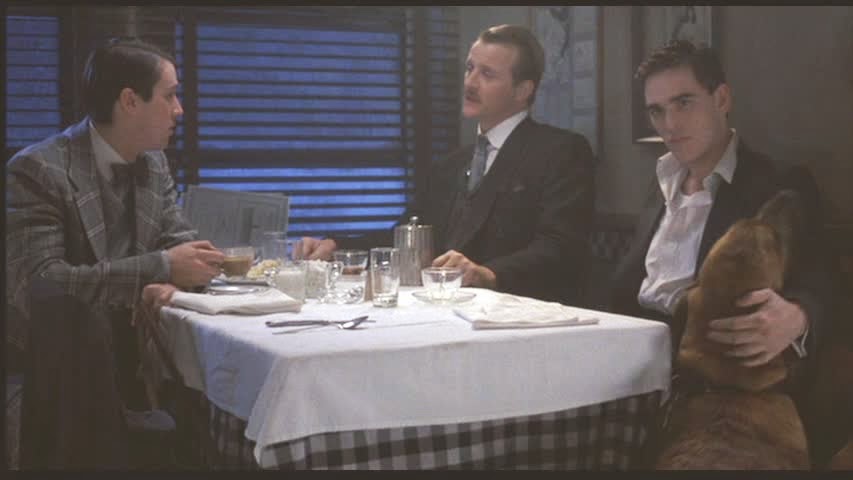
a) Schlub #1 is Regret (Matt Dillon), a cocky bettor nicknamed for the only pony who delivered. His paramour is Lovey Lou (Jennifer Grey), a solemn showgirl whose patience is wearing thin in her pining for the skirt-chasing Regret. Their strained courtship is further beset by a murder rap which leads Irish-brogued Inspector McNamara (Gerry Bamman) to suspect Regret.

b) Schlub #2 is The Brain (Rutger Hauer), Broadway's top mobster and wry gentleman about town. At Mindy's café, which is where all of the main cast are gathered for introduction, The Brain treats Regret and stranger John Wangle (Alan Ruck) to a hearty meal, accompanied by Wangle's two hungry bloodhounds. But it's the impresario's last supper before getting shivved by Daffy Jack (Brookner), emissary to rival Mafioso Homer Swing. The Brain's henchmen seek out his various mistresses hoping for safe haven, but they all reject him. However, his karma could change if his act of kindness to a poor flower girl named Mary (Madeleine Potter) goes rewarded.


c) Schlub #3 is Basil Valentine (Ethan Phillips), a Nervous Nelly who falls under the amorous eye
of socialite Harriet McKyle (Julie Hagerty). After giving Inspector McNamara the slip by introducing him to Wagner's hounds, Basil makes his way to Harriet's posh New Year's bash and bluffs his way into convincing her he's a thug. But when humiliated playboy Handsome Jack (Esai Morales) takes a shot at her prized parrot in a fit of rage, Basil finds himself an accidental assassin.

d) Schlub #4 is Feet Samuels (Randy Quaid), an honorable, hapless goofball "lousy in love" with Hortie Hathaway (Madonna), the star attraction of Missouri "Mizzoo" Martin's (Anita Morris) nightclub and niece of type-writing confidante Waldo Winchester (Josef Sommer). In his suicidal desperation, Feet sells his body to quack Doc Bodeeker (Robert Donley) for $400, which he invests in craps and poker games which make him even richer. Torn between his gradually requited love for Hortie and his impending obligation to Doc, Feet is forced to welsh for the first time in his life, either for true love or an end to his misery.


The movie crisscrosses between these four primary stories in a rather unwieldy manner, relying on Waldo's voice to make the necessary transitions and color commentary. After Feet hits it off with Hortie at Harriet's and Regret woos fellow lonely heart Miss Maud (Dinah Manoff) to Lovey's confused chagrin, the two schlubs are immediately transported to a poker table presided over by Big Shelley (Herschel Sparber), a temperamental goombah who tries to grease the wheels in his favor against the improved odds favoring Feet. These sudden shifts are indicative of much of the film's structure, which sacrifices any real breathing room or compelling flow for simple whimsy.

Judged on their own merits, only a couple of the stories truly retain their power to charm. "The Brain Goes Home" segment is carried along by appealing turns from regular rogue Rutger Hauer, who is a thrill to watch even pale-faced and dragged around in near death, and the beatific Ms. Potter. As a simple morality play, it gets the job done. But the most pathos is mined from the most pathetic character in the lot, Randy Quaid's Feet, in an overlooked showcase for the cracked comic talent to truly flaunt his character chops. Quaid's so physically vibrant and devoted to the role, he makes Waldo's narration surrounding him all the more redundant.

The dalliances between Basil and Harriet as well as Regret and Lovey unfold with a more comedy-of-errors tone, replete with copious double-crosses and misunderstandings, which demand a certain momentum this movie cannot achieve. The catchall ending which resolves the four stories tries to link these two particular strands together with equal indifference. The twists they offer up are shrug-worthy, at best. Better to just appreciate Hortie's fantasy of the simple life, replete with chicken farm and an overnight wedding ceremony in Hackensack that doesn't require a blood test.

Brookner's not entirely without promise, though, especially in the handling of his wide variety of performers as well as the periodically perfect production design. The likes of Matt Dillon and Jennifer Grey don't appear to be stretching beyond their comfort zones (rascally and angsty, respectively), thus making for easy amiability. But Julie Hagerty builds upon her reputation as a grand comedienne (honed from Airplane! and Lost in America) with a chameleonic abandon as the politely repressed Harriet. And in taming the wild Madonna, here with a brunette bob reminiscent of Louise Brooks, Brookner coaxes the superstar into an honest-to-goodness performance, cheekier and less grating than either of her previous cinematic disasters.


As well as reliable turns from Esai Morales, Dinah Manoff and Ethan Phillips, Brookner's film is loaded with plenty of recognizable mugs even in the margins. There's a boyish Fisher Stevens as a practical joker named Hotfoot Harry, always on the lookout for shoes to torch; Richard Edson (Super Mario Bros. flashbacks, anyone?) as dice parlor emcee Johnny Crackow; Steve Buscemi as one of the bums Feet bests at the card game; Michael Wincott as Soupy Mike, the smirking fugitive tending bar at Harriet's Park Avenue palace, plus William S. Burroughs (the subject of Brookner's first doc) as her butler; Tony Longo as Crunch Sweeney, The Brain's right hand man and love interest for Miss Maud; Stephen McHattie as Red Henry, the gunsmith who antagonizes Handsome Jack; and Louis Zorich as Mindy, the restaurateur with the wavering policy towards serving bloodhounds.

Brookner also shows some humorous compositional flair, whether it be the sight of Hortie slow dancing with Feet, using his oversized cleats as a cushion, or the actual countdown to 1929 heralded through a montage of ticking clocks and barking dogs alongside the usual revelers.

But even after giving Brookner the benefit of the doubt, what Bloodhounds of Broadway reminds me most of is another screen adaptation made over a decade later, Rent. The original stage production was notoriously overcast by its creator Jonathan Larson's early death and the film version was so belated that by hiring both mainstream mogul Chris Columbus and the same actors who originated their roles, it was played way too safe. Brookner's legacy seems to parallel Larson's in as morbid and misfortunate a way. It's not a total bust, and I would watch this over Shanghai Surprise any day, but I don't feel like giving Bloodhounds of Broadway my love, my life, my all.


Tuesday, January 27, 2015

Shanghai Surprise


SHANGHAI SURPRISE
(PG-13, Metro-Goldwyn-Mayer/HandMade Films, 97 mins., theatrical release date: August 29, 1986)

Should Panda Express ever introduce a new entrée called Mandarin Turkey, Lionsgate Films ought to immediately negotiate a tie-in deal to offer free DVD copies of Shanghai Surprise. I'm serious about that.

I say this after NetFlix has decided that the best way for me to view this was via Artisan Entertainment's pathetically outdated 2003 release. In case you weren't an avid video collector back then, Artisan were to digital video what SLP mavens Avid Video [ahem] were to the VHS contingent. They were catalog title distributors who offered up low-grade transfers basically selling unsuspecting consumers VHS dupes transferred to disc, freed from the tyranny of original aspect ratios and special features. The standard retail prices for their titles were hardly worth the effort, and unless you really needed to revisit Watchers or Shadows Run Black out of your own masochism, well...just watch Dirty Dancing again. That was all they were good for.

Lionsgate rectified this by issuing an actual "special edition" several years later, complete with all manner of tacky talking heads showcases and a "Fans Unite!" audio commentary from a quintet of male Madonna scholars. NetFlix didn't get that memo, and thus I am in the temporary possession of a stagnated piece of plastic which may as well represent Madonna's own presence in the film.

What a hell of a way to see China.

Howard the Duck, at least, had actual contemporary interviews with accessories to the crime, chiefly creators Willard Huyck & Gloria Katz as well as stars Lea Thompson and Jeffrey Jones. Nobody wanted to reflect upon the making of Shanghai Surprise, meanwhile, Howard's immediate contender as the biggest flop of 1986 and cutthroat multiple Razzie nominee, which may as well be a given since, as it is now as it was then, its real legacy rests squarely on its long-estranged leading actors, Sean Penn and Madonna.


Oh, the 1980s, you worked in mysterious ways. How did two of the most disparate egos in show biz manage to tie the knot for a bated-breath audience of tabloid junkies and industry insiders? What circumstances led the Me Decade's premier Method actor to declare his vows to the Queen of Pop? What was going through George Harrison's mind when he pursued this project despite the baggage associated with this diabolical duo?

Yes, Shanghai Surprise was produced by the Quiet Beatle himself, the same man who got into film simply because he felt Monty Python's Life of Brian was too precious not to be shared with the wide world. Harrison's HandMade Films also helped produce a slew of British cult classics such as The Long Good Friday, Time Bandits and Withnail and I. And if Harrison had not taken out that mortgage on his own humble abode, the UK would never know the discreet charms of The Burning, which HandMade distributed theatrically alongside Venom, the movie which pitted Klaus Kinski, Oliver Reed and a Black Mamba against each other in a grudge match for the ages.

The prospect of a George Harrison/Madonna duet would go unfulfilled, sadly, as evident in the opening credits of Shanghai Surprise, which were animated by none other than Maurice Binder. If Madonna's British affectations had kicked in before her dalliance with Guy Ritchie, then by rights she'd be the one taunting George with the line "You must be crazy/You got no money/And you're a liar."

And George...oh, dear: "My straits are dire from the wok into the fire/I'd like to trust you but I've broken my rickshaw." I didn't think he could make Paul "Spies Like Us" McCartney sound hip, but it happened. I can't find my brave face, and I haven't even made it to the man's musical credit.

Enough time lapses for me to think about the bizarre choice about having Sean Penn inherit Sir Roger Moore's mantle before the movie takes us to 1937, the year when the Japanese occupied China. There we meet Walter Faraday (Paul "Belloq" Freeman) enjoying a hearty, crunchy dinner with what looks like steel chopsticks. Because heaven knows, you never smuggle 1000 pounds of opium on an empty stomach. Ironically, the morbidly obese man sitting across from him demands he get a move on, as there are Jap soldiers outside their door. "Their beef's with the Chinese," Faraday counters, savoring the taste of his own plate of delicious Alpo. The Chinese's beef is with him!

As the rickshaws pull Faraday and his loot towards international waters, the self-described "Opium King" (have it your way, Faraday) decides to pay a visit to a certain China Doll. We never see his supposed maiden, instead being treated to the first of many double-crosses as Wu absconds with the bounty and both Faraday and his fat companion, a journalist named Willie Tuttle (Richard Griffiths), are cornered by the foot soldiers of Chinese official Mei Gan (Kay Tong Lim), who wants returned to him what he feels is rightfully owned. In lieu of that, Mei Gan confiscates Faraday's utility belt and starts emptying out its contents, only to trigger the explosive within its final compartment and have his hands blown clean off. Faraday and Tuttle make a run for the nearest harbor and dive right in, but the secret police open fire and apparently murder Faraday. I say "apparently," because...well, you'll see.

One year later, the whereabouts of the opium treasure, or "Faraday's Flowers," continue to remain unknown. A pair of missionaries tending to wounded Chinese troops have a rendezvous with destiny when they seek a bilingual stooge to bankroll for investigative purposes. Their salvation comes in the form of an unkempt drunkard, Glendon Wasey (Sean Penn), booted off his boat to Los Angeles for insufficient funds. The elderly Mr. Burns assigns his associate Gloria Tatlock (Madonna) to watch over Wasey, who will receive a ticket back home provided he locates the father of a mortally wounded rickshaw carrier, one Wu Ch‘En She.

You can tell that what Miss Tatlock is really interested in are Faraday's Flowers, as the opium within them could be used as morphine to administer to her patients. Wasey catches wise to the deception, but stays on the search though coercion and thus leads us into a veritable slew of shady ancillary characters and dead ends. Wasey encounters Faraday's beloved China Doll (Sonserai Lee), a concubine with delusions of empress-style grandeur, and thus piques the curiosity of Mei Gan and porcelain replacement hands. He is also shadowed by the lanky Justin Kronk (Philip Sayer), who is in cahoots with Mr. Tuttle, and there is also a baseball-obsessed entrepreneur named Joe Go (Clyde Kusatsu) and his Oddjob-esque muscle (Professor Toru Tanaka). All of these characters also have their fingers in the pie, and it's up to Wasey and Tatlock to navigate these interlopers if they hope to uncover Faraday's Flowers.


Shanghai Surprise was a fiasco from the word go, as George Harrison (who worked with Michael Kamen on the film score and manages a couple of decent original tunes such as "Breath Away from Heaven" and the especially salvageable "Someplace Else") himself admitted in interviews where he grieved over the poor choice of script, director and leads. Infamous stories abound over Sean Penn's ill temper and the constant friction on set. If only these anecdotes amounted to a camp classic, as this is more a confusing and slapdash assemblage of worn-out adventure movie clichés reliant entirely on the superficial novelty value afforded by putting Penn and Madonna into a period play date.

Penn tries to make the best of the situation, but the nature of his particular acting style contradicts the film's supposed fluffiness. Even as early as Fast Times at Ridgemont High, Penn's Methodical meticulousness put him squarely in the lineage of Robert De Niro rather than Clark Gable. The role demands a playful, roguish charisma which he instead plays way too sour-faced and stoic. Given his beginnings as Jeff Spicoli, the precursor to the likes of Bill & Ted & Wayne & Garth, you'd think Sean could make lemonade out of the material, but he seems to be out of his element and doesn't commit with the same compelling brio he reserves for his dramatic roles. That being said, Penn does endeavor, particularly when he consoles a regretful, drunken Miss Tatlock after she places him under "obligation."

If it's not love that you need, then he'll try his best to make everything succeed, I suppose.

The real weak link throughout is, no surprise and all shanghai, Madonna. In only her second major film role following Desperately Seeking Susan, she is making a dreadful reach in the kind of role you expect from one of the Old Hollywood fixtures she rapped about in "Vogue." Alas, she proves no exception to the rule that being an established pop icon doesn't automatically make you a star actress. Madonna is perpetually frigid and awkward as Miss Tatlock, her appalling inability to mine humor or honesty in any situation marking her as fatally unfit for a farce, let alone any movie trying to sell her as a 1930s missionary. To be fair, it's not as if the screenplay gives her an arc, making half-hearted references to a phony identity and a loose morality which are not followed up on. This disingenuousness is emblematic of both the character and the performance.

Put these miscast lovebirds together and you got a movie that doesn't so much sing as yowl like a cat with a stiletto through its tail. The romantic heat between them is vaporous, a form of anti-chemistry which invites more speculation on their notoriously erratic private lives than any investment in their celluloid personalities. I mean, compare this to Rob Reiner's The Sure Thing, released a year before Shanghai Surprise, which deliberately modernized Frank Capra's It Happened One Night with two then-unknown actors who weren't real life items. That John Cusack and Daphne Zuniga clicked charmingly whilst Penn and Madonna flounder from one crummy confrontation to the next shows up the utter famine of faith on behalf of all involved.

Shanghai Surprise disgraces all of its varied lineages, not just the Casablancas and The African Queens of rosy vintage, but even the more contemporary James Bond and Indiana Jones sagas. The supporting players don't even compel on the most rudimentary level of exposition, and their motivations are contrived to the point of abject confusion. The plot, adapted from a novel published in 1978, has all the meticulous structure of a fifth-rate Choose Your Own Adventure book, with threads involving bogus diamonds and the sanctioned intimidations of Mei Gan going absolutely, implausibly nowhere. The recreated Chinese backdrop, which should be distinctly colorful, is staged with dispiriting drabness by director Jim Goddard, who makes even mid-eighties John Glen (Octopussy, A View to a Kill) look like classic Terence Young (From Russia with Love, Thunderball).

Going back to Howard the Duck for a second, and the mention of Lea Thompson and Jeffrey Jones. That movie is terrible, yes, but at least one could feel duly ashamed that actual talent went to waste, as Thompson was so beguiling in Back to the Future and Jones was in peak form in Ferris Bueller's Day Off. Shanghai Surprise offers no such luxury, with the slight exception of Sean Penn, and even then his off-screen cockiness put merciful paid to any notions that he and Madonna's presence alone was publicity enough. They weren't working actors who managed to find themselves in a flop, these two willed it upon themselves and have done little to lighten up in the meantime. Shanghai Surprise stinks of a massive ego trip to this day even if its principals continue to ignore it, and so should you.

Still my guitar gently weeps.