Showing posts with label music. Show all posts

Friday, February 28, 2020

Enchantéd: Nick DeLaurentis' GOOD BOY


Enchantéd: Nick DeLaurentis' GOOD BOY

It's getting tougher to write these days, if I can continue to use my platform for honesty's sake. Something about that last review just feels too candid for me to even think about, and I can't pretend that what I said isn't still plaguing my psyche in the worst way. I didn't feel compelled to go back to my Amityville Murders review. This was the kind of piece so close to my heart, it came together more effortlessly than I could have hoped. I wrote in one sitting, because it was so direct to the core of what has become of me. And even though Diane Franklin herself as well as English critic Kevin Matthews have typed their support, I'm too confused to persevere. Did I withdraw in disgust or am I merely surrendering to apathy? When someone like Diane believes I have a novel in me, does that kind of faith have a long term effect? What am I even trying to accomplish now that I have let distance rule my heart?

There aren't that many celebratory options for me as I approach 36, so I elected to make one that will take me out of my comfort zone and maybe prove as rewarding as the piece I did on Olivia DeLaurentis' short films, which like that last article about her mother came out of confronting death. In the case of Olivia's tribute, my father was the departed as opposed to the more recent death of my grandmother. But it's more than just the passing of family now that is fogging up my creative inspiration. It's the losses of certainty, of connections and of conviction. I'm flying blind as I try to do something I haven't done since I published all my work on the former Epinions site: I am going to write an album review.

I am talking about the debut LP of Diane Franklin's youngest child, Nick DeLaurentis, the young Jesse Holiday from Devon Bight & the Sensitive Boys and composer of that film's mock teen pop. In fact, I am going to repost the link to Olivia's short film on Vimeo and ask that you watch that please before I make the transition.

My knowledge of Devon Bright is the sole piece of context I have in regards to Nick DeLaurentis, unless I must also credit him with the orchestral cover songs sprinkled throughout Royal Effups. A classically-trained teenage musician, Nick is currently pursuing his passion in Chicago, based on the interview conducted by Christian Thorsberg over at Navy Peer. His first two Spotify singles, “Knowhere” and “Beauty Mark,” showed his skill at acoustic guitar, and both songs carry over to Good Boy, his admittedly introspective solo debut. Boundless if not restless, Nick is already contemplating his follow-up as a truer extension of his taste, less informed by the indie folk scene like Good Boy is. My biggest takeaway listening to the album is that, as the title implies, Good Boy is a young man's fresh start, one which asks encouragement as he accrues further experience and curiosity.

For now, Nick is acting on the instincts of the moment, so I look to the opening track “Bone Dance,” also the source of his inaugural music video, for a proper introduction. Closer to Emma Bull than Miley Cyrus, the lyrics remind me of Gotye's “Eyes Wide Open,” which could be construed as a troubled relationship lament either interpersonal or ecological in scope. For his song, Gotye fashioned a bass part by sampling percussive rhythms off a musical fence in Winton, Australia, whereas Nick DeLaurentis is on the beach, specifically Montrose, the faint sound of bowed strings conjuring a colony of seagulls in the sky. Finger snaps provide a skeletal rhythm, with acoustic tolls and scrapes pulling the song further away from the DOR urgency Gotye favored, yet still attaining an irresistible groove. The overtracked chorus, delivered Monk style, comes across as jarring given the softness in Nick's verse vocals: “Everyone I know plays god games, but they don't even pray.” As rats threaten to breed in charm bags and the instruments drop out for an Imogen Heap-esque coda (“30 years away/No prayers left to pray/Singing Amen”), I hope I'm hearing this particular observation correctly for the sake of levity: “The things you left behind, you think I won't discover/I give you Olive Garden, but you just want the butter.”

The “Bone Dance” video shows Nick being tortured by mirrors, but on his first single release, “Knowhere,” he seemed preternaturally doubtful against a coffeehouse bossa nova backdrop. “I want you to be happy/I want you to be kind,” he sings on “Bone Dance,” a sliver of light through overcast clouds. But the tentative steps towards the outside world on “Knowhere” offer no relief when “we are still trapped in the fire,” with worldly knowledge proving insubstantial in the end. A corny opening couplet which rhymes “plane” with “train,” not to mention one of the clumsiest chorus lead-ins I can recall (“And you could be the president of Cuba/I'll bet you think you are important, too, yah”), prove more twee than such an existential joke can bear. At least the version of “Knowhere” on Good Boy ends less bleakly than before, mitigating the insular anxiety and promising some joy in life's journey. 

Amidst the overtaxed empathy and sensory overload of “Chatter,” the album's peppiest track (with vocodized “blah blah blahs” for good measure), Nick gasps “I need peace!” but is generous enough to wish the same for his town and the planet in general. The hearth of family, luckily, helps Nick towards realizing it for a few lovely songs. The fondness of “Sweatshirt” could be dedicated to Diane DeLa...erm. Franklin, herself: “Some people play make believe/But I know it's all real after you leave/Your ghost by my side/Kissing me on the cheek.” On “Beauty Mark,” which opens once again with imagery of flames a la “Knowhere,” Nick sings “You twist my arm/I love you, anyways” in that rare “Just the Way You Are” ballad that references both the Phoenix and chocolate-covered marzipans in the same space. And Olivia DeLaurentis provides background vocals on the least foreboding love song in show, “Storage Space.”

“The Abstinence Dungeon” undercuts comically nervous portrayals of platonic affection with a blunt if faintly-sung “I would like to know how it feels to not be f***ing indecisive all the time,” and is way less insufferable for a Nice Guy anthem than “Treat You Better,” even without a lyric sheet (which I admittedly would appreciate: Nick sings like a young Steve Miller and gets overpowered easily in the mix). Nick's predilection for atmosphere resurfaces for the remaining songs, the title cut (which comes with an instrumental prelude and continues the beach ambiance from “Bone Dance” with Maui-style buoyancy) and the closing “Prelude to Dreams.” That last one seems sculpted from the indie folk cookie cutter, to be true, yet if Nick DeLaurentis chooses to embrace a fuller sound next time, this particular Good Boy will continue to listen patiently.


Sunday, November 4, 2018

Bohemian Rhapsody


BOHEMIAN RHAPSODY
(PG-13, 20th Century Fox, 134 mins., theatrical release date: November 2, 2018)

"This thing called Queen
I just can't handle it
This thing called Queen
I must get around to it
I ain't ready!
Crazy little thing called Queen."
- Freddie Mercury, R.I.P.

It's 10am on a Saturday, and I figure coffee can't compare to a shot of Queen's incomparable pomp rock in seat-shaking Dolby Surround. That's not a backhanded compliment for the record: Queen are perhaps the only real combo who made bombast sound fun. An old Rolling Stone article declared Queen "the first truly fascist rock band," and those late ‘70s anthems have a jackbooted arrogance to them. But if they didn't have hooks, energy and especially Freddie Mercury, I could hold no nostalgic yearning for them. They'd slot easily into the same AOR ghetto with Journey, Styx and REO Speedwagon, all of whom pale in comparison to the Mercury-May-Deacon-Taylor music machine.

But as Bohemian Rhapsody, the band-sanctioned biopic of their rock ‘n' roll reign, concluded with an abridged recreation of the 1985 Live Aid mini-set which showed them at the height of their power, I surrendered. It's all in the tune of "Radio Ga Ga," the Roger Taylor-penned hit from 1984's The Works (it only went to #16 in the U.S.A., but was a chart-topper or a notch close to such in 14 countries). It's got the martial beat, the synths, the note-bending guitar, the shout-along chorus, the earnest lyrics mourning a format which means even less almost 25 years later. It's sounds stripped down compared to the band's flamboyant first decade, a credit to the evolution begun with the pop-minded 1980 LP The Game. And I sang along to it in the theater shamelessly, or at least the first verse and final chorus.

Then there's that titular behemoth, a song whose pop-cultural revival is the stuff of legend. There are even text graphics filling the screen which shows just how reviled Queen were in 1975, when they embraced rock and opera with the kind of kitsch abandon even Pete Townshend was too reserved for. But cut to 1992, after the death of Freddie Mercury, and a little movie called Wayne's World is released on Valentine's Day, the better to plant a big wet kiss on the kind of music which punk and metal were meant to discredit. Wayne Campbell, Garth Algar and friends singing along, banging their heads, weeping to the fatalistic coda; it was a glorious sequence which began the revitalization of Queen.


Not a lot of bands deserve such an afterglow, but Queen did. Looking back on the jewels of their discography, from "Killer Queen" to "You're My Best Friend," "Somebody to Love" to "Bicycle Race," "Another One Bites the Dust" to "Radio Ga Ga," Queen were the misfit band they proclaimed themselves to be in Bohemian Rhapsody. When they were on, they were the champions of the world. This adrenaline rush was just what I needed first thing in the morning. "Hot dog?" I say "Cool it, man." Let's just surrender to the many glories of Queen without question.

Bohemian Rhapsody should be the essence of Queen. We're not dealing with a hot-tempered soul innovator like James Brown or an insular, troubled pop genius like Brian Wilson. Queen were comparably modest even if they didn't sound like it. They would and did rock you, and their legacy presents an interesting dichotomy. Queen are the stadium band to end them all yet a campy pleasure who scored the 1980 Flash Gordon movie. Freddie Mercury is a homosexual icon and showman supreme, but was introverted and soulful enough to counter any stigma. Brian May, John Deacon and Roger Taylor (here played by Gwilym Lee, Joseph Mazzello and Ben Hardy, for the record) were all undeniably talented as songwriters and musicians. I wanted a whole movie to reinforce the very reaction I get upon hearing that compact version of "Radio Ga Ga" from their Wembley barnstormer, a moment to rival U2's equally compelling extended version of "Bad."

Alas, the widely-reported controversies behind the eight-year production and the simple appeal of Queen have clashed together to result in a film that is a rock biopic pile-up. It isn't exactly "Death on Two Legs," but better to serve it with the title "Hammer to Fall." Bohemian Rhapsody contrives a series of blunt melodramatic clichés which left me numbed by the time Live Aid is shoehorned into a third-act redemption arc. There I was turning as skeptical as Queen's past critics. This isn't merely a group of British pros putting on a great show for the ages in support of a worthy cause. It's a broken family coming together for the first time "in years." It's a wayward frontman learning humility, mending tattered relationships and coming to grips with AIDS. It's the most important charity guest appearance ever, with telethon lines ringing off the hook and funds raised into the stratosphere. It's no longer amusingly pompous but wretchedly hagiographic.


It didn't have to be like this. Spearheaded by Rami Malek's laudable approximation of Freddie Mercury's strutting, saucy charms, Bohemian Rhapsody is not lacking in charisma. Whether working up a paying crowd or a crowding player (look beyond the Gerry Rafferty makeup of one impresario for a flash, ah-ah, of stunt casting), Malek is dashing and daunting when duty calls. This is the first half of the movie, when the band is on the rise (there is a joyful depiction of their first studio sessions) and shacked up in a muddy, creaky country house to record A Night at the Opera. I could overlook the fact that during their preceding Sheer Heart Attack era, the movie version of Queen is blasting through "Fat Bottomed Girls," which wasn't released until 1978's Jazz (no "Stone Cold Crazy," which Metallica so awesomely covered, or "Brighton Rock?").

But then the movie progresses, fudging chronology and fabricating pitfalls with such superficial aggression that I was constantly demanding "Don't bore us, get to the chorus." It's London 1980, and Queen are now working on "We Will Rock You." Memo to screenwriter Anthony McCarten: "News of the World, motherfucker!" I would also assume the band members know the name of a certain single/live staple from that ‘77 album to be "Spread Your Wings." And why do we need hackneyed "Freddie goes solo" tension (which leads to the overstated Live Aid gig) when we could have Queen in 1977, taking one look at the punk landscape which was gobbing in their general direction and laying down the raucous "Sheer Heart Attack?"

Get On Up and Love & Mercy both had more respect for context than McCarten and directors Bryan Singer & Dexter Fletcher (not to mention consultants Brian May & Roger Taylor). They are like revelatory deep cuts next to Bohemian Rhapsody's exhausted hit parade. I came out of Get On Up genuinely sparked by the towering ambition of James Brown as well as the full extent of his brutishness, against bandmates, lovers and perfect strangers. Love & Mercy was rich with empathy for the frazzled soul of Brian Wilson, who heard searing symphonies and pained reveries in his head until he was drugged into possible oblivion. Everything about Freddie Mercury in Bohemian Rhapsody, especially his sexual orientation, is a hedged bet, a concession to formula which negates the declared intent of Queen's music.

Forgive me if I sound like I'm angling for a think piece, but the stodgy construction of this really does stink of the hetero-genous. I'm not asking to see what Sacha Baron Cohen or Stephen Frears originally had in mind. But as an adult, I would care for a depiction of Freddie Mercury that doesn't make his homosexuality look like a sheepish trip down the proverbial rabbit hole guided by a wasted Allen Leech as duplicitous manager Paul Prenter, tinted in infernal clubland reds and subject to migraine-inducing funhouse mirror-lenses when Mercury is grilled about his private life in a press conference. Never mind the way Mercury's real life soul mate Mary Austin (Lucy Boynton) and his bandmates are trotted out as reactionary figures, as well as the sexless bond he has with Jim Hutton (Aaron McCusker), another important friend of Freddie reduced to an agent of salvation. I think Freddie Mercury is more than worthy of wrenching pathos, an unfortunate casualty of a wasting disease which during the 1980s was seen largely as Biblical retribution by assorted religious fanatics and politicians. But damn are these filmmakers pushing for the retrograde; Bryan Singer showed more solidarity towards gays in his inaugural X-Men entries.

The performers are willing, but the flesh is decayed. Lucy Boynton, the love interest of John Carney's transcendent Sing Street, is as worthy of better material as Malek. Imagine a film which delved deeper into the intimacy between Freddie and Mary, the kind which inspired Freddie to treat her as his top confidante and inheritor in his will. Here, she is reduced to a fling, forcing Freddie into an emotional void he immediately fills with decadence and pageantry. All of the relationships, including the former Farrokh Bulsara's defiant connection to his Parsi parents (Ace Bhatti, Meneka Das), have this half-formed (or less) quality to them. Freddie was so much more larger-than-life in actuality, but you'll never know from the way the disco thump of "Another One Bites the Dust" juxtaposes a fateful walk through a leather bar. Didn't John Deacon write that song out of appreciation for Chic's "Good Times?" I heard no Nile Rodgers (Rick James, instead, another anachronistic credit to the film's millennial wankery), but I did get a "THIS IS DISCO!" fit to lead me into another false-improvisatory recording session. Did Steve Dahl ghostwrite this?


Let's be clear: Bohemian Rhapsody is geared towards the more middlebrow section of Queen's fandom, people who titter at a meta joke involving Wayne's World but do not feel a tinge of regret that director Penelope "The Decline of Western Civilization" Spheeris herself didn't contribute a eulogy which would've closed with greater power than the predictable trope we do get. Having mentioned Spheeris and Stephen (My Beautiful Laundrette, High Fidelity) Frears does no favors to Singer and Fletcher; with the latter connected to an Elton John biopic, whose teaser trailer graced Bohemian Rhapsody, look forward to more edgeless plug-and-play rock star dramatizations (please don‘t let me down, Lee Hall).

And Bohemian Rhapsody is strictly plug-and-play, to inexplicably reference "Weird Al" Yankovic (remember his "Bohemian Polka?"). Montages soak up whatever potential resonance there is to be gained from watching a baggage handler born in Zanzibar realize the highs and lows of stardom, and they just keep absorbing and absorbing until the film is as dry as the Atacama. Each musical moment proves an oasis, but they seem scattered because of the way Live Aid bookends the film. And these moments make up the bulk of the offending montages; every workhorse of a song is handled unimaginatively, their accompanying geneses too cute for their own good.

The more I think about it, the less I consider this even a "biopic," since it's too unreliable to have the quotes removed. What you ultimately get with Bohemian Rhapsody is a breakout performance from Rami (Mr. Robot) Malek that wants badly to be of Oscar caliber (Paul Dano and Chadwick Boseman, we hardly knew ye) and as disposable a reminder of Queen's popularity as Hollywood could muster. I don't anticipate what'll happen to, say, Judas Priest when the wind blows their way (save a prayer for Rob Halford). I should've cried those intended tears of joy as they wrapped up at Live Aid but wound up as sad as Garth Algar upon the immortal last words of "Bohemian Rhapsody" itself. Nothing really matters to me.*

*Except the songs, of course. But I can sing along with "Don't Stop Me Now" or "Play the Game" for free.


Wednesday, October 26, 2016

Sing Street


SING STREET
(PG-13, The Weinstein Company, 106 mins., theatrical release date: April 15, 2016)

In the 1970s, Van Morrison mused on the transcendent promise of rhythm & blues in his own thickly-brogued, folksy fashion, rekindling the romantic charge in Jackie Wilson's honeyed voice as well as his own passion for live performance as channeled by the 11-piece Caledonia Soul Orchestra. To cite one of Van's influences, Sam Cooke, he could no longer fight the feeling, and the It's Too Late to Stop Now LP of 1974, as well as its three-volume companion piece released over 40 years later, is on par with the Cooke who played the Harlem Square Club or James Brown at the Apollo back in the 1960s.

Fellow Irishman John Carney aims to capture that same revitalization of spirit through song, which is tricky business since his forte is narrative filmmaking. Through sheer force of intimacy, 2007's Once managed to convey that passion through the professional and romantic union of a busker and an immigrant on the streets of Dublin. It was also hailed as a miracle for the movie musical format due to its naturalistic, nuts-and-bolts scale. Carney's third film is a period piece set in 1985, neither the freshest or the most honest era for pop music let alone nostalgia. Not only that, but it's a teen film set in 1985, the year the genre exploded for the American market.

Chalk it up to Carney's grounded sincerity and filmic lyricism that Sing Street, were it time-warped back into the heyday of Hughes, could've usurped 92% of its competition on the strength of imagination alone.

Lots of youth-oriented pictures in the first half of the 1980s touted music-as-escape, the majority of which simple-mindedly reduced the concept to flashy montages or raucous house parties or dance bonanzas. In the hands of hucksters, such freedom came across as trivial. John Carney communicates the shared bond people can form over late night turntable binges, as well as the inspiration it can yield. There is a moment a little over 30 minutes in where two boys spin Joe Jackson and The Jam, crack jokes about rabbit pellets and brainstorm an original song. Carney fluidly expands that confidential moment of creativity into a band practice of the same tune and goes further from there. The rhythm of the film and the song interlock gracefully, and you can sense the main character's growing confidence handled with majestic precision.

Carney's human touch is more than fitting given that budding singer/lyricist Conor Lawlor's dizzying coming-of-age is all for love, specifically one for the beguilingly beautiful older girl who stands in waiting across from Conor's parochial school on Synge Street. She's Raphina, an aspiring model with a drug-dealer boyfriend whom she claims will whisk her off to London, land of opportunity. Conor asks if she'd be interested in being a video vixen in the meantime for his rock band. Before he knows it, Conor and his new friend, prepubescent entrepreneur Darren Mulvey (Ben Carolan), are hustling to form said group and produce said video for a non-existent song.

Advised by his college dropout brother Brendan and allied with homely multi-instrumentalist Eamon, who names the ragtag five-piece band Sing Street, Conor's individuality blossoms upon exposure to the likes of Duran Duran, Hall & Oates and The Cure. The band practice Conor & Eamon's new songs and film a second video on the way to their first gig at the midterm dance. Conor falls deeper for the orphaned Raphina whilst having to confront his own disintegrating family unit as well as the pressures from draconian school headmaster Baxter (Don Wycherley) and ruffian classmate Barry (Ian Kenny).


Forget all that you can read about Sing Street being a youthful version of The Commitments (do watch for Maria Doyle Kennedy as Conor's ma opposite Aidan Gillen), because this is on a higher level of cinematic nirvana. Think more of Bill Forsyth, who made the winsome Gregory's Girl in 1981. Think more of John Duigan, author of the affecting Danny Embling saga with The Year My Voice Broke and Flirting. Imagine a School of Rock if it had been written by Richard Linklater as well as directed by him. Carney's charm is reminiscent of those films, so rich with character-building sensitivity and mundane-seeming quirkiness and a naturalistic, guileless treatment of growing pains. It would seem to be a dreamer's version of a depressing reality, especially given how Dublin appears a one-horse town (the end credits offer an assurance that things have progressed in the economy and educational system), but there is way too much courage, wisdom and tenderness in Sing Street's slice-of-life playlist to ever write off as sappy, closet-pretentious button-pushing.

As Conor himself puts it to his bandmates, looking for the words to clarify Raphina's diagnosis that he's not happy being sad, "it means that I'm stuck in this shithole full of morons and rapists and bullies...I'm gonna try and accept this and get on with [life] and make some art."

Ferdia Walsh-Peelo is a terrific discovery as Conor Lawlor, the pint-sized New Romantic whom Raphina pet-names "Cosmo." More than just another lovesick archetype, Walsh-Peelo turns Cosmo's clumsiness into the stuff which makes him secretly the coolest kid on the block. It's got nothing to do with the fact that he walks into Christian Brothers School one day resembling a junior Nick Rhodes (although I smirk every time I notice it), but it's the incremental integrity and bottomless joy of discovery he demonstrates. Getting the girl may be a top priority, and rooting for him is an irresistible inevitability, but if he has more songs in his heart, then he truly deserves his name written in the cosmos.

Lucy Boynton perfects that same attractiveness of soul and body as Raphina, a sophisticated 16-year-old whose innocence is renewed by the affections of Conor. The Sing Street band mates, trained musicians all, appear to have less material to excel with than the leads, but John Carney does right by them regardless. Mark McKenna has that droll, lanky demeanor which automatically signals introversion, but there's a spark in his Eamon that makes him an invaluable asset for Connor. Percy Chamburuka gets a great introduction as "golliwog" keyboardist Ngig, whilst Karl Rice & Conor Hamilton shine as the elementary-aged bassist Garry and drummer Larry. Rice's impromptu costume for the band's first video shoot turns out be a corker, and he also dances with an elderly lady on the shuttle.

As Brendan, Jack Reynor plays the kind of boisterous, slacker savant that Jack Black does so well, but while he gets a handful of opportunities to demonstrate such (there's a putdown of Phil Collins worthy of Black's overbearing clerk from High Fidelity), Reynor also gets at the inner resentment brought on by his dysfunctional parents and his kid brother's prodigious ascent. When Conor sings "You just can't stand the way/That I turned myself around" in one song, it feels closer to his relationship with Brendan than Raphina. But Carney shades in lovely bondings between Conor and both these respective muses, and Reynor finds the soul in his own character as much as Walsh-Peelo and Boynton.

And then there's that soundtrack, which is another impeccable touch to add alongside Carney's proficiency with his actors here: "Rio," "A Town Called Malice," "Maneater," "Steppin' Out," "In Between Days," Motorhead's "Stay Clean," Genesis' "Paperlate," Flash & The Pan's "Waiting for a Train," and Spandau Ballet's "Gold." All of these top-notch selections are matched by the original compositions which take cues from the hits on show, written by Carney with assistance from Gary Clark of "Mary's Prayer" renown. "The Riddle of the Model" flaunts John Taylor-style slap bass and Walsh-Peelo's spot-on impression of Phil Oakey's monotone. "Up" takes flight both lyrically and musically, and "Brown Shoes" is a singular kiss-off anthem from Conor to his tormentors (although skinhead Barry is sold on being a roadie). But Clark's solo compositions, the gorgeous "To Find You" and the giddy "Drive It Like You Stole It," are the surest and best candidates for Oscar consideration, even with Adam Levine, the Maroon 5 singer who starred in Carney's Begin Again, collaborating with "Falling Slowly" award-winner Glen Hansard for "Go Now."


The synergy of song and plot in Sing Street is intoxicating. Conor and Raphina exchange a possible video idea for "Drive It Like You Stole It" modeled on the Enchantment Under the Sea dance from Back to the Future. An unspoken betrayal reflecting cruel reality is wrapped around Conor's fantasy of the video during rehearsal, where a group of oblivious teens fail spectacularly to emulate the '50s choreography from the movie. In Conor's mind, there is peace between his parents, Brother Baxter does back flips and Brendan comes through for true love with switchblade and motorbike. Only one of the latter will happen in the end, which isn't hard to guess, but I've never seen a reverie on film this magnificent. 

Sing Street is one of 2016's most pleasant little miracles. Like the best of its decade's pin-up pop, it has been blessed with an everlasting hook and a vivacious sense of itself. Carney weaves proven material both in teen movies as well as his own oeuvre into the best long-form music video never made in the ‘80s. It may hit the sweet spot for the fanatically nostalgic, but a coming-of-age movie this superior deserves its own DIY cover version, no vampire teeth required.


Thursday, October 20, 2016

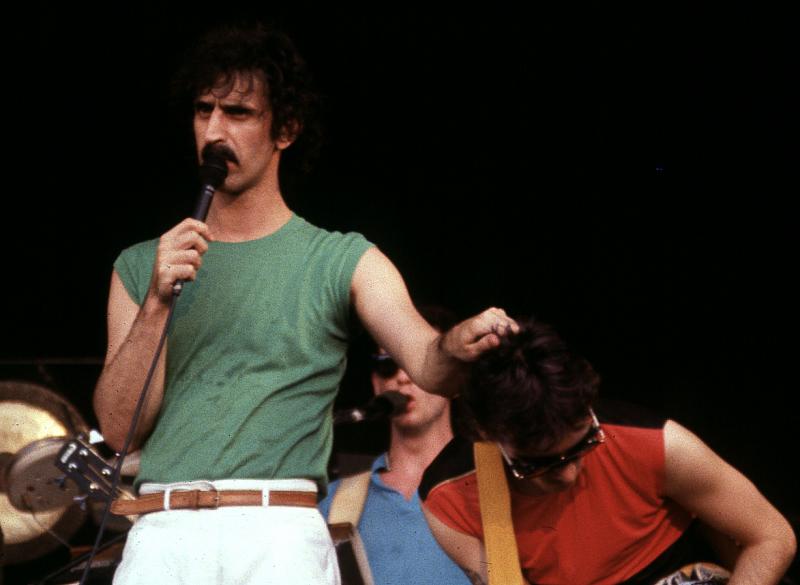
Eat That Question - Frank Zappa in His Own Words

This will be my 99th official movie review on this site, so if you are reading this, thanks for your time and support. I already plan on doing something special for my #100, to extend my support to a great talent who I feel deserves the recognition. But going through all I have written so far, I'm surprised to have got this far even if I had to struggle in some regards. For one, I had to retract my presence from social media for a spell because it wasn't doing my soul or my creativity any good. This meant I ended up sacrificing a connection which ran very deep to me, as well as losing touch with several very receptive people. I have been taking steps to getting back in the stratosphere, mostly on the strength of my devotion to writing.

I don't want to get too deep into this, instead resolving to continue to revitalize and strengthen my passion. So on the eve of my celebratory post, here is my latest review:


EAT THAT QUESTION - FRANK ZAPPA IN HIS OWN WORDS 
(R, Sony Pictures Classics, 93 mins., limited release date: June 24, 2016)

Growing up in Apache Junction High School, I may have been the only person in my drama class to bring a Frank Zappa CD to the dressing room.

My tastes will still formative and a lot of what I was getting into musically were cult artists. I was big on Paul Westerberg and The Replacements then and still am, but I also picked up on every Mother's Father through a compilation album called Have I Offended Someone? I preferred short, simple songs at the time, and the album at least contained some Zappa tunes for the neophyte: "Dinah-Moe Hummm," "Catholic Girls," "Bobby Brown (Goes Down)," "We're Turning Again," and "Valley Girl." This was barely scratching the surface of Zappa's discography, as the CD contained nothing as old as "Harry, You're a Beast" or "Call Any Vegetable," but it boiled down a lot of highlights from Overnite Sensation to The Mothers of Prevention.

And it did so by culling a lot of Zappa's bawdiest tracks, at least in terms of lyrics. One of the songs was "Jewish Princess," which was condemned by the Anti-Defamation League for such lines as "I don't want no troll, I just want a Yemenite hole." Like I said in the last review, tons of people had Porky's to get their illicit kicks. I chose Frank Zappa.

But Have I Offended Someone? turned out to be a gateway of sorts into Zappa's past, which has enough material for a companion volume devoted to his 1960s work. I eventually started hearing the kind of material Zappa wrote which earned him a reputation as a "composer" instead of "rock musician." The xylophone-heavy, jazz-structured perversions of R&B in which no runaway melody was strident enough to become a bar on Zappa's sheet. The discordant experiments with woodwinds and brass, like chamber-of-hell pop. The multitude of distorted voices spouting some dadaist catchphrase, especially in regards to such buzz words as "creamcheese" and "tinsel cock."

Frank Zappa was a genuine freak in a world eager to compartmentalize him, and the music exceeded his grungy attributes. And when it came to promoting himself on television, he drew blood with his sardonic estimations on a society that knew little about his recorded legacy, but held him in esteem or fear as an eloquent dissenter against the lowest common denominator. In 1981, upon the release of his Tinseltown Rebellion LP, one talk show host senses "a deep, permanent, irreversible cynicism" within Zappa, but is he really that different from George Carlin or Groucho Marx when you get right down to it? Zappa's immediate response is that he hopes his skepticism will prove contagious. A moment later, Zappa monologues about the subpar state of modern American culture, from designer jeans to schlock rock, a deprivation of identity upheld patriotically, and pathetically, with poison gas and neutron bombs.

Having read The Real Frank Zappa Book hoping to contract some of Zappa's righteous disdain, Thorsten Schütte's Eat That Question - Frank Zappa in His Own Words does the job visually, a feature-length mosaic drawing from videotaped cross-examinations and the occasional live performance. Going as far back as Zappa's boy wonder slot on Steve Allen's show in 1963, where the multi-instrumentalist improvised a deliriously discordant concerto for Allen's house band accompanied by bicycle, Eat That Question seeks to balance Zappa's outspoken public persona with a wider appreciation of Zappa's desired reputation as a composer in a cultural environment where your only chance at livelihood is to write jingles instead of suites.

Although hardly as all-encompassing as one would hope for a man who wrote 300 different arrangements and put out albums at a steady clip, Schütte does cull a chronologically satisfying array of song selections. From a version of "Plastic People" sung to the tune of "Louie Louie" to such Flo & Eddie-period highlights as "Penis Dimension" to a smidgen of "Approximate" from 1974's A Token of His Extreme special (featuring Ruth Underwood on the vibes and Chester Thompson on the drums) to his 1980s work bolstered by the presence of Ike "Thing-Fish" Willis ("Tinseltown Rebellion," "When the Lie's So Big"), Schütte gives you enough of Zappa at his band-leading best. The cherry on top are Zappa's conducting duties for both the London Symphony Orchestra and the Ensemble Modern (the German musicians captured for posterity on 1992's The Yellow Shark).

Lest you think this but a conduit for welcome renditions of "The Air" and "Cosmik Debris" (so good you'll demand another movie to piece together Zappa's musical accomplishments), Schütte gives Zappa a posthumous solo examination of the artist at his most Frank. When he released 1968's We're Only in It for the Money, Zappa ridiculed the "flower power" generation who flocked to San Francisco without mercy: "I'll stay a week and get the crabs and take the bus back home/I'm really just a phony but forgive me, ‘cause I'm stoned." Incidentally, he was still dogged by the perception that he was for the counterculture. Schütte finds the right sound bites to solidify Zappa's distance from the hippie scene, the highlight a notorious anecdote about Zappa's refusal to assist a group of Berlin radicals escalating into a riot during a Mothers concert.

Zappa refrained from habitual drug use, showing zero tolerance for any of his musicians getting high on the road to impede the flow of "entertainment on time." He also turned down numerous offers to play outdoor festivals in France for the benefit of the communist party. "Some people think that I am some sort of a political rebel," he says at one point. "Isn't it strange the fantasies that people have?" The only instance where Zappa was moved by international politics was when his once-blacklisted music helped bring down the Iron Curtain in Czechoslovakia, inspiring Vaclav Havel to fly Zappa over for a hero's welcome and a short-lived appointment to cultural ambassador. This was a rare triumph for Zappa in terms of opposing the forces of reaction; a few years before, he took the PMRC to task for trying to legislate warnings against "obscene" messages and content.

Like Carlin, Zappa frequently debunked the concept of Dirty Words as a barometer of moral impurity, less an affront to America's integrity than the movement of a "fascist theocracy" whose beliefs were so far right as to invoke Attila the Hun. But it's a fight Zappa had to bear arms against as far back as the late 1960s, when MGM Records reps would clandestinely remove a reference to a waitress' pad (in "Let's Make the Water Turn Black") because they thought of the more sanitary definition. A planned orchestral performance of the 200 Motels score at the Royal Albert Hall was canceled at the 11th hour by manager Marion Herrod because of such trigger words as "brassiere" (nowadays, Adele can drop more R-rated words at the same venue and sell at platinum).

Schütte doesn't include snippets of Frank Zappa's few U.S. novelty hits ("Don't Eat the Yellow Snow," "Dancin' Fool," "Valley Girl"), nor his music video for 1981's "You Are What You Is" (immortalized on Beavis & Butt-Head), but we do hear Zappa's international hit "Bobby Brown." The song was a chart-topper in Norway and Sweden, one would guess because of its doo-wop melody and not the perverted black comedy Zappa grafts onto it. Over a 1978 performance of the song in Munich, Zappa confesses his amusement upon learning it was a popular slow dance number despite its references to sadomasochism, date rape and premature ejaculation.

Eat That Question is not the conventional summation one might expect, but that's no excuse to hold out for Alex Winter's planned documentary. Zappa may have equated interviews with the Inquisition, but that didn't mean he wasn't about to shut up, proving dastardly enough to stymie his tormentors. Goaded into revealing the primary audience for his work, Zappa snipes back "That's none of your business." Winning a Grammy for the title song from Jazz from Hell, Zappa isn't the least bit amused until he demonstrates the Synclavier on the morning news and outright praises it for removing the human element.

Every documentary, even piecemeal ones like this, need an arc, and Schütte gets it from Jamie Gangel's candid discussion with Zappa on the Today Show from 1993. 52 years old and wasting away from prostate cancer, the degenerating fruits of his labor finally granting him massive European success, Zappa is as unrepentant, hilariously upfront and caustically bitter as earlier in the documentary. And then comes one of Zappa's final answers, in regards to how he wants to remembered: he simply scoffs, and says "That's not important." To Zappa, it's an egotistical act of gross spending more suited for former presidents than a simple composer.

The enigma of Frank Zappa remains despite all his testimonials which Schütte has assembled. He was passionate about free speech because it allowed him to spend years proving that nothing was sacred, and that he could offend everybody. And being misunderstood and stereotyped and censored for so long, Zappa could have been conditioned to believe that remembrance isn't a top priority. Cultural apathy, rigid conformity, closet fascism...all things Zappa is given the chance to denounce are surely worth the outrage. This is one movie where you should stay until after the closing credits if you really want to honor Zappa's spirit. But Thorsten Schütte, bless him, has made an effort, and all the ugly people can be happy he did.

Eat That Question - Frank Zappa in His Own Words is a perfect introduction for a world that can finally understand what made Frank Zappa so controversial but also a man who is dearly missed in spite of himself. There will always be hungry freaks, daddy, in need of a little motherly love. Let them eat Uncle Meat.