Showing posts with label biopic. Show all posts

Sunday, November 4, 2018

Bohemian Rhapsody


BOHEMIAN RHAPSODY
(PG-13, 20th Century Fox, 134 mins., theatrical release date: November 2, 2018)

"This thing called Queen
I just can't handle it
This thing called Queen
I must get around to it
I ain't ready!
Crazy little thing called Queen."
- Freddie Mercury, R.I.P.

It's 10am on a Saturday, and I figure coffee can't compare to a shot of Queen's incomparable pomp rock in seat-shaking Dolby Surround. That's not a backhanded compliment for the record: Queen are perhaps the only real combo who made bombast sound fun. An old Rolling Stone article declared Queen "the first truly fascist rock band," and those late ‘70s anthems have a jackbooted arrogance to them. But if they didn't have hooks, energy and especially Freddie Mercury, I could hold no nostalgic yearning for them. They'd slot easily into the same AOR ghetto with Journey, Styx and REO Speedwagon, all of whom pale in comparison to the Mercury-May-Deacon-Taylor music machine.

But as Bohemian Rhapsody, the band-sanctioned biopic of their rock ‘n' roll reign, concluded with an abridged recreation of the 1985 Live Aid mini-set which showed them at the height of their power, I surrendered. It's all in the tune of "Radio Ga Ga," the Roger Taylor-penned hit from 1984's The Works (it only went to #16 in the U.S.A., but was a chart-topper or a notch close to such in 14 countries). It's got the martial beat, the synths, the note-bending guitar, the shout-along chorus, the earnest lyrics mourning a format which means even less almost 25 years later. It's sounds stripped down compared to the band's flamboyant first decade, a credit to the evolution begun with the pop-minded 1980 LP The Game. And I sang along to it in the theater shamelessly, or at least the first verse and final chorus.

Then there's that titular behemoth, a song whose pop-cultural revival is the stuff of legend. There are even text graphics filling the screen which shows just how reviled Queen were in 1975, when they embraced rock and opera with the kind of kitsch abandon even Pete Townshend was too reserved for. But cut to 1992, after the death of Freddie Mercury, and a little movie called Wayne's World is released on Valentine's Day, the better to plant a big wet kiss on the kind of music which punk and metal were meant to discredit. Wayne Campbell, Garth Algar and friends singing along, banging their heads, weeping to the fatalistic coda; it was a glorious sequence which began the revitalization of Queen.


Not a lot of bands deserve such an afterglow, but Queen did. Looking back on the jewels of their discography, from "Killer Queen" to "You're My Best Friend," "Somebody to Love" to "Bicycle Race," "Another One Bites the Dust" to "Radio Ga Ga," Queen were the misfit band they proclaimed themselves to be in Bohemian Rhapsody. When they were on, they were the champions of the world. This adrenaline rush was just what I needed first thing in the morning. "Hot dog?" I say "Cool it, man." Let's just surrender to the many glories of Queen without question.

Bohemian Rhapsody should be the essence of Queen. We're not dealing with a hot-tempered soul innovator like James Brown or an insular, troubled pop genius like Brian Wilson. Queen were comparably modest even if they didn't sound like it. They would and did rock you, and their legacy presents an interesting dichotomy. Queen are the stadium band to end them all yet a campy pleasure who scored the 1980 Flash Gordon movie. Freddie Mercury is a homosexual icon and showman supreme, but was introverted and soulful enough to counter any stigma. Brian May, John Deacon and Roger Taylor (here played by Gwilym Lee, Joseph Mazzello and Ben Hardy, for the record) were all undeniably talented as songwriters and musicians. I wanted a whole movie to reinforce the very reaction I get upon hearing that compact version of "Radio Ga Ga" from their Wembley barnstormer, a moment to rival U2's equally compelling extended version of "Bad."

Alas, the widely-reported controversies behind the eight-year production and the simple appeal of Queen have clashed together to result in a film that is a rock biopic pile-up. It isn't exactly "Death on Two Legs," but better to serve it with the title "Hammer to Fall." Bohemian Rhapsody contrives a series of blunt melodramatic clichés which left me numbed by the time Live Aid is shoehorned into a third-act redemption arc. There I was turning as skeptical as Queen's past critics. This isn't merely a group of British pros putting on a great show for the ages in support of a worthy cause. It's a broken family coming together for the first time "in years." It's a wayward frontman learning humility, mending tattered relationships and coming to grips with AIDS. It's the most important charity guest appearance ever, with telethon lines ringing off the hook and funds raised into the stratosphere. It's no longer amusingly pompous but wretchedly hagiographic.


It didn't have to be like this. Spearheaded by Rami Malek's laudable approximation of Freddie Mercury's strutting, saucy charms, Bohemian Rhapsody is not lacking in charisma. Whether working up a paying crowd or a crowding player (look beyond the Gerry Rafferty makeup of one impresario for a flash, ah-ah, of stunt casting), Malek is dashing and daunting when duty calls. This is the first half of the movie, when the band is on the rise (there is a joyful depiction of their first studio sessions) and shacked up in a muddy, creaky country house to record A Night at the Opera. I could overlook the fact that during their preceding Sheer Heart Attack era, the movie version of Queen is blasting through "Fat Bottomed Girls," which wasn't released until 1978's Jazz (no "Stone Cold Crazy," which Metallica so awesomely covered, or "Brighton Rock?").

But then the movie progresses, fudging chronology and fabricating pitfalls with such superficial aggression that I was constantly demanding "Don't bore us, get to the chorus." It's London 1980, and Queen are now working on "We Will Rock You." Memo to screenwriter Anthony McCarten: "News of the World, motherfucker!" I would also assume the band members know the name of a certain single/live staple from that ‘77 album to be "Spread Your Wings." And why do we need hackneyed "Freddie goes solo" tension (which leads to the overstated Live Aid gig) when we could have Queen in 1977, taking one look at the punk landscape which was gobbing in their general direction and laying down the raucous "Sheer Heart Attack?"

Get On Up and Love & Mercy both had more respect for context than McCarten and directors Bryan Singer & Dexter Fletcher (not to mention consultants Brian May & Roger Taylor). They are like revelatory deep cuts next to Bohemian Rhapsody's exhausted hit parade. I came out of Get On Up genuinely sparked by the towering ambition of James Brown as well as the full extent of his brutishness, against bandmates, lovers and perfect strangers. Love & Mercy was rich with empathy for the frazzled soul of Brian Wilson, who heard searing symphonies and pained reveries in his head until he was drugged into possible oblivion. Everything about Freddie Mercury in Bohemian Rhapsody, especially his sexual orientation, is a hedged bet, a concession to formula which negates the declared intent of Queen's music.

Forgive me if I sound like I'm angling for a think piece, but the stodgy construction of this really does stink of the hetero-genous. I'm not asking to see what Sacha Baron Cohen or Stephen Frears originally had in mind. But as an adult, I would care for a depiction of Freddie Mercury that doesn't make his homosexuality look like a sheepish trip down the proverbial rabbit hole guided by a wasted Allen Leech as duplicitous manager Paul Prenter, tinted in infernal clubland reds and subject to migraine-inducing funhouse mirror-lenses when Mercury is grilled about his private life in a press conference. Never mind the way Mercury's real life soul mate Mary Austin (Lucy Boynton) and his bandmates are trotted out as reactionary figures, as well as the sexless bond he has with Jim Hutton (Aaron McCusker), another important friend of Freddie reduced to an agent of salvation. I think Freddie Mercury is more than worthy of wrenching pathos, an unfortunate casualty of a wasting disease which during the 1980s was seen largely as Biblical retribution by assorted religious fanatics and politicians. But damn are these filmmakers pushing for the retrograde; Bryan Singer showed more solidarity towards gays in his inaugural X-Men entries.

The performers are willing, but the flesh is decayed. Lucy Boynton, the love interest of John Carney's transcendent Sing Street, is as worthy of better material as Malek. Imagine a film which delved deeper into the intimacy between Freddie and Mary, the kind which inspired Freddie to treat her as his top confidante and inheritor in his will. Here, she is reduced to a fling, forcing Freddie into an emotional void he immediately fills with decadence and pageantry. All of the relationships, including the former Farrokh Bulsara's defiant connection to his Parsi parents (Ace Bhatti, Meneka Das), have this half-formed (or less) quality to them. Freddie was so much more larger-than-life in actuality, but you'll never know from the way the disco thump of "Another One Bites the Dust" juxtaposes a fateful walk through a leather bar. Didn't John Deacon write that song out of appreciation for Chic's "Good Times?" I heard no Nile Rodgers (Rick James, instead, another anachronistic credit to the film's millennial wankery), but I did get a "THIS IS DISCO!" fit to lead me into another false-improvisatory recording session. Did Steve Dahl ghostwrite this?


Let's be clear: Bohemian Rhapsody is geared towards the more middlebrow section of Queen's fandom, people who titter at a meta joke involving Wayne's World but do not feel a tinge of regret that director Penelope "The Decline of Western Civilization" Spheeris herself didn't contribute a eulogy which would've closed with greater power than the predictable trope we do get. Having mentioned Spheeris and Stephen (My Beautiful Laundrette, High Fidelity) Frears does no favors to Singer and Fletcher; with the latter connected to an Elton John biopic, whose teaser trailer graced Bohemian Rhapsody, look forward to more edgeless plug-and-play rock star dramatizations (please don‘t let me down, Lee Hall).

And Bohemian Rhapsody is strictly plug-and-play, to inexplicably reference "Weird Al" Yankovic (remember his "Bohemian Polka?"). Montages soak up whatever potential resonance there is to be gained from watching a baggage handler born in Zanzibar realize the highs and lows of stardom, and they just keep absorbing and absorbing until the film is as dry as the Atacama. Each musical moment proves an oasis, but they seem scattered because of the way Live Aid bookends the film. And these moments make up the bulk of the offending montages; every workhorse of a song is handled unimaginatively, their accompanying geneses too cute for their own good.

The more I think about it, the less I consider this even a "biopic," since it's too unreliable to have the quotes removed. What you ultimately get with Bohemian Rhapsody is a breakout performance from Rami (Mr. Robot) Malek that wants badly to be of Oscar caliber (Paul Dano and Chadwick Boseman, we hardly knew ye) and as disposable a reminder of Queen's popularity as Hollywood could muster. I don't anticipate what'll happen to, say, Judas Priest when the wind blows their way (save a prayer for Rob Halford). I should've cried those intended tears of joy as they wrapped up at Live Aid but wound up as sad as Garth Algar upon the immortal last words of "Bohemian Rhapsody" itself. Nothing really matters to me.*

*Except the songs, of course. But I can sing along with "Don't Stop Me Now" or "Play the Game" for free.


Thursday, May 18, 2017

Pirates of Silcon Valley + American Mary + Dancin' - It's On!


PIRATES OF SILICON VALLEY
(TV-14, Turner Network Television, 95 mins., broadcast premiere date: June 20, 1999)

A made-for-TNT, Y2k-era precursor to The Founder given how ‘80s survivor Anthony Michael Hall reinvents the passive yet playful geek persona honed from his John Hughes partnerships while assimilating the malevolence of his best known role of the 1990s, the varsity bully from Edward Scissorhands. Channeling Microsoft mastermind Bill Gates, Hall is as awkward as ever ("You must have really great bandwidth" is his pathetic seduction line at a roller rink) but resting on a hot wellspring of aggressive subterfuge. Gates is even introduced as the new Big Brother for another seething entrepreneur, Apple's Steve Jobs (Noah Wyle), who begins by addressing the camera in the manner of Michael Keaton's Ray Kroc. It is revealed that Jobs is speaking to Ridley Scott (J.G. Hertzler), the director of Apple's Orwellian Super Bowl ad.

Writer/director Martyn Burke splits his superficial if fairly agreeable docudrama (based on Paul Freiberger and Michael Swaine's Fire in the Valley) between the evenly competitive Steve Jobs and Bill Gates, their prickly, isolating ascendancies mitigated by good-humored layman's testimony from their respective right hands, moral compass Steve Wozniak (Joey Slotnick) and morally deficient Steve Ballmer (John DiMaggio, the second Bender to be playing foil to Hall). The Berkeley-educated Jobs goes from acid-tripping boy guru to capitalist emperor, blithely ruthless in matters both personal and professional. The hapless geek standing in Jobs' shadow, Harvard grad Gates hustles to outsmart IBM (a common enemy) and ultimately Apple in the same way Jobs himself got the best of Xerox. As Pirates of Silicon Valley progresses, their power dynamic shifts, the once-charismatic Jobs ("Better to be a pirate than join the Navy") now a wayward cipher and Gates the clever parasite holding the royal flush.

Burke energizes the starboard-storming ironies with wit (Hall's delirious comic energy negotiating with Albuquerque factory man Gailard Sartain and a couple of airport ticket counters) and a couple solid musical cues (The Guess Who and The Police, not so much the overworked Moody Blues). But whatever psychological acumen he could've afforded the script instead falls upon his actors, expert impersonators of the impersonal. The unflattering portrayal of Steve Jobs as a wannabe Jim Morrison does enable the saucer-eyed Wyle to overact cockily like he was soliciting membership in the Brat Pack rather than detonating his fame as Dr. John Carter. Even in his subtler moments, which hint at a lost optimism amidst the rampant petulance, Wyle isn't as entertainingly heated as Hall. Gates gets the loot and Jobs walks the plank, where Martyn Burke awaits to chew the flesh clean off his bones.


AMERICAN MARY
(R, XLrator Media, 103 mins., limited release date: May 31, 2013)

Canadian ravens Jen & Sylvia Soska, a.k.a. the Twisted Twins, pull themselves up by their jet black back-straps for this heady extreme horror follow-up to 2009's Dead Hooker in a Trunk. Surgeon-in-training Mary Mason (Katharine "Ginger Snaps" Isabelle) goes from suturing literal turkeys to figurative ones when, having fallen behind on her student loan payments, she stumbles upon the lucrative "body modification" craze. A man-size Betty Boop named Beatress (Tristan Risk) cajoles Mary into performing an operation on her equally plasticine friend, Ruby Realgirl (Paula Lindberg), who yearns for the asexual physicality of a Barbie doll. That success leads Mary to cultivate a hardcore portfolio as well as enact revenge on the side after her med school professors take brutal advantage of her.

The Soska Sisters simultaneously pervert and subvert the mad doctor trope by virtue of Isabelle's poised performance and the outlandish subculture they advocate. Once she cuts herself off from the debasing rigors of academia, Mary finds a bizarre renewal of agency in the inundation of misfits who willfully request split tongues, implanted horns and, in the case of the Soskas themselves as German siblings, an elaborate act of Siamese oneness. Isabelle's busty physique is frequently on show (specifically to taunt Antonio Cupo's desensitized strip club owner), a Kraut "slasher" jovially namedrops Mengele and the gleaming array of saws are laid out fetishistically (Eli Roth gets a dedication, although this is more perceptible in the manner of a Sam Raimi/Wes Craven showdown). Still, Mary is a unique anti-heroine in a genre which frowns upon objective female identification outside of the whimpering, hysterical Final Girl U.

Mary's criminal nature does result in some routine torture and milquetoast investigation (the only male voice of reason is a kind-hearted bouncer who values Mary's knack for transmogrification), and the third act suffers from copious plot strands which fail to take. "Ave Maria" is thematically co-opted (it sure beats the silly "Bloody Mary" tag the clientele bestows upon Mary), yet American Mary sputters on its operatic take-off despite Katharine Isabelle's final moment of gory pathos. But exploitation movie sketchiness is inherently a bitch to overcome. At their wickedest and funniest, the Soska Sisters are ennobled by the proud legacies of David Cronenberg or Clive Barker. The extreme horror genre could stand for more kinky reveries in the style of those veteran Nightbreeders, and the Soskas show potential for transcending grisly provocation in favor of psychological squeamishness and gleefully outré dark comedy. And unlike Eli Roth, who as of 2017 has regressed to self-parody (The Green Inferno) while the Soskas settled for plug-in proficiency (See No Evil 2, Hellevator), there's still potential in Jen & Sylvia.


DANCIN' - IT'S ON!
(PG. Medallion Releasing, 89 mins., theatrical release date: October 30, 2015)

"Want a pickle?" Schlock City's doddering Davids have nothing left to offer compared to the Twisted Twins. Dancin' - It's On! unites David Winters (Thrashin') and late screenwriter David A. Prior (Deadly Prey) for a youthsploitation danceateria that was miraculously declared the Worst Film of 2015 by Brad "The Cinema Snob" Jones, beating out such faith-based madness as Old Fashioned and War Room. It's also a vehicle for two victors of TV's Dancing with the Stars and So You Think You Can Dance?, paired off a la Justin & Kelly as romantic leads who make the amateur Latino youths of Boaz Davidson's Salsa look like Patrick Swayze and Jennifer Grey. Never you mind the vapid, derivative plot; like Salsa and From Justin to Kelly, there's nothing to feel here.

Jennifer August (an awkward Julianne Hough replicant named Witney Carson) is Winters' millennial Baby, grudgingly spending her summer vacation in infomercial-scenic Panama City, where even the dump trucks are painted hot pink, to visit her estranged father (Gary Daniels) at his Hit Parade Hotel. The staff includes a sad-faced mime for a shuttle accessory, desk clerks who quote Shakespeare while holding the room key to 2B, some Dr. Seuss refugee on stilts, and "The Captain" (Russell Ferguson), a dreadlocked doorman who pops, locks and drops bon mots. There's even impersonators of Rhett and Scarlett so that Jenn can namedrop "her favorite movie" with less enthusiasm than she demonstrates on the floor, which I'm afraid is terminal. Wandering the lobby, she meets both Danny (Matt Marr), the weaselly bellhop whom her father has arranged to be her guide/boyfriend, and Ken (Chehon Wespi-Tschopp, that's not my head hitting the keyboard), the dishwashing dreamer who captures her fancy.

Advertised/pawned off as a successor to Dirty Dancing, High School Musical and The Karate Kid(?), what Captain A-Rab (who takes a supporting role as an instructor with a Tragic Past) hath truly wrought is a less accomplished mockbuster of Breakin' 2: Electric Boogaloo! Say what you will about Sam Firstenberg's Crayola-bright gift to rubberneckers, but it was far more reverent of musical tradition, coaxed an infectious community theatre spirit and didn't lean on chintzy wipe transitions. The niceties of film-making have so completely eluded Winters to the degree where one worries if he's in the throes of Alzheimer's: "guerilla" camera angles from yards away made sense if you stole shots from the Cote d'Azur (as in The Last Horror Film), but it's death for a dance movie. With a minor exception for the hammy Ferguson as the Magical Negro, every other performance stiffs colossally, transparently ADR-ed dialogue sounding listless enough to match the forgettable faces. And not a single cliché sleeps all the way up to the Big Competition complete with Go Ahead, Kiss Her!

Save for some slick, silly moves in the opening credits when Ken is putting a literal spin on his busboy vocation, even the dancing is beyond perfunctory. They're diluted even further by cut-rate, montage-minded pop, some voiced by Harry Styles and Katy Perry imitators, and all boasting laughably on-the-nose lyrics ("I'll sleep with a snake in my bed/Just to prove I love ya"). If ever a party needed to be crashed by Tommy Hook and the Daggers, it's Dancin' - It's On! It's garbage.

Tuesday, May 2, 2017

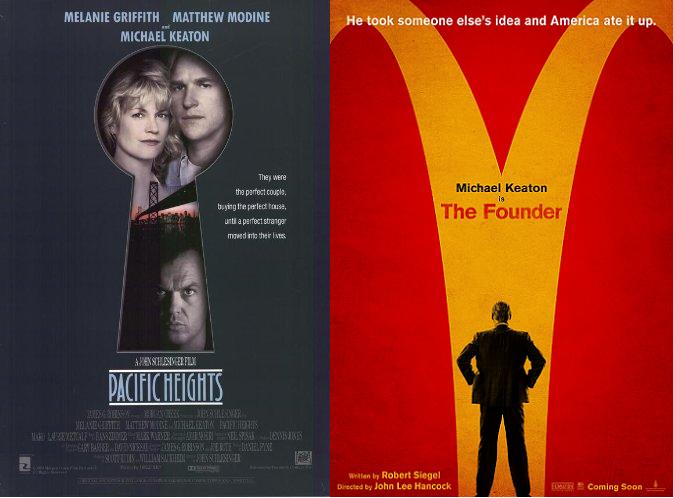
Pacific Heights + The Founder


PACIFIC HEIGHTS
(R, Twentieth Century Fox, 102 mins., theatrical release date: Sept. 28, 1990)

THE FOUNDER
(PG-13, The Weinsten Company, 115 mins., theatrical release date: Jan. 20, 2017)

P.T. Barnum couldn't have dreamed up someone like Michael Keaton. Ever since morgue mogul Billy Blaze scat-sang "Jumpin' Jack Flash" in Ron Howard's Night Shift, he could birth a sucker every 30 seconds, possibly even earlier, with his rapacious huckster's charisma. Having owned Beetlejuice and Batman for Tim Burton, Keaton certified his dramatic credentials with 1988's Clean and Sober, but it makes sense that after foiling Nicholson himself on screen, Keaton would cut his own swath at full-on villainy, recalibrating his jumpy charm towards nefarious purposes. Beetlejuice was a lovable louse compared to Carter Hayes from Pacific Heights, a black sheep who has built his own trust fund out of a series of real estate mind games, suggesting a squishy perversion of Keaton's persona.

Alas, Pacific Heights, which stood a chance at doing for psychotic tenants what The Stepfather did for Ward Cleaver wannabes, is just another hopelessly lurid cautionary tale for yuppies, detached and decaying when it should've slapped a new coat of paint on a promising pulp premise.

The latest marks Keaton sizes up for a fall are already in over their heads before the glad-handing even begins. First-time homeowners Drake Goodman (Matthew Modine) and Patricia Palmer (Melanie Griffith) whimsically put their collective savings into mortgaging and restoring a Victorian house in the titular San Francisco district. Their respective jobs crafting Oriental kites and training equestrians won't recover this $750,000 investment fast enough, so they start screening potential renters for a couple of downstairs rooms. At their luckiest, a humble Japanese couple, Mr. & Mrs. Watanabe (Mako, Nobu McCarthy), sign a year's lease and pony up their down payment.

But then along comes danger in a flashy Porsche, and he calls himself Carter Hayes.

A series of dopey mistakes on Drake's end simultaneously hands Carter the key to the studio apartment and plays right into Carter's shifty plans. Not only is his deceitful tenant withholding the security deposit and six months of rent he promised to wire (Drake takes it on faith simply through a flash of hundreds in Carter's wallet when they first meet), but Carter is dodging his landlords, carrying on rackets in the late hours and changing the lock. Drake cuts off the electricity to Carter's room, but it's a brief victory, as soon the police and the justice of peace are accusing Drake of tenant's rights abuse.

Carter seizes on this legal superiority to drive the Watanabes out of their agreement and instigate a row with Drake that results in a restraining order from the squatter evicting the landlord instead of vice versa. With no financial or lawful options left, it's up to Patty to save face and expose Carter for the deranged conman he is before the game begins again.

Screenwriter Daniel Pyne reportedly drew upon his own woes with a manipulative lodger, but by the formulaic finale, I'm sensing the rawness of his real-life situation informs Pacific Heights as deep as, say, Alan Shapiro demonstrated when he made The Crush a couple years later. Though juicy bundles of subtext and irony appear ripe for fermentation, Pyne and director John Schlesinger sour the wine through the rusty thriller mechanics which propel the material. They also grind the actors up and spit them out, too.

Matthew Modine's lack of formidability against Michael Keaton is played at such a hysterical pitch, it stomps on the notion that this is a good old-fashioned manly pissing contest. Drake's take-charge attitude is savagely undercut by the feet-shooting dialogue poor Modine has to bark instead of bargain with. Pyne's banal characterizations of Drake and Patty alike doesn't even ease let alone convince their reversal of power as the former blunders into an obvious trap and the latter composes herself after a miscarriage to be reborn as Nancy Drew. At least Griffith's retaliation has that sense of humor the sidelined Modine is denied in so many words.

The paltry chemistry and lack of genuine idiosyncrasy essentially cripple Modine and Griffith, who are strait-jacketed by the routine shenanigans of Pyne's script. They emerge as a couple of yuppie ciphers rather than relatable dreamers, which makes it all too easy for Keaton to steal the show. And although he is adept as can be, not even Keaton makes it out of Pyne's script with any true perception. The psychology of his character is boilerplate angst at best, a deprived child who preys on the gullible upper class and keeps white trash company in Luca Bercovici's handyman-from-hell and Beverly D'Angelo (unbilled) as a sex object. His schemes never really generate primal urgency, and John Schlesinger's workaday gloss is hardly worthy of De Palma let alone Hitchock or Polanski.

The saddest waste of talent certainly belongs to Schlesinger, and it's not a stretch to surmise the fade away of his once-great career began here, with Eye for an Eye and The Next Best Thing to follow. Shallow material defeats Schlesinger every time, and there's little he can do to give the proceedings any palpability. Whenever he tries to generate atmosphere, it emerges as window-dressing, gritty confinement traded in for gross conformity. When a camera circles around a desperate plea from Patty to her curt lawyer (Laurie Metcalf), it's all for nothing. Though he keeps the pacing taut, Pyne's feeble confrontations give him nothing to bite into. You long for the assurance of someone like Stephen Frears (The Grifters) or Phillip Noyce (Dead Calm) far too often, especially when Schlesinger's thematic malaise descends into tasteless clichés.

Aside from Griffith's giddy payback and an effective glimpse of Keaton shrouded in darkness, spinning a double-edged razor between his fingers, the fleeting pleasures come in the form of Tracey Walter's stymied Orkin man and Tippi Hedren, mother of Griffith herself, as perhaps the most charitable pillar of high society imaginable.

Alas, Pacific Heights is a terminal cheater of a psychological thriller, teasing every time the material threatens to develop an edge. From the way Drake pussyfoots around his unfounded, passively racist suspicions over a prospective tenant (Carl Lumbly, who as Lou Baker remains benevolent enough to let Drake crash with him after Carter files a restraining order) to the limp end-of-innocence coda, this is simply craven without the Wes (ever notice the difference between The Believers and The Serpent & The Rainbow?). For an actor as endearingly wicked as Michael Keaton, it's a shame Schlesinger and Pyne do not share his irrepressible knack for transgression. Instead, Pacific Heights represents the foreclosure of a scream.

Keaton's star power dried up in the 1990s, sadly, after one more round in the Batsuit and a slew of forgettable vehicles, the consensus nadir being 1998's Jack Frost. 2014's Birdman restored his fortunes, however, and he's since been on a roll thus far. The Founder adds to Keaton's second wind by once again revisiting the shyster grifter persona Keaton does so well and, unlike Pacific Heights, creating a more subtle malevolence that unspools enticingly as the film progresses and without trading in the grease gun for the nail gun.

The titular visionary is Ray Kroc, more of an opportunist than a creative genius when he franchised McDonald's away from its creators and settled into their legacy through cutthroat legal maneuvers. Keaton begins the film as pathetic as Willy Loman, but ends the film as a middle-aged Mark Zuckerberg, having successfully rammed the hose down the mouths of both Mac (John Carroll Lynch) and Dick McDonald (Nick Offerman) while the brothers drowned. All it took was one handshake and a trunk load of powdered milkshakes.

And persistence, as a Calvin Coolidge quote recited on self-help vinyl clues you early on before Kroc's epiphany, when the disgraced multi-mixer salesman is holed up in a motel room following another series of rejections. Kroc learns that someone out in San Bernardino has ordered eight of his units and capriciously rides Route 66 all the way out there to understand why such a demand. When he encounters the McDonald's restaurant for the first time, it's the California Gold Rush all over again. He's genuinely taken aback by the scene, where the food is prepped quicker and delivered with more accuracy than the drive-in joints he regularly frequents. He eats his combo meal on bench next to an all-American family instead of the familiar J.D. congregation. It's all too beautiful, and Kroc takes jolly Mac up on an offer for the grand tour.

Keaton's Kroc is spellbound by the brothers' post-Depression success story, as director John Lee Hancock (Saving Mr. Banks, The Blind Side) and writer Robert Siegel (The Wrestler, Big Fan) concoct a rapturous montage (added credit to editor Robert Frazen) of Dick working out the choreography and layout of the Speedee System of fast food preparation on a tennis court. And then comes Kroc's pitch in one word: "America." He looks at the painting of Dick's golden arches, an architectural coup which tanked in Phoenix, and vows to succeed at expanding McDonald's where the brothers were once as luckless as Kroc. This could be as much a symbol of family, community and patriotism as the church and the flag, and the McDonald brothers are sold, though not without the safety of a contract.

Kroc hustles to secure potential franchisees including country club friends, who unscrupulously run their locations into the ground with overcooked patties and overindulgent menus. It's clear to him that only love makes the Speedee System run efficiently, as he looks to his wife Ethel (Laura Dern) for inspiration she's too exhausted to provide. Kroc's ambitions eventually alienate him from Ethel as well as Dick & Mac, who shoot down every cost-cutting measure and unfair profit percentage he needs to float the empire. Also pivotal are chance encounters with Joan Smith (Linda Cardellini), the wife of a potential investor in Minnesota (Patrick Wilson), and business impresario Harry Sonneborn (B.J. Novak), each equipped with foolproof solutions to Kroc's financial straits.

Suffice to say that The Founder itself has been constructed much like a McDonald's burger. Hancock's direction is the bun, a warm 'n' golden if flavorless sandwich necessity. He films the story in such a straightforward way that it lends a certain ambiguity to Ray Kroc, neither self-righteously vilifying nor celebratory of his (mis)deeds. And this MOR approach works given the rest of the ingredients. Ketchup and mustard shots are added in the comparatively unfulfilling elements of Siegel's adept script, particularly the relationships Kroc has with Ethel and Joan. The former is given enough screen time to cook up a subdued, sensitive Laura Dern performance, though Linda Cardellini's presence as Joan feels like a scene is missing. The former Lindsay Weir has come a long way since those small fry days, and she is solid.

The pickles leave the clearest aftertaste, though, when the film focuses on the McDonald twins. You can practically savor the juice as much as John Carroll Lynch and Nick Offerman (sans that Ron Swanson mustache), pitch-perfect as homely entrepreneurs secure in the 8x10 frame whilst Kroc guns for the life-size statue. The integrity and fraternal humor between these bulky character actors is lip-smacking, which makes their betrayal all the more wrenching.

But you can't have a hamburger without the patty, which puts Michael Keaton in the sizzling center of this confection. 35 years after coming up with the idea of edible paper in Night Shift ("Is this a great country, or what?"), there's still a wild man in this ol' warhorse. In a world where our current president is a ruthless, ethically-perverted businessman but also a raging imbecile, Keaton's entertaining/enervating acumen is as refreshing as a McFlurry. This is a dramedic performance that is, by design, its own wicked pitch, and when people can be fanatically conned by lesser men, Keaton's "Founder" is grade-A all-American beef.

Against all odds, The Founder not only goes down (and comes back out) appetizingly, it sticks in your teeth. Now if you'll excuse me, I need to get these toothpicks out my back.