I LOVE YOU TO DEATH
(PG-13, Tri-Star Pictures, 97 mins., theatrical release date: Apr. 6, 1990)
Aside from Marisa Tomei, Kevin Kline is one of the last Oscar recipients I can think of to be rewarded for his comedic prowess. In 1989, he won Best Supporting Actor as the blustery Otto from A Fish Called Wanda, where he breathed lustily from Jamie Lee Curtis' boot, insulted the "so superior" British every opportunity he could and gulped down Michael Palin's beloved aquarium, fin by fin. An impulsive, imperialist cad whose self-delusional claims of great intellect where debunked by his shapely partner-in-crime Curtis, Kline's portrayal of Otto remains the high mark for unctuous invention in the farcical game.
Kline's first role since nabbing that trophy doubles down on Otto's buffoonish machismo. I Love You to Death, which reunited him with director Lawrence Kasdan (The Big Chill, Silverado) and paired him with River Phoenix (whose performance in Running on Empty was also in the running when Kline won), casts him as Joey Boca, a swarthy pizzeria owner who is introduced confessing to a priest his sin of adultery, committed twice in one week. Or was it four times with two women? But what about the four women last week? Best to round it off at a dozen give or take a couple of times, which he makes up promptly by bedding both Victoria Jackson and Phoebe Cates (Kline's wife in an uncredited cameo).
Joey Boca sees neither harm nor foul in his indiscretions, simply an extension of the American dream which finds him at one point a good-natured family man and the next a lusty hedonist. "I'm a man," he tells Jackson's Lacey in a post-coital rationalization, "I got a lotta hormones in my body." His wife, Rosalie (Tracey Ullman), is dutiful and headstrong in her own way, but in denial herself. To her, Joey's merely flirting, despite the concern of smitten pizzeria co-worker Devo Nod (Phoenix), who catches Joey on the phone with a mistress, fondling pizza dough with all the sensuality he reserves for female flesh.
That Rosalie will discover the truth about Joey's routine plumbing excursions is unavoidable, but her thirst for revenge in the aftermath, deciding on murder as a suitable punishment on the advice of her tabloid junkie of a Mama Nadja (Joan Plowright), is a little less predictable. Joey is too full of life and marinara sauce for a first-degree consummation of "'til death do us part."
As scripted by John Kostmayer, I Love You to Death was inspired by the well-publicized case of Frances Toto from Allentown, PA, whose five unsuccessful attempts on her oafish hubby Tony's life were quickly forgiven by the husband, who went so far as to raise the $50,000 bail money to keep his family together. Though Frances was prosecuted and jailed for four years, they stuck together after her release and remain, to this day, a happy couple.
Kostmayer and Kasdan translate this incredible true story as a combination of ethnic comedy and black comic farce which could be pitched as "Moonstruck on the Verge of a Nervous Breakdown." But the result is far shaggier than either Jewison or Almodovar demonstrated, the zippy energy expected of screwball comedies traded in for the appeal of the various characters and their respective performances. Luckily for Kasdan, he's assembled a surplus of talent to keep the picture going even when the proceedings threaten to peter out.
Opposite the physically robust and carefully caricatured Kline, the equally talented Tracey Ullman opts for a warmer characterization of the cuckolded Rosalie. It's a valiantly humanized effort on her part, as there's nothing particularly funny about the epiphany Rosalie experiences while stopping at the library and her subsequent breakdown in a restroom. She's also an effective median given that Ullman is flanked by the loud presences of clown Kline and joker Joan, and not just in a particularly funny bilingual argument between Joey and Nadja during a public dinner.
Ullman's dedicated personification teases out the black comedy with ease. As scorned as she is, she hopelessly loves Joey enough to opt for a painless way out for her paramour.
Joan Plowright, meanwhile, lives up to her surname as Rosalie's mom, a feisty crone who just has to listen to Johnny Mathis when asked to put on a record to drown out a gunshot and inaugurates the first attempted hit on Joey with a family friend, paying him in cookies and speaking like the Serbian Marla Brando. The favor is accepted by the reluctant assassin, who bumbles into Joey's backyard with a baseball bat and ill-fitting Abe Lincoln mask and just as swiftly chickens out.
Just as inept in their services are Devo, too sensitive to fire a pistol despite having a brother in the Marines, and the supposed pros he hires to finish the job, lowlife cousins Harlan and Marlon James. While River Phoenix is comically spacey as Devo, William Hurt (another of Kasdan's good luck charms) and Keanu Reeves go even farther out there as the druggie James boys, dimwitted and amusingly unkempt casualties of their respective generations. Their banter is marked with pregnant pauses, slow-on-the-uptake realizations and general imbecility. They can't even locate Joey's heart without remembering, and then butchering, the Pledge of Allegiance.
Even Miriam Margolyes, who as Mama Boca arrives late in the game to beat Joey into shame, makes her single minute onscreen an uproarious delight.
The combined talents of this ensemble, all of whom are precise players (even Keanu Reeves, who is as smart being stupid here as Ted Logan), works strange magic onto the screenplay, which draws out the madcap murder games like it was simmering a pot full of spaghetti sauce to a roiling bubble, with Kline stumbling in as flesh-and-blood punchline. It's not particularly accommodating to certain character motivations, and the somnolent pacing isn't rewarded by much of a finale, which departs drastically from the facts of the Toto case for a rousing reconciliation.
And yet Kline remains sublime even when Joey is dosed with two bottles of barbiturates and takes a bullet clear through his chest. It just makes him all the more genial, in a bizarre way, as he offers Harlan & Marlon cheese and crackers with a pale, bleary face. Even when his Italian accent is laid on so thick that you'd expect him to suggest breadsticks, Kline is a physical marvel throughout the movie. Just the way he acts with his hinder is enough to put Jim Carrey to shame.
Kasdan and Kostmayer go lax with the pacing in ways that grossly simplify what should have been a crackerjack comedy of unreliable manners, their conclusion aiming too hard at achieving audience goodwill. If you don't get as much of a kick out of Hurt and Reeves like I do, their shenanigans will slow the procession down even as Ullman's and Plowright's energies barrel on. I Love You to Death has a piping hot ensemble yet a curiously undercooked slab of dough supporting them. Still, it got zestier laughs out of me than most of the retro comedies I've endured, so maybe it will come full circle in the future. Mama Nadja says it best: “I like you once. Maybe someday I like you again."
THE FOUNDER
(PG-13, The Weinsten Company, 115 mins., theatrical release date: Jan. 20, 2017)
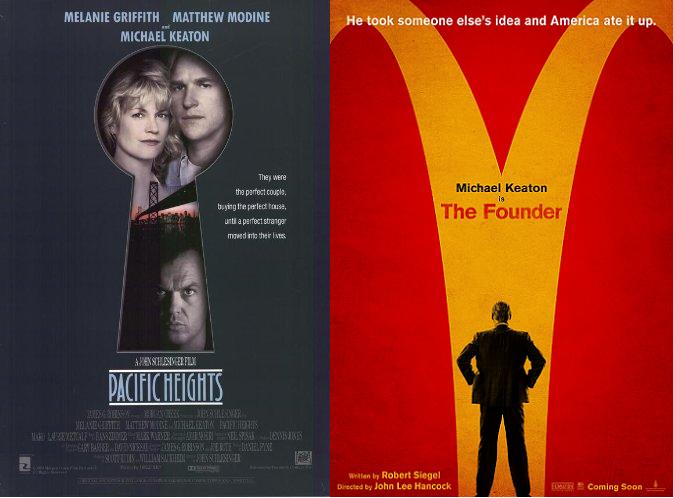
P.T. Barnum couldn't have dreamed up someone like Michael Keaton. Ever since morgue mogul Billy Blaze scat-sang "Jumpin' Jack Flash" in Ron Howard's Night Shift, he could birth a sucker every 30 seconds, possibly even earlier, with his rapacious huckster's charisma. Having owned Beetlejuice and Batman for Tim Burton, Keaton certified his dramatic credentials with 1988's Clean and Sober, but it makes sense that after foiling Nicholson himself on screen, Keaton would cut his own swath at full-on villainy, recalibrating his jumpy charm towards nefarious purposes. Beetlejuice was a lovable louse compared to Carter Hayes from Pacific Heights, a black sheep who has built his own trust fund out of a series of real estate mind games, suggesting a squishy perversion of Keaton's persona.
Alas, Pacific Heights, which stood a chance at doing for psychotic tenants what The Stepfather did for Ward Cleaver wannabes, is just another hopelessly lurid cautionary tale for yuppies, detached and decaying when it should've slapped a new coat of paint on a promising pulp premise.
The latest marks Keaton sizes up for a fall are already in over their heads before the glad-handing even begins. First-time homeowners Drake Goodman (Matthew Modine) and Patricia Palmer (Melanie Griffith) whimsically put their collective savings into mortgaging and restoring a Victorian house in the titular San Francisco district. Their respective jobs crafting Oriental kites and training equestrians won't recover this $750,000 investment fast enough, so they start screening potential renters for a couple of downstairs rooms. At their luckiest, a humble Japanese couple, Mr. & Mrs. Watanabe (Mako, Nobu McCarthy), sign a year's lease and pony up their down payment.
But then along comes danger in a flashy Porsche, and he calls himself Carter Hayes.
A series of dopey mistakes on Drake's end simultaneously hands Carter the key to the studio apartment and plays right into Carter's shifty plans. Not only is his deceitful tenant withholding the security deposit and six months of rent he promised to wire (Drake takes it on faith simply through a flash of hundreds in Carter's wallet when they first meet), but Carter is dodging his landlords, carrying on rackets in the late hours and changing the lock. Drake cuts off the electricity to Carter's room, but it's a brief victory, as soon the police and the justice of peace are accusing Drake of tenant's rights abuse.
Carter seizes on this legal superiority to drive the Watanabes out of their agreement and instigate a row with Drake that results in a restraining order from the squatter evicting the landlord instead of vice versa. With no financial or lawful options left, it's up to Patty to save face and expose Carter for the deranged conman he is before the game begins again.
Screenwriter Daniel Pyne reportedly drew upon his own woes with a manipulative lodger, but by the formulaic finale, I'm sensing the rawness of his real-life situation informs Pacific Heights as deep as, say, Alan Shapiro demonstrated when he made The Crush a couple years later. Though juicy bundles of subtext and irony appear ripe for fermentation, Pyne and director John Schlesinger sour the wine through the rusty thriller mechanics which propel the material. They also grind the actors up and spit them out, too.
Matthew Modine's lack of formidability against Michael Keaton is played at such a hysterical pitch, it stomps on the notion that this is a good old-fashioned manly pissing contest. Drake's take-charge attitude is savagely undercut by the feet-shooting dialogue poor Modine has to bark instead of bargain with. Pyne's banal characterizations of Drake and Patty alike doesn't even ease let alone convince their reversal of power as the former blunders into an obvious trap and the latter composes herself after a miscarriage to be reborn as Nancy Drew. At least Griffith's retaliation has that sense of humor the sidelined Modine is denied in so many words.
The paltry chemistry and lack of genuine idiosyncrasy essentially cripple Modine and Griffith, who are strait-jacketed by the routine shenanigans of Pyne's script. They emerge as a couple of yuppie ciphers rather than relatable dreamers, which makes it all too easy for Keaton to steal the show. And although he is adept as can be, not even Keaton makes it out of Pyne's script with any true perception. The psychology of his character is boilerplate angst at best, a deprived child who preys on the gullible upper class and keeps white trash company in Luca Bercovici's handyman-from-hell and Beverly D'Angelo (unbilled) as a sex object. His schemes never really generate primal urgency, and John Schlesinger's workaday gloss is hardly worthy of De Palma let alone Hitchock or Polanski.
The saddest waste of talent certainly belongs to Schlesinger, and it's not a stretch to surmise the fade away of his once-great career began here, with Eye for an Eye and The Next Best Thing to follow. Shallow material defeats Schlesinger every time, and there's little he can do to give the proceedings any palpability. Whenever he tries to generate atmosphere, it emerges as window-dressing, gritty confinement traded in for gross conformity. When a camera circles around a desperate plea from Patty to her curt lawyer (Laurie Metcalf), it's all for nothing. Though he keeps the pacing taut, Pyne's feeble confrontations give him nothing to bite into. You long for the assurance of someone like Stephen Frears (The Grifters) or Phillip Noyce (Dead Calm) far too often, especially when Schlesinger's thematic malaise descends into tasteless clichés.
Aside from Griffith's giddy payback and an effective glimpse of Keaton shrouded in darkness, spinning a double-edged razor between his fingers, the fleeting pleasures come in the form of Tracey Walter's stymied Orkin man and Tippi Hedren, mother of Griffith herself, as perhaps the most charitable pillar of high society imaginable.
Alas, Pacific Heights is a terminal cheater of a psychological thriller, teasing every time the material threatens to develop an edge. From the way Drake pussyfoots around his unfounded, passively racist suspicions over a prospective tenant (Carl Lumbly, who as Lou Baker remains benevolent enough to let Drake crash with him after Carter files a restraining order) to the limp end-of-innocence coda, this is simply craven without the Wes (ever notice the difference between The Believers and The Serpent & The Rainbow?). For an actor as endearingly wicked as Michael Keaton, it's a shame Schlesinger and Pyne do not share his irrepressible knack for transgression. Instead, Pacific Heights represents the foreclosure of a scream.
Keaton's star power dried up in the 1990s, sadly, after one more round in the Batsuit and a slew of forgettable vehicles, the consensus nadir being 1998's Jack Frost. 2014's Birdman restored his fortunes, however, and he's since been on a roll thus far. The Founder adds to Keaton's second wind by once again revisiting the shyster grifter persona Keaton does so well and, unlike Pacific Heights, creating a more subtle malevolence that unspools enticingly as the film progresses and without trading in the grease gun for the nail gun.
The titular visionary is Ray Kroc, more of an opportunist than a creative genius when he franchised McDonald's away from its creators and settled into their legacy through cutthroat legal maneuvers. Keaton begins the film as pathetic as Willy Loman, but ends the film as a middle-aged Mark Zuckerberg, having successfully rammed the hose down the mouths of both Mac (John Carroll Lynch) and Dick McDonald (Nick Offerman) while the brothers drowned. All it took was one handshake and a trunk load of powdered milkshakes.
And persistence, as a Calvin Coolidge quote recited on self-help vinyl clues you early on before Kroc's epiphany, when the disgraced multi-mixer salesman is holed up in a motel room following another series of rejections. Kroc learns that someone out in San Bernardino has ordered eight of his units and capriciously rides Route 66 all the way out there to understand why such a demand. When he encounters the McDonald's restaurant for the first time, it's the California Gold Rush all over again. He's genuinely taken aback by the scene, where the food is prepped quicker and delivered with more accuracy than the drive-in joints he regularly frequents. He eats his combo meal on bench next to an all-American family instead of the familiar J.D. congregation. It's all too beautiful, and Kroc takes jolly Mac up on an offer for the grand tour.
Keaton's Kroc is spellbound by the brothers' post-Depression success story, as director John Lee Hancock (Saving Mr. Banks, The Blind Side) and writer Robert Siegel (The Wrestler, Big Fan) concoct a rapturous montage (added credit to editor Robert Frazen) of Dick working out the choreography and layout of the Speedee System of fast food preparation on a tennis court. And then comes Kroc's pitch in one word: "America." He looks at the painting of Dick's golden arches, an architectural coup which tanked in Phoenix, and vows to succeed at expanding McDonald's where the brothers were once as luckless as Kroc. This could be as much a symbol of family, community and patriotism as the church and the flag, and the McDonald brothers are sold, though not without the safety of a contract.
Kroc hustles to secure potential franchisees including country club friends, who unscrupulously run their locations into the ground with overcooked patties and overindulgent menus. It's clear to him that only love makes the Speedee System run efficiently, as he looks to his wife Ethel (Laura Dern) for inspiration she's too exhausted to provide. Kroc's ambitions eventually alienate him from Ethel as well as Dick & Mac, who shoot down every cost-cutting measure and unfair profit percentage he needs to float the empire. Also pivotal are chance encounters with Joan Smith (Linda Cardellini), the wife of a potential investor in Minnesota (Patrick Wilson), and business impresario Harry Sonneborn (B.J. Novak), each equipped with foolproof solutions to Kroc's financial straits.
Suffice to say that The Founder itself has been constructed much like a McDonald's burger. Hancock's direction is the bun, a warm 'n' golden if flavorless sandwich necessity. He films the story in such a straightforward way that it lends a certain ambiguity to Ray Kroc, neither self-righteously vilifying nor celebratory of his (mis)deeds. And this MOR approach works given the rest of the ingredients. Ketchup and mustard shots are added in the comparatively unfulfilling elements of Siegel's adept script, particularly the relationships Kroc has with Ethel and Joan. The former is given enough screen time to cook up a subdued, sensitive Laura Dern performance, though Linda Cardellini's presence as Joan feels like a scene is missing. The former Lindsay Weir has come a long way since those small fry days, and she is solid.
The pickles leave the clearest aftertaste, though, when the film focuses on the McDonald twins. You can practically savor the juice as much as John Carroll Lynch and Nick Offerman (sans that Ron Swanson mustache), pitch-perfect as homely entrepreneurs secure in the 8x10 frame whilst Kroc guns for the life-size statue. The integrity and fraternal humor between these bulky character actors is lip-smacking, which makes their betrayal all the more wrenching.
But you can't have a hamburger without the patty, which puts Michael Keaton in the sizzling center of this confection. 35 years after coming up with the idea of edible paper in Night Shift ("Is this a great country, or what?"), there's still a wild man in this ol' warhorse. In a world where our current president is a ruthless, ethically-perverted businessman but also a raging imbecile, Keaton's entertaining/enervating acumen is as refreshing as a McFlurry. This is a dramedic performance that is, by design, its own wicked pitch, and when people can be fanatically conned by lesser men, Keaton's "Founder" is grade-A all-American beef.
Against all odds, The Founder not only goes down (and comes back out) appetizingly, it sticks in your teeth. Now if you'll excuse me, I need to get these toothpicks out my back.
Under the Cherry Moon, Prince's directorial debut from 1986, was a tough movie to evaluate. I can't possibly give the movie any higher than three out of five stars, which is still kinder than anyone who caught it first-run (excepting J. Hoberman). I watched it multiple times in the wake of Prince's passing and struggled to come up with some kind of critical closure. There's a part of me that really admires Prince for playing up both his glamour and humor, as well as championing Jerome Benton, but I felt something close to nothing towards the coupling of Prince and Kristin Scott Thomas. It didn't live up to the standards Prince set as a musician, but I could at least see it as a lark, and it provided more entertainment than I get from most vanity projects.
The term "vanity project" seems like an oxymoron if you watch enough movies in your lifetime. These days, I even take it as given. Aren't all movies "vanity projects" in one way or another? A writer or director clearly has a point-of-view which they are trying to sell a viewer, frivolous or not. It defines the performances, dictates the wide spectrum of aesthetics and is self-important enough to attract financing and marketing to goad someone into a screening. This is how auteur theories start, when you realize a filmmaker is directly selling you his perspective, sometimes often enough that they become themes. To me, it doesn't become damning until a filmmaker's display of ego is devoid of almost all niceties as wit, style, intelligence, empathy, or just plain amusement.
Which brings me to Prince's Graffiti Bridge, his second and final go at movie directing and one in which he branches out to screenwriting. In the wake of Under the Cherry Moon's mass rejection, this was as straightforward a follow-up to Purple Rain as most people wanted from Prince. It's once again centered around musical and romantic competition between a serious artist and a shameless underling, Prince's "The Kid" and Morris Day as...er, Morris Day. The film's soundtrack was again almost single-handedly attributable to Prince. There are return appearances from Jill Jones (this time as a fickle lover who breaks up with The Kid by removing her panties in public), imaginary letters to the father who "took the easy way out" and a ballad-heralding finale ("Still Would Stand All Time"). It would be the safest possible successor to Purple Rain were it not for the existence of Under the Cherry Moon as well as the fact that in 1990, things were much different for Prince in the six years since his cultural dominance.
By order of the Paisley prophet, The Revolution, Prince's backing band, were no more by the end of 1986, as were Morris Day & The Time. Much like Pete Townshend's Lifehouse/Who's Next, an entire concept for an album ("Dream Factory") was abandoned and the resulting song cycle streamlined into what became the brilliant double-LP Sign o' the Times. Prince was ready to throw another curve in the form of The Funk Bible/Black Album, which was infamously recalled a week before release in a drug-induced epiphany of conscience and replaced soon enough with Lovesexy, which The Artist himself considered "a gospel album." But Prince's commercial prospects were diminishing, with lead single "Alphabet St." climbing as high as #8 U.S. in the summer of 1988 and then dropping swiftly. The A-sides to follow ("Glam Slam," "I Wish U Heaven") tanked. Lovesexy eked out mere Gold-certifiable sales by the end of the year.
Prince was falling behind the popular times as 1989 arrived, especially upon the arrival of what was called "new jack swing," a forceful new R&B sound driven by hip-hop technology. Incidentally, it was former Time members Jimmy Jam & Terry Lewis who pioneered this sound with Janet Jackson's Control (and later Rhythm Nation 1814), which was taken over the top by genre-defining producer Teddy Riley, particularly through collaborating with Bobby Brown on Don't Be Cruel. Janet and Bobby both made forceful proclamations of independence ("What Have You Done for Me Lately," "My Prerogative") and full-on bangers ("Miss You Much," "Every Little Step") under the new jack swing sound, eclipsing Prince's star in the process.
His rebuttal, as quoted from the opening verse of the first song heard in Graffiti Bridge: "Pardon me for living, but this is my world, too."
This is from the defensive "New Power Generation," one of the few tracks written expressly for Graffiti Bridge and the name of Prince's early 1990s backing group, making their debut here. It's Prince's own "My Prerogative" in sound and attitude, showing that he clearly absorbed the "brand new funk" which he instigated through Minneapolis brethren Jam & Lewis. Issued as the third single of Graffiti Bridge's soundtrack, it trailed in the wake of two more successful predecessors, "Thieves in the Temple" and the Tevin Campbell-sung "Round and Round." These were the other debut compositions Prince wrote, as the remainder of Graffiti Bridge's soundtrack had existed in some form, spanning as far back as 1981's Controversy ("Tick, Tick, Bang") to the aborted "comeback" album for The Time, Corporate World, which, like their past releases, was simply Morris Day singing over Prince's music & lyrics (the actual band wouldn't write/play their own material on record until Corporate World was overhauled to become 1990's Pandemonium).
But Prince's multi-instrumental dominance was already made plain on the evidence of the Purple Rain and Parade soundtracks. Graffiti Bridge is historical in Prince's timeline because it is his one and only filmed screenplay (recall that Purple Rain director Al Magnoli co-wrote it with William Blinn and Under the Cherry Moon was penned by Becky Johnston). Originally written with Madonna in mind in the fall of 1987, the unfortunate star of Shanghai Surprise and Who's That Girl rejected the first draft with outright disgust. After courting Kim Basinger during the Batman blitz, Prince reconfigured the film for Vicki Vale herself, but they separated in early 1990. The shooting script was finalized a month later with a new romantic lead in Ingrid "The Spirit Child" Chavez, Prince's companion/muse for the Lovesexy and co-writer of Madonna's 1991 breathy chart-topper "Justify My Love" opposite Lenny Kravitz, whom Chavez sued for muscling her out of a credit.
More than Prince or Chavez, Graffiti Bridge is perhaps best appreciated as a vehicle for the reassembled original line-up of The Time, Jam & Lewis included. The New Power Generation's B-boy gallery can't help but look anonymous against these flashy funksters, whose sassy party-starters are in direct combat with The Kid's more "spiritual noise." The plot of the movie is your basic bad vs. evil showdown: Morris Day is elevated to Big Boy Caprice-level villainy as owner of the Pandemonium club and shareholder of The Kid's Glam Slam hangout, whose patrons are driven away by the less carnal "Love God" messages in The Kid's jams. As Morris extorts, vandalizes and continually one-ups him, The Kid finds solace in a hard knock seraph named Aura (Chavez) and her equally mystical prolix. "It's just around the corner" is her spectral advice, referring to The Kid's potential for redemption and victory.
Having buried his farcically aggressive Christopher Tracy persona from Under the Cherry Moon, Prince straightens out his curls and stubbles up on his glowering Purple Rain presence. He goes from abnormally charismatic to blankly enigmatic in the process, a narcissistic void best filled with production numbers. Prince gets a couple of great moments, particularly the alleyway gyrations of "Thieves in the Temple" and the desperate lust of "Tick, Tick, Bang," but he serves Morris Day & The Time two annihilators with "Release It" and "Shake" (the latter is not a Sam Cooke cover, but rather the missing link between ? & The Mysterians and The Dust Brothers). The fifth highlight belongs to Tevin Campbell, 13 at the time and previously scouted for Quincy Jones' Back on the Block album. He beat Kris Kross and Another Bad Creation to the punch with a confident delivery of the irresistible "Round and Round" (sadly, Tevin vanishes from the film afterwards). His mom, Melody Cool, played by gospel-soul legend Mavis Staples, finds her own tavern's financial assets coveted by Morris as much as those of the man behind the Clinton Club (guess who!).
With its central conflict involving the owners of four different clubs, Graffiti Bridge lives up to its promise as a musical. The problem is that, compared to the performances in Purple Rain, Prince the director approaches them like generic music videos, complete with rudimentary framing/editing techniques, scads of women dancing in cages (including Robin Power, Morris Day's statuesque girlfriend, who is better flattered in the glow of strobe lights) and egregious lip-synch fails. Despite the combined showman powers of Prince and Morris Day, a majority of their performances tend to fall back on flash at the expense of passion. "Thieves in the Temple" and "Round and Round" prove exceptions by going outside the club milieu, as well as showcasing Prince and Tevin Campbell's respective talents. But as fine as the soundtrack is (even with a lyric like "I'm testing positive for the funk/I'll gladly pee in anybody's cup"), Prince can't get the music to explode off the screen the way Purple Rain did over and over again.
There's also the chemistry problem from Under the Cherry Moon come back to haunt Graffiti Bridge, too. Whereas Kristin Scott Thomas at least proved a game foil for Prince's arrogance, Ingrid Chavez's character is explicitly a plot device, a ponderous pixie as light as the white feather she carries around. Even before the character experiences a clumsily-crafted "noble sacrifice" under the wheels of a runaway Jeep, Aura's attempts to give the movie a New Age gravity is likely to stir cynicism, especially when saddled with Prince's wishy-washy characterization and prattling prose. Put this deficiency next to a one-note Prince performance and the result is more superficial than spiritual.
In all fairness, I do not doubt Prince was genuinely trying to create a soulful but sexy plea for brotherhood and sanctification. And much like Under the Cherry Moon, there are plenty of entertaining moments to be gleaned, especially whenever Morris Day glides onto the screen. He's the callous hotshot elevated to Fool, if you get my drift, fumbling a pose by the Porsche, passing around a jar of hot peppers to test his lackeys' fealty or engaging in a "Dueling Banjos"-scored cash contest with right-hand man Jerome Benton. There's even a gay panic gag which slightly works because of Morris and Jerome's extended bug-eyed awkwardness (only for them to retch the laughter away). These are such crack comic talents, even Kevin Smith can recognize.
But Graffiti Bridge is ultimately Prince's vision, first and foremost, and the flow is treacherous. All of his eccentricities, personality shifts and single-minded visions are aired out in this movie even more than in his two previous vehicles. With its back lot recreation of Minneapolis' Seven Corners and Grease/Can't Stop the Music vet Bill Butler's cinematography, Graffiti Bridge posits a waifish-looking Prince as clubland's Saviour, but it's his boundless gifts as a musician/songwriter rather than his limitations as writer/director/actor that convinces you of such. Thus Graffiti Bridge makes a greater impression as a compilation album than a coherent movie, and once Prince devoted himself full-time to music afterwards, even if it meant crusading against Warner Brothers with "slave" on his cheek, his discography truly became his gospel.
And it is through these equally personal but far more soulful and frisky chapters of Prince's career (yes, that includes Emancipation and The Rainbow Children as well as his post-Musicology public revival) which I best recommend you honor the legacy of Prince. Visit the Tidal store and ride the wave of faith. But seek out Graffiti Bridge at your own peril, for it's enough to test your faith in the existence of angels.
This is an Orlando-shot killer monkey film with the name Shakma.
Shakma!
Shakma!!
Watch the monkey get hur...
No, I promised myself I wouldn't reference a certain Peter Gabriel song which was previously the opening credits music for another film about scared simians. There's more that needs to be said about this film than just a mere slam-dunk, MST3k-style allusion. God help me to hold out long enough to find the right words to discuss Shakma, of all things.
Well, first off, the film's alternate, international title is Panic in the Tower, whose cover art superimposes a shrieky monkey over what appears to be the Nakatomi Plaza. That gives the impression that the movie makes cunning use of its particular architectural coup, which is something that does not happen at all throughout the 100 minutes of this lame attempt at a Showtime original movie. At no point does the mad mandrill chase its victims through ventilation ducts or up to some cryptic, undiscovered floor of the building. The monkey doesn't corner anyone on the roof, which seems wrong considering it's a vital cliché for a movie of such stunning originality as Shakma.
It's just a group of people forever stuck on the fourth floor, no climbing or swinging required. You could almost call it existential given how restless the movie makes you feel.
Secondly, the filmmakers went to the trouble of casting a credited animal performer named Typhoon the Baboon. Sadly, he never would act again before or after this, but he fares better than his slumming homosapien co-stars, among them Ape-man Roddy McDowall and Blue Lagoon maroon Christopher Atkins, going from Beaks to Cheeks. The method acting going in Typhoon's primitive brain whenever he hurls himself against a door, which comprises much of his role, is a wonderful thing. Compare him to Roddy McDowall, who appears to have been in the early stages of Alzheimer's throughout. At least he's not living the self-fulfilling prophecy of standing idly by as a demented madman in a ski mask runs around, hacking up young virgins.
There's also Amanda Wyss and Ari Meyers as the dueling eye candy, Wyss being Atkins' primary love interest and Meyers the infatuated younger girl, respectively. Amanda Wyss has the edge because she was involved in three seminal 1980s films: Fast Times at Ridgemont High, A Nightmare on Elm Street and Better Off Dead... The former Kate & Allie teen starlet, meanwhile, went from playing Al Pacino's fictional daughter in the overlooked Author! Author! to starring alongside The Barbarian Brothers and a chicken bone. And I also kept confusing her with Lori Loughlin.
Shakma begins with some tender scenes of graphic brain surgery, no doubt intended to shock you to life (sorry), but also to introduce us to Roddy McDowall as Dr. Sorenson, chief of staff for the medical school situated in this ten-story office building meant to be a tower. Sorenson and his charges also apparently have a proud weekend tradition involving a Dungeons & Dragons-style LARP game called "Nemesis," where they adopt secret identities and wander aimlessly throughout the rooms collecting clues to help rescue the princess situated on the fifth floor, like they're Gleep Glop and the Floopty-Doos.
Enter the monkey in the wrench, Shakma, the titular baboon who reacts harshly to having his naked brain injected with corticotropin. He attacks the students, drawing blood from one of them, and is sedated by his trainer Sam (Atkins) before Sorenson arrives in a fit of exasperation and demands Shakma be put to sleep. Sam realizes he made a mistake by injecting the wrong substance into his prized pet, but shrugs it off and decides to let the resident lackey Richard (Greg Flowers) dispose of the damned, dirty ape.
Vague statements of scientific purpose aside, the game remains on, with Richard's sister Kimberly (Meyers) playing the fair maiden and Sorenson as the Game Master, tracking their progress through homing devices and walkie-talkie updates. The players in this case are Sam, his feisty girlfriend Tracy (Wyss), token black Gary (Robb Morris), and noxious nerd Bradley (Tre Laughlin), who sounds like the Comic Book Guy doing a John Malkovich impression.
But Shakma is far from dead, which Bradley learns the hard way when he goes into the specimen room to find Shakma having killed and/or eaten nearly all the caged critters before experiencing a fatal monkey pile. Sorenson sends Richard to investigate, and he too gets assaulted by Shakma despite arming himself with a glass of hydrochloric acid. Sorenson leaves his post to discover Richard's melted corpse, but cannot hitch an elevator ride to safety in time before he gets his own demise. This leaves Sam and Tracy to ponder all manner of failed distractions and escape plans, with Shakma poised to attack around virtually every corner.
Did I mention that this simian slasher film takes up 100 minutes of film? That's nearly two hours of screen time, all in the service of a thinly-plotted excuse for bloodletting which is as mediocre in its supposed scares as it is presenting the contrived scenario which isolates the various characters. It runs about as long as either King Kong Lives or Link, only without the bracingly apeshit inanity of either film. Shakma just dawdles along in its dumbness, especially in the overlong attempts of its erstwhile heroes to take charge of a situation that should not be so difficult to control.
The situation is that Sorenson has locked up the entire building, including every office where a phone may be conveniently accessed, and apparently even the windows prove inconvenient for any rescue. All this for a silly LARP more than any sense of security. Whenever Sam suggests escaping from the ground floor or Tracy produces a strobe light, the results fizzle out ridiculously. A tremendous deal of the chasing involves the duo holding the stairwell door closed as Shakma bounces repeatedly off it before scampering away. The only real moment of tension is when Tracy hides herself in a wooden bureau, Shakma clawing away murderously, but even this is defused by Sam's utter impotence as a hero, something which the finale tries to subvert by activating his own primal instincts, but instead provokes half-hearted chuckles much like the rest of the endeavor.
You'd think there would be some kind of novelty to a baboon as bogeyman, but directors Hugh Parks (another cautionary tale in exploitation history) and Tom Logan fail to capitalize. With the exception of the acid-burned Richard, Shakma's pouncing upon the human cast is dull and reliant on big reveals rather than bloody wrestling (the scenes of which you do get are reliably laughable). Furthermore, given how many times it tries to break through the stairwell door, you wonder how come Shakma's doesn't lose an arm in the struggle, or at least experience some minor injury when confronted with acid. Even the allegedly trained monkey doesn't appear to be directed properly, which further discredits the supposed bond between Sam and Shakma.
Poor Christopher Atkins, a frequent Razzie regular (A Night in Heaven, Listen to Me) who was even up for the "Worst New Star of the Decade" prize the year Shakma was released, makes for a bland male lead, routinely overshadowed by Typhoon as well as the likes of the charming Amanda Wyss (who gets away with the movie's crowning achievement in dopey dialogue with the line "You are sooo male!") and the coasting Roddy McDowall. The rest of the cast is wholly negligible given how keen the movie is to have them bumped off, which could constitute a series of mercy killings given how much color they add to the proceedings, if only the film weren't so boring.
The trailer for Shakma, however, is truly legendary. Not only does it compact the essence of the main characters in a tighter way than the movie proper, but the Percy Rodrigues stand-in doing the narration really goes bananas by the end. I mean, seriously..."Christopher Atkins, two-time winner of the National Association of Theatre Owners' 'Star of the Year' award, first for Blue Lagoon, now for Shakma." You don't even have to watch this amateurishly-edited preview to ask yourself, "What theaters did this ever play in?" But I recommend you do...
GREMLINS 2: THE NEW BATCH
(PG-13, Warner Bros. Pictures, 106 mins., theatrical release date: June 15, 1990)
In the 35 years since his solo directorial debut with 1978's Piranha, Joe Dante proved himself to be one of the most lovable anarchists in the cinema biz. His imagination is the product of both a garrulous, genuine love of film and the puckish, feverish invention of a Warner Bros. studio animator. Under Roger Corman's employment and Allan Arkush's partnership, he proved he could sell New World Pictures' line of B-movies with shrewd, demented glee. Even better was when Dante got the chance to make his own independent, irreverent fan favorites like Piranha and The Howling. And then Steven Spielberg, the man Dante was once tasked to rip off, saw his potential and started him small with a segment of Twilight Zone: The Movie, which finally led him to the blockbuster promised land that was 1984's Gremlins.
Naturally, the sadistic suburban chaos of that anti-Christmas classic proved a tough act to commodify. Neither Dante nor Spielberg were satisfied with the many half-baked treatments sent their way, not that Dante expressed much interest in a sequel to begin with. Desperation caused Warner Bros. to approach Dante with the ultimate enticement for any artist, the lure of total "creative control." I can only imagine the great, Grinch-y grin which graced Dante's mug, as that same mischievous smile was what I got numerous times watching that long-delayed sequel, 1990's Gremlins 2: The New Batch.
The studio was angling for a summer hit to compete with Disney and Dick Tracy, but Dante's flick wasn't the underdog success story you wished it would be. Gremlins 2 grossed merely a third of the original's profits, while Gremlins screenwriter Chris Columbus cornered the family market later that year with the massive, $476 million take from Home Alone. Dante had no interest in hackneyed sentimentality and bumbling slapstick, so once again, whatever Dante glory gleaned from the experience was purely archaeological.
1990 was the year Warner Bros. celebrated Bugs Bunny's 50th anniversary on the backs of two flop sequels, the second being The Never Ending Story II: The Next Chapter, and that one was preceded by an actual cartoon short, Box-Office Bunny. But it was the wraparound animation in Gremlins 2 which had the input of the legendary Chuck Jones himself, after Dante had him in a cameo for the original Gremlins. The movie even begins with the classic Warner logo as presented in the vintage Bugs toons, perched wabbit and all, instead of their reliable blue sky bumper. And sure enough, egotistical Daffy Duck storms in to steal the spotlight only to suffer a fruitfully embarrassing comeuppance.
The next 100 minutes of live-action antics only get much, much Loonier from here.
Gizmo, the cuddly Mogwai mascot/failed household pet, is back at Mr. Wing's (Keye Luke) Chinatown antiques emporium, but New York City's gentrification trickles down like water to start the chaos anew. The trouble begins when tycoon Daniel Clamp, glimpsed only via pre-recorded videocassette delivered by chief assistant Forster (Robert Picardo), wants to buy out Wing's property to build his own version of Little China. The answer again is a direct "No," but it's not like old Wing sounds fit enough to continue fighting. Six weeks later, Wing passes on, and a dozer duly levels his shop, with Gizmo scrambling to escape the wreckage. But the creature won't be homeless for long, as Clamp's tower has men in low places, namely the Splice of Life genetics lab technicians who seize him for study.
Also in Clamp's service are Billy Peltzer (Zach Galligan) and Kate Beringer (Phoebe Cates), the Kingston Falls lovebirds now seeking upward mobility at the billionaire mogul's high-tech, sky-scraping office block. Billy overhears a mailman humming a familiar melody in his design department cubicle, which is enough to spur him to rescue Gizmo from the surgical clutches of laboratory head Dr. Catheter (Christopher Lee). Despite Billy's command to keep out of sight until Kate arrives to pick him up, Gizmo ventures out and in the path of a faulty water fountain, which inevitably yet accidentally breeds another clutch of rogue Mogwai not ready to play nice.
The first rule officially re-broken, then naturally comes the dreaded prospect of them eating after midnight. Luckily, the yogurt and salad bars are open all night, and when Kate brings home not Gizmo but a cross-eyed, cackling impostor, he pigs out on chicken and throws the rest of dinner back in the couple's faces. Freshly cocooned, it isn't long before the Gremlins hatch, and, of course, you realize this means war.
And not just in the Bugs Bunny sense, but a battle worthy of Rambo as the introductory scenes tease out.
The battleground are the many floors of the Clamp Center, already a subject of Tati-style satire from the moment it's introduced given the corporation's sign has the world squashed in a vise. This "smart building" is equipped with revolving doors which travel at 100 mph, inconvenient eco-sensors that go off when menial workers sit inactive for too long and an overbearing PA system possessed of eerie intelligence. In greeting you upon entrance, the announcement is that you "Have a powerful day." Should you enter the executive washroom, it knows if you forgot to wash your hands. Parked in a restricted area? It will straight-up insult your taste in automobiles. And the fire alarm? Well, you need to hear that one for yourself.
Dante and screenwriter Charlie Haas establish this larger-than-life locale as a narcissistic totem to a character modeled trenchantly on both Donald Trump and Ted Turner. Somehow, it not only feels fresher than the original's Capra-esque winter town, but more expansive and ripest for ruination. Daniel Clamp is the entrepreneur to end them all; his self-made empire, already recounted in a best-selling autobiography, corners the market on cable television, construction, sports, finance, jams, and jellies. Filmed on location in Clamp Tower are such niche programs as: "Microwaving with Marge," hosted by the titular soused chef (Kathleen Freeman); "The Movie Police" with Leonard Maltin, who wasn't a fan of the first Gremlins; and whatever is airing on The Archery Channel, where the current Robin Hood actor has snapped his bow in protest.
Having established all these facetious facets, I hope you are duly prepared for the madness once those Gremlin pods melt away. This is undiscovered territory far from what Chris Columbus and, for that matter, FX master Chris Walas ever dreamed of. Let's not forget to clap our clamps and claws for Rick Baker, another in the movie's roster of MVPs, for supervising the creation of this new and improved batch. Thanks to Dr. Catheter's crimes against nature, the Gremlin menace evolves to the degree where the building's occupants are terrorized by an arachnid Gremlin, an electrical current Gremlin, a bat gremlin, the Brain Gremlin who injects the latter with "genetic sunblock" (granting it immunity against bright light, that third no-no in the protection manual), and the Miss Piggy/Bugs-in-drag creation that is the Lady Gremlin, who gets the vapors near the pompous Forster.
Lucky for us, also, is the human defense team which proves equally clever in regards to performances. Zach Galligan is made a more active and honorary foil than before, especially amusing when he makes a wrong turn at Albuquerque and into a Marathon Man reference, and Phoebe Cates gets to flex comedic muscle in a couple of meta moments. There's even the welcome return of Billy's former neighbors and snowplow attack survivors, Murray and Sheila Futterman, played by the no-nonsense Dick Miller and the jovial Jackie Joseph. And Baker has given Gizmo an animatronic overhaul, not just an adorable miniature puppet but an expressive creature able to command the tightest of close-ups.
John Glover, previously having provided eccentric flourishes to his must-see roles in 52 Pick-Up and The Chocolate War, plays Daniel Clamp impeccably against type and emphasizes a child-like wonder which elevates the character from mere yuppie caricature. Haviland Morris, a severely undervalued comedienne who started in Sixteen Candles and whom many feel should've taken Madonna's lead in Who's That Girl, gets a juicy character with the name of Marla, a name solidified in Charlie Haas' 1989 final draft before the Maples/Trump headlines broke wide open. With her loud mane of orange hair, hysterical Brooklyn accent and jittery, chain-smoking poise, Morris is a ball of fire made flesh.
As a late-night horror movie host and aspiring newscaster boasting an uncanny resemblance to Grandpa Munster, Robert Prosky makes a witty impression. Ditto Kathleen Freeman as the dubious cooking expert who adds sherry by the dollop whilst ingesting it by the trowel. Gedde Watanabe, the 1980s precursor to Ken Jeong who was also in Sixteen Candles with Morris, is his reliably hyperactive self as an overzealous shutterbug. Real life identical twins Don & Dan Stanton, of Good Morning, Vietnam and T2: Judgment Day, play Martin & Lewis, the quirky assistants of Dr. Catheter, the disease-obsessed mad doctor played with exquisitely creepy camp by Christopher Lee.
Look, I could go on about the subtle in-jokes and cameos, including many of Dante's friends since the New World years and a couple of WTF surprises which others have spoiled for me. I could talk about how the movie includes any number of offbeat gags involving serene nature videos heralding the apocalypse, characters openly poking holes at the nature of the three rules and the (in)correct uses of microwaves, paper shredders and wet cement. I could geek out over Tony Randall's hilariously haughty voice work as the Brain Gremlin, which culminates in a joyous performance of "New York, New York" which is sublime beyond words. I can applaud the movie for disarming us with more than enough delicious black comedy, as appetizing as the Chocolate Moose served up in that Clamp Canadian-themed restaurant, but doesn't forget the scares and the slime where it counts.
Gremlins 2: The New Batch is fondly remembered among Dante aficionados not just because it was so undiluted and unconventional, but also hilarious enough that the hits outweighed the misses. The film's reception and cult legacy kind of reminds me of Savage Steve Holland's Better Off Dead, another film which used a familiar plot as an excuse to dream up surreal situations and comic set pieces. And if Holland saw himself in the John Cusack role, Dante imagines himself a Gremlin in the machine, a pop culture prankster of minimal pretension and maximum destruction. This is my Snow White and the Seven Dwarfs, and it freaks me out. It's a legitimately sardonic, side-splitting and sanity-proof take-off from Dante's biggest hit, which cannot be said about the next film I will cover...
THE WILLIES
(PG-13, Force Majeure Productions, 92 mins., video release date: December 27, 1990)
The demand for kid-friendly horror movies by the late 1980s wasn't huge, but the genre was still substantial enough to make for a few choice VHS rentals. Disney had a couple of early ‘80s efforts, including an adaptation of Ray Bradbury's Something Wicked This Way Comes. And although they pushed their PG ratings to extremities which the MPAA soon rectified, the Steven Spielberg productions Poltergeist and Gremlins remain bona fide classics. In 1987 alone, both The Gate and The Monster Squad began their paths to cult discovery. My personal favorite of these movies is Nicholas Roeg's genuinely creepy 1990 film The Witches, adapted from a book by Roald Dahl, produced by Jim Henson and boasting a memorable lead performance by Anjelica Huston as the nefarious yet glamorous Grand High Witch.
It's certainly not to be confused with rather homophonic The Willies, which plopped itself directly to video store shelves after Christmas 1990. Released through Prism Home Video, there were many copies which bore the classic Paramount Pictures logo, and on them was the tagline “If you want to see a cute, nice, sweet little movie...RENT SOMETHING ELSE!” I don't know how many people heeded that advice, as I'm guessing that a large percentage of American families were probably watching Home Alone in theatres for the tenth time. Alas, I personally never discovered the film in my youth, and had to wait until I was 30 years old to get around to it.
Even my inner child doesn't like this one, though.
The Willies is, of course, named after the slang term for goosebumps, but R.L. Stine this is definitely not. The writer and director of this one is Brian Peck, a Fred Armisen doppelganger best known among 80s cultists for minor roles in The Last American Virgin and The Return of the Living Dead. Here his role is to cater to literal minors, taking a sharp turn from the R-rated shenanigans of those two films to instead fashion a PG-13 twist on the horror anthology format seen in Creepshow or Deadtime Stories. You know, movies that an actual 13-year-old stumbles upon instead of following the parameters set up by ratings boards and Blockbuster Video policies.
Chances are if I had watched this at my most impressionable, I'd be sniggering more than shivering, because The Willies is a patently juvenile experience. This is Gordie Lachance's fable of the pie-eating contest from Stand by Me expanded to feature length, told from the perspective of three adolescents camping out in the backyard. The leader of which is named Michael and is played by Sean Astin, who is duly leveled with a token reference to his character from The Goonies. It would've worked better had he taken an occasional respite from his stories to occasionally take a hit from an inhaler, but you can't have everything.
Anyway, Mikey's bickering cousins Kyle (Jason Horst) and Josh (Joshua Jon Miller, not to be confused with the Joshua John Miller who played Homer in Near Dark) swap tall tales which are episodic re-enactments of well-accepted urban legends. A customer at a fried chicken restaurant (in a scene nowhere near as classic as the finger food bit from The Hitcher), an old man riding a Haunted Mansion-style fairground ride and an old lady drying off her wet poodle in the microwave are the unappetizing appetizers before Mikey spins his yarns and the movie spins its wheels.
Whereas most anthology films have a minimum of three disparate stories, Brian Peck is limited to two of them. As a result, The Willies drags them both out an to excruciating degree, not exactly the tried and true method of creating suspense. In the first, set at Greeley Elementary School, meek Danny Hollister (Ian Fried) is put upon by a trio of cocky bullies as well as spinster schoolteacher Miss Titmarsh (Kathleen Freeman), his only ally being kindly custodian Mr. Jenkins (James Karen). Danny's misfortunes simultaneously worsen and improve when he finds a monster in one of the boys' room stalls (not made out of feces, mercifully) and lures all of his tormentors to their doom. Danny doesn't realize what the eagle-eyed viewer notices, though, in that the monster has a human disguise as made clear by the fact that a decapitated head looks unmistakably like a mask.
The second entry is decidedly unpleasant thanks in no small part to its central character, Gordy Belcher (Michael Bower), a noxious, rather sociopathic fat kid whose hobby is collecting flies and using them for dioramas. His bickering, belligerent parents aren't so much enablers as sad specimens of humanity themselves, and Gordy's idea of a good joke is to feed a pretty girl raisin cookies of a rather unsavory recipe. But Farmer Spivey (Ralph Drischell) has invented a “miracle manure” which may prove to be Gordy's undoing once the boy steals the fertilizer for his own purposes.
The Willies is thematically consistent in regards to the fantasy of seeing unruly boys getting their karmic come-uppance, with Gordy and Danny's foes making dutiful, straw-filled antagonists. The problem with The Willies is that it lacks the color or the quirks of any number of EC Comics descendants, fashioned so basically as to be anemic and not helped by a uniform level of cheapness in performances and imagination. Sure, there are a couple of grisly gags, mainly in the dream sequences Gordy encounters which involve maggots and the even more disturbing sight of Kirk Cameron talking back at him during an episode of Growing Pains. But instead of any kind of juicy allegory or over-the-top dark humor, the stories come across as weak and tedious, boring set-ups which lead to lame pay-offs. The average Troma movie is campier and more creative than this.
Peck calls in favors from friends for several cameo appearances, so Kimmy Robertson, Dana Ashbrook and the venerable Clu Gulager make the briefest of appearances (Return of the Living Dead FX artist Kenny Myers is also credited here). And seeing James Karen as the passive-aggressive Mr. Jenkins is good for a smirk. But Kathleen Freeman, who in the same year played a deliriously sauced-up satire of Julia Child in Joe Dante's Gremlins 2: The New Batch, is curiously sedate as the disbelieving teacher and the young stars throughout are directed with little flair. The only real impression is made by Bower, who went on to star as Donkeylips on Nickelodeon's Salute Your Shorts, and that's because the lisping, whiny Gordy renders him completely insufferable and amateurish. And you have to put up with him for a torturously long half-hour, to boot.
This isn't even as scary as a repeat viewing of Joseph Sargent's Nightmares on cable television. The Willies is something I would've found just as forgettable as a preteen as I do now, and it's a shame that Peck, in his only auteur credit, pooled all his resources into something this leaden and lifeless. It makes Return of the Living Dead Part II look like Evil Dead II.
FLATLINERS
(R, Columbia Pictures, 115 mins., theatrical release date: August 10, 1990)
----------------------------------------------------------------------------------------------------------------------------------------
"It's a good day to die," broods the aspiring Norse God of Medicine, Nelson Wright (Kiefer Sutherland). A cocky gunner eager to know the true nature of the Afterlife, Nelson recruits four of his fellow undergrads for a radical, risky experiment in which he will temporarily shake off his mortal coil through hypodermics and heat blankets. The EKG screen will not detect a heartbeat for thirty seconds, leaving only the vertical line of death. If his accomplices can resuscitate him back into consciousness, Nelson will have conclusive knowledge about the out-of-body experience. If not, then consider him the freshest cadaver on campus.
Somewhere between life and death, between heaven and hell, between St. Elmo's Fire and Final Destination, that is where you'll find Flatliners. The early 1990s was a glorious period for morbid mainstream movies about the Great Beyond. In particular, Bruce Joel Rubin busted this theme wide open with his scripts for both Ghost and Jacob's Ladder, but it was first time writer Peter Filardi who devised the premise for this one. The director is Joel Schumacher, fresh off of St. Elmo's Fire and The Lost Boys, working with a new batch of rising stars but otherwise up to his tawdry old tricks. Although the setting is Chicago, this may as well be "the murder capital of the world" all over again, and the pompous main characters do like to spend their nights at the bar after a hard night of cheating death. Give ‘em a little drop more.
Nelson's lab partners include Rachel Mannus (Julia Roberts), the obligatory love interest with maternal bedside manner; resident atheist David Labraccio (Kevin Bacon), who gets a four-month suspension for performing noble if unauthorized gynecological surgery on a dying woman; sleazy womanizer Joe Hurley (William Baldwin), who is tasked with filming the experiments using the same camcorder he uses to covertly record his many conquests; and portly philosopher Randy Steckle (Oliver Platt), the requisite voice of deadpan, comical reason. They converge in what appears to be an abandoned, spherical chapel flown over from the Renaissance, less the University of Illinois or even the Art Institute of Chicago and more of a Dan Brown fever dream of higher education.
Once Nelson is successfully revived after thirty seconds in the Void, his skeptical colleagues prove overzealously eager to not just recreate the experience, but to bid on who can last the longest in limbo. Rachel and Joe are the first to argue, but it is he who wins the next slot on the slab, and once again the results prove successful. Unfortunately, Nelson and Joe start to have recurring, guilt-addled hallucinations related to the lives which flashed before them in death, and withhold their anxieties until after David and Rachel subsequently take their turns.
Flatliners takes the notion of how your life flashes before your eyes in the throes of death and places it in the actual being of non-existence. Furthermore, it finds a pop psychological spin on the theme of being tormented by your sins. The first two times look innocent enough for Nelson and Joe, as the former experiences a reverie of childhood straight out of a marketing firm brainstorming session and the latter is surrounded by buxom models in what could pass a Herb Ritts-directed interlude (you could easily imagine Chris Isaak or Madonna singing in your head). Eventually, both Filardi the scripter and Schumacher the stylist grow more and more inspired by the Nightmare on Elm Street series, as waking life segues into ghastly fantasy. Nelson is haunted by a figure in a red-hooded sweatshirt attacking him with a hockey stick, an image straight out of 1970s bad kid cinema. David is also confronted by his childhood cruelty in the form of an ostracized black girl, whilst Rachel encounters the ghost of her daddy, a junkie Vietnam vet who committed post-traumatic suicide.
The combination of the graven and garish manifests a kind of navel-gazing pretentiousness that makes Flatliners a chore to sit through. If Schumacher was aiming for camp, he's much less assured here than he was in The Lost Boys. Recall how Kiefer Sutherland relished the head vampire role in that film with a demonic zest that made his performance less like a deliberate pose, creepy and charismatic in equally-calibrated measure. In Flatliners, Sutherland is unable to balance the scales, sinking into a one-note solemnity which is good for conveying nervousness but not investment. His vulnerability seems like a put-on, a bratty defense mechanism rather than something natural to the character. Compared to the subtle touches of humanism found in his co-stars Bacon and Roberts, Sutherland's velvet-throated authority is wasted.
William Baldwin and Oliver Platt are equally misused, essaying the two characters who don't seem to pull their weight amongst the drama. It's all too easy to peg Baldwin's Joe Hurley as a fictitious cheap shot at St. Elmo's Fire star Rob Lowe, and whilst his sexist ego is dutifully detonated, there's no satisfactory pay-off to Hurley other than his debasement. Platt is pithy and witty as Steckle, but underplays to a deadly degree that he becomes nothing more than a mere lackey.
The best performances in the film belong to Kevin Bacon and Julia Roberts in a role that preceded her Pretty Woman fame in production if not exposure. Bacon tempers his madness with vulnerability and rational cool, whilst Roberts knows how to play a potential moment of empty schmaltz close to the bone and frequently comes up aces. Their romantic liaison doesn't exactly cause for a lot of sparks, and is as superficial as most of the screenplay's attitude, but these two stars give the movie whatever soul is buried under the artifice.
Alas, Schumacher's forte in lurid overkill makes drags the film down into inconsequence. A film concerned with Big Questions and Life-or-Death Stakes needs someone less concerned with making every frame as grossly literal as possible. Compare Flatliners to Adrian Lyne's work on Jacob's Ladder for an example of how you temper rock-video flashiness with honest-to-goodness tension and the thrill of the mystery. Schumacher surrounds himself with technical craftsmen who bring out the symbolism and style with reckless abandon, including cinematographer Jan De Bont and production designer Eugenio Zanetti among others, but these prove to be eyesores once you realize they are the norm. There are a few moments of simplistically surreal unease, particularly when Nelson walks alone through the town (watch out for those cyclists) and chases a dog down into a sewer, which hint at the kind of restraint Schumacher would've done better to harness. It's also Sutherland's finest moment in the entire film.
If Flatliners had demonstrated as much care and detail in the characters as it does in the settings, which doesn't so much parallel the students' brash decision to play God as much as it points the finger and laughs, this movie could've been on to something brilliant and affecting. Imagine this as a hired gun project for someone like David Cronenberg, and Flatliners becomes even more of a tragedy in hindsight.
THE SLUMBER PARTY MASSACRE
(R, New World Pictures, 77 mins., release date: Nov. 12, 1982)
SLUMBER PARTY MASSACRE II
(R, Concorde Pictures, 75 mins., release date: Oct. 30, 1987)
SLUMBER PARTY MASSACRE III
(Unrated, New Concorde Pictures, 87 mins., release date: Sept. 7, 1990)
You have to admire the Roger Corman-produced Slumber Party Massacre series in providing the exploitation cinema's equivalent of affirmative action. The glass ceiling of schlock was shattered in 1982 when Amy Holden Jones made her feature debut, having worked up the ladder from assisting Martin Scorsese on Taxi Driver to becoming a prolific film editor, even turning down the prospect of cutting together Spielberg's stellar E.T. - The Extra Terrestrial to have a go behind the camera. Not only that, but Jones was fascinated by a script from Rita Mae Brown, an activist/novelist in the feminist and lesbian societies. Never mind that in the same year, another first-time director named Amy was at the forefront of the definitive teen comedy Fast Times at Ridgemont High (whose most memorable song cue is recycled in the trailer for the first film, suprisingly), as we were still in the era of the Dead Teenager Movie, and there was a marked estrogen famine in that quick-buck field.
Thus New World Pictures' original The Slumber Party Massacre, with its familiar-sounding title and proverbial slasher scenario, managed a cult reputation as subversive and satirical. Jones and Brown have made a film with a predominantly female cast, all of whom are uninhibited in their bodies and attitude to the point of parody, and their persistent panicked screams are matched by the rather wimpy male characters. Even the killer, an unmasked sanitarium escapee brandishing a portable power drill, is taken down a beg by Freudian means.
It all begins so demurely, as Trish Devereaux (Michelle Michaels) rises from bed on the eve of her eighteenth birthday, inspecting her budding figure in front of the closet mirror and clearing her dresser drawer of girlish trinkets like stuffed animals and plastic dolls. Trish's parents are heading off for a vacation, conveniently affording her the chance to invite her close friends on the basketball team over for a pajama party with plenty of alcohol, marijuana and pizza. One of Trish's pals, the catty Diane (Gina Smika), jealously tears into a luminous transfer student, Valerie Bates (the late Robin Stille), who declines Trish's gesture of atonement, deciding to spend her night babysitting her firebrand kid sister Courtney (Jennifer Meyers). But they are all uniformly ignorant of the news of a killer on the prowl, Russ Thorn (Michael Villella), who stalks the night hoping to put his depraved love into the chicks.
Around the halfway point of Thorn's massacre, the withdrawn Valerie switches on the TV to watch Hollywood Boulevard, the 1976 Allan Arkush/Joe Dante patchwork picture on which Amy Jones served as co-editor. The moment resembles an inversion of Laurie Strode's desperate pleas for rescue at the Doyle house from Halloween, with the damsel-in-distress here being one of the leery boys who crashes Trish's sisterly soiree. It ends with Thorn stabbing the kid to death out of Valerie's sight as Jones cross-cuts between that and clips from the televised film, thus sowing the seeds for Scream a good decade or so early.
But Jones' overall approach is less post-modern than Wes Craven's, which means that most of The Slumber Party Massacre is pro forma pandemonium, replete with an synthesizer-based suspense score akin to Rick Wakeman's soundtrack for The Burning and a handful of "Psyche!" scares not limited to suspicious-seeming hands over unsuspecting shoulders, characters feigning death for practical jokes and, lest you forgot, the classic "It's Only a Cat" standby. Not that there's anything necessarily wrong with such tactics, as they sometimes are followed by a traditionally grisly pay-off, but wasn't this supposed to be more clever than this? The deadening devotion to cheap tricks coupled with the rigid interchangeability of the film's starlets, all of whom given short shrift by a screenplay stuck between the poles of dry academia and dull convention, allow for instances of compromise to leap out of the shadows just as much as the villain does.
Villella, who gives the film's liveliest performance as the rape-minded slaughterer, bears a striking resemblance to Mal Arnold, a.k.a. the psychotic caterer Fuad Ramses from H.G. Lewis' Blood Feast, his motivations distinctly Mansonite ("I love you"). He also affects a peacock's body language as he pursues his victims, and the demented mannerisms of this Method-heavy performance are admittedly humorous. Top it off with the phallic nature of his murder weapon, which dangles down his groin with every intent of penetration (Brian De Palma was surely watching when he recycled this in 1984's Body Double), and you can sense the female empowerment manifesto teased at in the film's distinct pedigree.
The movie does have some particularly entertaining, borderline-camp ideas about female sexuality, from the giggly small talk of Trish's clique, the lingering close-ups of butts (step forward and turn around, Brinke Stevens!) to prepubescent Courtney's restless curiosity, which prompts her to raid Valerie's stash of Playgirl mags. At times, it gets hard to believe this wasn't written by a gay man. Still, The Slumber Party Massacre is a clearly Corman affair, a tried-and-true amalgam of bared and bored flesh which has its rewards (one of the gags involves the therapeutic ingestion of cold pizza crushed by a dead delivery boy because, hey, "life goes on") and is not too shabby for a 77-minute hunk of nostalgic ephemera. It's just a shame it's too leaden to truly embrace its playful side.
Deborah Brock, on the contrary, puts an even more outlandish spin on the original with her Slumber Party Massacre II, writing/directing a phantasmagoric quasi-musical which may as well be one of the guiltiest pleasures I've ever witnessed. In the spirit of Hello Mary Lou: Prom Night II and Sleepaway Camp II, tragedy gets reborn as dopey farce with the surviving Courtney (Crystal Bernard, of TV's Wings) still traumatized by her encounter with the Driller Killer as she experiences her own Birthday Girl sexual awakening. Hormones and horrors kick in simultaneously as her fantasies of hunky athlete Matt Arbicost (Patrick Lowe) are interrupted by eerie flashbacks (many of which, naturally, she wasn't there for), premonitions and regular visits from both her insitutionalized sister Val (Cindy Eilbacher) and a perverted Elvis impersonator (Atanas Ilitch) whose guitar, which resembles a Satanic trident, has a functioning drill bit where the neck should be.
Courtney herself carries a six-string given that she is in a girl band with her best buds Amy (Kimberly MacArthur, 1982 Playboy calendar girl), Sheila (Juliette Cummins, from Friday the 13th V and Psycho III) and Sally (Heidi Kozak, from Friday VII and Society). The quartet arrange a festive weekend away at the condo owned by Sheila's dad, but Courtney's mental state continues to worsen until finally she and Matt are alone and the temptation to "go all the way" brings out the Driller Killer from her subconscious.
Despite not salvaging the original's squandered theme of sisterhood under pressure (once the kangaroo meat hits the grinder, its practically every woman and man for themselves), Brock's central characters have a greater sense of camaraderie at the start. Even better, the roles at played earnestly and with a measure of natural charm by the four ladies. Bernard makes for a fetching, sympathetic lead star, whilst Cummins has waaay more fun as the requisite exhibitionist than her previous credits allowed. Kozak gets the wildest acne-based gross-out gag in history, and even if Sally's songwriting prowess is hardly on the level of the solid power pop on loan from Wednesday Week (whose "If Only" and "Why" are mimed rather adorably), Kozak is bubbly cute, as is MacArthur. There is a more casual sense of sexuality (read: swimsuits), too, that makes up for the noted lack of T&A.
And then there's Atanas Ilitch, a real life Detroit Rock City underdog who cackles and preens his way into slasher film infamy, a homicidal goofball who fires off quotes classic rock song titles with deranged gusto ("I can't get no...satisfaction!") and even turns a routine murder into a sock hop ("Let's Buzz!"). Not even Pamela Springsteen's reconfiguring of Angela Baker as a cheery psycho-Puritan can compete with Ilitch, a nutty send-up of John Travolta's Greaser image. Call that description a stretch, if you must, but he's the most talented, charming Fred Krueger clone of them all.
You know what they say, "Trixters are for kids."
Brock's screenplay and direction are the right kind of unpretentious, although the ending is pretty much a doozy in what is already a succession of moments worth inducting in the WTF? Hall of Fame. What's better is that she's taken the original's fanatical insistence on love-as-rape and comes up with some jubilantly dark comedy in Ilitch‘s presence (listen to him sing "I can't stop loving you, I won‘t stop until I do" as he chases after Courtney and Amy in a construction site). Some of the visual effects are dodgy, especially the fiery conclusion, yet Slumber Party Massacre II produces a couple of nasty prosthetic delights and boasts more ingenious production design and camerawork for its low budget than the original. Forget about the film's curmudgeonly one-star reputation; this is certainly the most hummable, quotable and repeatable entry in the series.
If the first film had all the nudity and the sequel all the fun, Slumber Party Massacre III, made under Corman's bottom-scraping New Concorde banner, has all the unpleasantry. It's a blunt retread of the original that literalizes the maniac's impotence and his reliance on the power drill as substitute for his limp manhood. The very first drill kill in this one involves a young woman cornered in her car, with her hands bound behind the headrest and the murder thrusting his drill pornographically. Once again, we have a female director looking for her break in Sally Mattison, as well as an intellectually-gifted writer in Harvard grad Catherine Cyran, but watching this queasy-making, assembly-line gorefest only makes me pine for the minor subtleties of Jones and Brown's original.
What else is there to say about the plot? Much like the recent Texas Chainsaw Massacres, it's plug-and-play-and-slay stuff in which a gaggle of close-bonded girls try to enjoy a night of revelry, are interrupted by their boy toys and end up falling prey to a vicious killer. The few cosmetic differences include: hostess Jackie Cassidy (Keely Christian) is selling her childhood home and the party is kind of a long goodbye; there is a hapless dork named Duncan (David Greenlee) filling the woobie position, who trades places with the pizza delivery girl (Marta Kober from Friday II) to assert himself into the party; two red herrings are on hand to provide devious glares; and there is a back story for the psycho involving Uncle Touchy, also a recently suicidal retired cop.
The character roster is overstuffed with uninteresting characters, as there are now seven spunky girls and five horny guys in attendance. Mattison has trouble managing her cast of twelve, and after duly isolating a couple off for a quick bumping off, there are at least seven survivors by the time panic ensues. This is about 30 minutes until the end of the film, which means the last act is a protracted, tedious chase sequence where some will conveniently stand off to the side whilst one of their ranks is assaulted. The villain will continually have objects broken over his head to slow him down, and even takes a bucket of bleach to the face, but the girls continue to stand around like idiots. And this is even when poor Maria (Maria Ford as one of the two characters who doff their tops) desperately tries to reason with and console the killer to delay her inevitable death. You start to miss the proactive courage of Trish Devereaux and the Bates sisters something fierce.
I don't get how anyone could say this is an improvement over SPM II. At least the women in that had personality and pep and were distinguishable by virtue of their musical hobby. They were so appealing, I myself fantasized about crashing their party. The chicks in this film seem utterly directionless and ditzy. It gets so dire that one character (played by Hope Marie Carlton, the fantasy girl in the waterbed from Nightmare on Elm Street 4) leaps through a glass pane out of defiance and commits suicide. I guess that's supposed to be funny, but the cynicism and brutishness prevalent throughout the rest of the movie just made this particular viewer want to say "Lucky lady. Give me Atanas Ilitch or give me death of Preppy Terminator already!"
Slumber Party Massacre III doesn't quite know the drill as much as either of the previous films and just ends up coming across as straight-up boring. That pun-heavy sentence both sums up my final thoughts about this flick as well as provides the one chuckle the film failed to give me. The poster is art is also amusing, in that none of the models who pose for it bear any resemblance to the film's stars, including the likes of Ford and Carlton. If Roger Corman doesn't care, why should I?
With only the original being planned for a BD upgrade, all three films can be found in Shout! Factory's The Slumber Party Massacre Collection DVD set, which in the company's proud tradition goes the extra mile in supplemental material. Each of the film's have their own full-length commentary track, moderated by diehard fan Tony Brown (webmaster over at the Old Hockstatter Place), and twenty-minute retrospective piece which recounts the experiences of working for the notoriously thrifty Corman, the juiciest anecdotes going to Deborah Brock and producer Don Daniel of SPM II. The mogul himself is missing, but the stories told do a good job of making you feel like he's monitoring your living room, too. Amy Holden Jones and Sally Mattison provide frank remembrances of their own, and we also get to hear from the likes of cast members Michael Villella, Debra Deliso, Brinke Stevens, Heidi Kozak, Juliette Cummins, Jennifer Rhodes, Brandi Burkett, Hope Marie Carlton, and Yan Birch. Also included are original red-band trailers and photo galleries corresponding to each entry.


 Aside from Marisa Tomei, Kevin Kline is one of the last Oscar recipients I can think of to be rewarded for his comedic prowess. In 1989, he won Best Supporting Actor as the blustery Otto from A Fish Called Wanda, where he breathed lustily from Jamie Lee Curtis' boot, insulted the "so superior" British every opportunity he could and gulped down Michael Palin's beloved aquarium, fin by fin. An impulsive, imperialist cad whose self-delusional claims of great intellect where debunked by his shapely partner-in-crime Curtis, Kline's portrayal of Otto remains the high mark for unctuous invention in the farcical game.
 Joey Boca sees neither harm nor foul in his indiscretions, simply an extension of the American dream which finds him at one point a good-natured family man and the next a lusty hedonist. "I'm a man," he tells Jackson's Lacey in a post-coital rationalization, "I got a lotta hormones in my body." His wife, Rosalie (Tracey Ullman), is dutiful and headstrong in her own way, but in denial herself. To her, Joey's merely flirting, despite the concern of smitten pizzeria co-worker Devo Nod (Phoenix), who catches Joey on the phone with a mistress, fondling pizza dough with all the sensuality he reserves for female flesh.