Did you know that when you die, apparently your spirit leaves your body and swoops down the same CG cityscape as seen in the current HBO Feature Presentation bumper. That's all there is to learn from the 2017 revival of the previously-discussed Flatliners. I'm not fond of Joel Schumacher's 1990 brood feast in an everlasting way, but at least it once played on HBO with a minute-long introduction (in SPACE!) which earns its nostalgia. There are no specs rosy enough to make the new model seem appealing now let alone in 2044.
Schumacher had been a fickle, flippant filmmaker throughout the entire 1980s (following the "hip" ensemble dramedy St. Elmo's Fire with the "hip" ensemble horromedy The Lost Boys), whereas Niels Arden Oplev at least has the original 2009 adaptation of The Girl with the Dragon Tattoo to his credit. But it hasn't been a good year for Tomas (Let the Right One In) Alfredson let alone Oplev, on top of everything else you can think of going wrong in 2017. Screenwriter Ben Ripley adapts Peter Filardi's original story, but he's not at Source Code efficiency this time. Despite his user friendly surname, Ripley is slumming it in a dimwitted regression to the DTV half of the Species saga he began with.
Full disclosure: I needed the fast-forward button on my DVD player to keep me from death by boredom. Flatliners runs a grueling two hours thanks to protracted, derivative scenes of creeping terror but still manages graceless transitions and a dearth of investment. Oprev and Ripley ignored the notion that flatlining creates the kind of rush which one character suggests should be bottled and sold as a "club drug." Theirs is instead a sleepy-time depressant you swig once the party's over.
Kiefer Sutherland re-emerges from Schumacher's gothic amber playing not the older version of ringleader Nelson Wright, but instead an inconsequential cameo as the movie's Dr. House, "Woolfson." It's Ellen Page as Courtney Holmes who assumes Nelson's obsession with the afterlife nine years after drowning her kid sister Tessa in a texting-while-driving wreckage. Courtney strong-arms second year womanizer Jamie (James Norton) and the fearfully studious Sophia (Kiersey Clemons) into assisting her two-minute demise. The Oliver Platt-like outsider is Diego Luna's morally assertive yet mischievous Ray, and our Julia Roberts manqué is the woeful Nina Dobrev as Marlo.
Working in the basement of their hospital in order to take advantage of a functioning MRI machine, they competitively stop their hearts by lowering their body temperature via a cooling jacket and receiving a fatal hit from the defibrillator. Courtney claims that her astral projection was actually "a little sexual," but good luck sensing this based on the screensaver visuals Oprev preserves. The carnality is strictly TV-PG, as Sophia has a vigorous if ridiculous tryst with Jamie and moony Ray confesses his love to Marlo. Save for Ray, the resurrected med students tap into repressed mental faculties whether it's book knowledge or bread recipes or, in the 25-year-old Sophia's case, standing up to her mother, who demands she Win At All Costs.
Sure enough, they also dredge up their guiltiest secrets in the form of vengeful apparitions. Courtney is haunted by the Samara-style ghost of her sibling. Player Jamie, instead of being shamed by all of his conquests a la Billy Baldwin, is pestered by one long-lost lover he deserted upon impregnating. And in a racial inverse of Kevin Bacon's sin, it's black Sophia who humiliated a smarter schoolmate by hacking and dissembling her naked photos. This entails the same quest for forgiveness as before, but only after one of them is flatlined permanently by his/her demon.
The urgency of their predicament is euthanized by the deadening ways in which they go about killing themselves and then celebrate their complicated resuscitations with slow-mo hedonism before their interminable torment by Paranormal Activity spooks. Flatliners has no soul to lose. Without visuals worthy of Jan de Bont's breathtaking cinematography from the original, the numbing cycle instead comes on like probable outtakes from Platinum Dunes' A Nightmare on Elm Street 2. Schumacher, for all his flaws, was at least wittily portentous and filmed the original's crises of conscience with variety and elegance. Oprev's Flatliners has no identity of its own away from the most crushingly familiar of "quiet...quiet...BANG!" exploitation.
Even more so than the original, there is a airbrushed vacancy to the characters' games of one-upsmanship and their ability to function as promising healers. Though Courtney and Jamie come out of the experience with amazing powers of diagnosing rare diseases and administering life-saving drugs, I didn't feel the overriding sense of real, irresponsible danger in these egotistic tests. There's no mortality to their madness, and whatever invigoration they get from playing chicken with death doesn't seem worth the possibility of brain damage or psychological instability or terminal malpractice.
Flatliners flits from one half-assed conceptual triviality to another, freed from gravity just like its cast during those out-of-body experiences. Not since posing as Kitty Pryde for disgraced hack Brett Ratner has Ellen Page been so egregiously squandered. Diego Luna (has it already been 16 years since Y Tu Mamá También?) and Kiersey Clemons (a comedic charmer as seen in Neighbors 2) have too proven themselves overqualified for this tedium, which is more than can be said for small screen ciphers Nina Dobrev and James Norton. The work Oplev and Ripley have done could've been accomplished by any slumming work-for-hires toiling under the Screen Gems banner. There's nothing exquisitely tricky or emotional to make their Flatliners come alive, just 110 minutes which transition into rigor mortis early on and never lets up. It's the kind of stiff which you don't so much as review as perform an autopsy on. And with so many people trying to look on the bright side of a downer year, the sooner we bag and tag Flatliners '17, the better.
CULT OF CHUCKY
(R, Universal 1440, 91 mins., video release date: October 3, 2017)
The Chucky saga isn't as overbearing as Freddy or Jason, but ever since Karen Barclay bought the possessed play pal for her son Andy in 1988‘s Child's Play, the trajectory proved fairly similar. First, there was that intriguing and clever original from director Tom Holland. Then came a routine “the terror continues” sequel wherein the rebuilt Chucky proceeded to menace Andy Barclay and his adoptive family. It was tolerable, but the third installment made it look like Aliens by comparison. Controversial for the time as a lynchpin for the Video Nasties furor over in England, Child's Play 3 was also the series' nadir for a spell. Writer Don Mancini steered his creation through a couple of pomo revivals with the decent Bride of Chucky and the tired Seed of Chucky, which veered off too far into winking camp.
2013's Curse of Chucky gave Mancini's psychotic toy a fresher sense of purpose and also introduced the gifted Fiona Dourif (daughter of Chucky vocalist and character actor Brad) into the fray. This wasn't the Friday the 13th idea of a new beginning, but instead a leaner, meaner chamber thriller with a transfusion of new blood. Cult of Chucky, a.k.a. Child's Play 7, follows the path of Curse, but incorporates the more self-aware elements of the post-Scream Bride/Seed as well as tries for a trickier third act than expected from the reliable formula. The combination still seems unrefined: self-promoted director Don Mancini is no Wes Craven, and to watch Chucky brag about beating mean old Ms. Kettlewell with a yardstick is to cringe once again at the diminished returns which set in too early. Cult is a lesser movie than Curse despite its ambitions, but more tempered than previous rehashings and hinting at what could be a decent finale if Mancini tries for a third effort.
Andy Barclay (Alex Vincent) and Nica Pierce (Fiona Dourif) are most assuredly not well off for having made it out alive. Andy has never experienced a real childhood thanks to Chucky, and his adult life is even more abnormal. When another blind date ends in rejection because of his violent past, Andy retreats home to torture the disembodied, taunting head of his lifelong tormentor. Andy (and the child actor who played him in the first two movies) may have grown, but he's still mentally 12 and burning his action figures in a mutually spiteful dynamic. Paraplegic Nica, meanwhile, took the rap for the mass killings of Curse and is now in psychiatric care, with deliberate echoes of Brad's Oscar-nominated debut role as well as Fiona's association with the crowd-funded indie chiller Fear Clinic.
In a fraction of the time it takes for Nica to be rehabilitated, who should come interrupting her group therapy sessions but a Good Guy Doll with the familiar name of Chucky! The body count rises and Nica's warnings go unheeded by her lecherous shrink (Michael Therriault as Dr. Foley). Outside of these confines, Andy is mocked over the phone by Charles Lee Ray's paramour Tiffany Valentine, whose soul continues to live on in the body of actress Jennifer Tilly. Turns out there's an even more abridged version of the Damballa voodoo chant which Charles exploited to inhabit the Chucky toy. Worse, there's enough of the Lakeshore Strangler to go around when there are eventually three Chuckys going to murderous work at the funny farm.
Mancini quotes the visual tricks of De Palma and Kubrick (split screens and sterile palettes) as he peppers his dialogue with throwaway references to not just earlier Child's Play movies, but even the Hannibal TV show. Just as ham-fisted are his attempts to discredit Nica's sanity by having Dr. Foley hypnotize her into believing she is the real homicidal maniac, which only serves to set up the big ironic twist to come. There's a strong Elm Street 3 vibe to the proceedings, especially when Andy arrives to take care of Chucky but is punk'd in much the same way Nancy Thompson was at the end of Dream Warriors. Alex Vincent has less screen time than Langenkamp, but he does make a stronger impression up until he ends up in the cell. The characterizations of Nica's fellow inmates, which include the smooth-talking former vagrant Michael (Adam Hurtig) who believes her as well as the nastily skeptical Claire (Grace Lynn Kung), are as stock as a supermarket's inventory.
What remains good about Mancini's series are both Brad and Fiona Dourif, the delirious mixture of graphic violence (the worst saved for an unsuspecting orderly who walks into Dr. Foley‘s office) and psychological trickery (Elisabeth Rosen as Madeleine forms a deranged attachment to Chucky in repose) and his willingness to embrace unconventional narrative outcomes. I've come around to the diabolical fates for Andy and Nica in hindsight, and the film's reliance on practical puppet/splatter effects is old-fashioned in the best ways. And like Curse, the unrated version of Cult of Chucky is baited with a credit cookie that brings back another beloved survivor (“You seen dolls that pee?“) and gooses up Mancini's cliffhanger finale. It's tempting to suggest that Don Mancini, whose energies are better spent on writing, should hand over the directorial reigns to, in Chucky's vulgar parlance, your “goddamn women drivers!” You think the Twisted Twins would sign on for it? This is 2017, after all, and at least in the entertainment world, the honor of saluting the good old days of horror should itself transfer to a more progressive body.
SPY HARD
(PG-13, Hollywood Pictures, 81 mins., theatrical release date: May 24, 1996)
Turner Classic Movies aired Who's That Girl recently as related from a tweetby Bill Chambers of Film Freak Central. But having reviewed it myself, it's just another sub-mediocrity which has benefited way too much from glib nostalgia. I dread TCM turning into I Love the '80s, but 1996’s Spy Hard doesn't make me pine for the dregs of the next decade to end up on the suspect list of modern "classics." Another case of something which stunk from the beginning and has rightly decomposed, Spy Hard appears to be a feature-length vehicle for director Rick Friedberg and spoof comedy superstar Leslie Nielsen. But it was also the debut screenplay credit for Rick's son Jason and his college roommate Aaron Seltzer, and one's heart not only sinks at this, it forces you to leave your seat to ensure it didn’'t fall right out of your ass.
The seminal send-up of espionage tropes already came from the ZAZ trio with Top Secret! All Spy Hard adds to it is "Weird Al" Yankovic's send-up of the Maurice Binder title sequences from umpteen James Bond movies and the discreetly bombastic theme songs accompanying them. Without his Airplane!/Police Squad benefactors, Nielsen winds up in his very own Leonard Part 6 as secret agent Dick "WD-40" Steele, facing arch-nemesis General Rancor (Andy Griffith) 15 years after blowing up his helicopter, but merely ridding him of both arms in the process. Rancor has taken hostage Barbara Dahl, daughter of Steele's deceased one-and-only Victoria (both Dahls played by Stephanie Romanov), but what the 80-minute Spy Hard is most concerned with are the kind of toothless pop culture references Friedberg & Seltzer have beaten to death since then as amateur parodists: from Butch Cassidy & The Sundance Kid to Sister Act to Speed, with an already-expired swipe at Cliffhanger (and a Michael Jackson gag better used in Neil Young's "This Note's for You" video) and an aimless recycling of Pulp Fiction's dance sequence which fails to do for that iconography what “Straighten the Rug” from Top Secret! did for Elvis movies.
With Nicollette Sheridan as the Yurrupean love interest (or Agent 3.14), Charles Durning as the Agency's master-of-disguise chief, Marcia Gay Harden as Moneypenny, and Barry Bostwick & Robert Guillaume as the reigning top agents, Spy Hard doesn't lack for a willing ensemble. Bostwick affects Ted Kennedy's Brahmin accent with blithe merriment, and the times when Nielsen simply coasts on his mugging, velvety charisma are comparatively painless to the inferior jokes he delivers. But the Friedbergs and Seltzer and fourth writer Dick Chudnow can't even do right by the cameo talent they've corralled, let alone their principals. Aside from both Mr. T and Alex Trebek in the opening riff on Mission: Impossible, there are the wasted likes of Ray Charles as a bus driver, Pat Morita (first Collision Course, now this) as a gay maitre d' and, as passengers on Charles' bus, both Curtis Armstrong and Michael Berryman. That I didn't notice or laugh at Curtis Armstrong at first watch is a special form of stupidity (the late Taylor Negron is in this, too, as a painter, but I don't want to see any more Savage Steve Holland MVPs pissed away like this). Eddie Deezen is in this, too, but so what? He's been too good for a lot of his post-Grease career.
Spy Hard plays like a dark omen for the way spoof movies would devolve into mean-spirited, cheapjack redundancy rather than genuine subversion or anarchy. Bond movies tended to be in on the joke even at their laziest and lamest, and Spy Hard doesn't push their inherent ridiculousness over the edge in an amusing way. Seeing Talisa Soto, the gangster moll from Licence to Kill, and Robert Culp, the other half of I-Spy who's not Cosby, doesn't lend it any charitable relevance. We get a lot of femme fatales and ancillary characters dispatched in cartoonish ways, including a dancing fool who pops up frequently to take bullets and throwing stars for Steele. But they are about as unfunny as the Home Alone rip-off (read: NOT parody, just regurgitation) which casts John Hughes' Dennis the Menace, Mason Gamble, to be Macaulay Culkin only to have the thugs rough him up as revenge for Getting Even with Dad and both My Girl movies. That Gamble-as-Culkin has to say he wasn't even in My Girl 2 only reinforces this malignant recognition-as-joke approach would get worse in the future with the "movie" movies. Ian Pugh, also of Film Freak Central, said it so well in his book-exclusive takedowns of Friedberg/Seltzer's Meet the Spartans and Disaster Movie from the FFC 2009 Superannual. And so did Doug "The Nostalgia Critic" Walker in this editorial.
It took "Weird Al" Yankovic seven years after UHF to come up with the single funniest element of Spy Hard. In a shorter time frame, Seltzerberg have been distressingly rewarded for their brainless, repetitive, shoddy contributions to the genre. There have been six of them ranging from Date Movie to The Starving Games, and there isn't one moment in any them that could light the menorah like Yankovic did when he married the music from "Money for Nothing" to the lyrics of "The Ballad of Jed Clampett." Mark Knopfler is no match for such dire straits as this. In the spirit of Yankovic, here's my final thought on Spy Hard courtesy of Rip Torn's Artie from The Larry Sanders Show and the aforementioned Savage Steve Holland: "You opened with a showstopper. The movie's over...You can go home now." Move-ah, move-ah.
THE MONEY PIT
(PG, Universal Pictures, 91 mins., theatrical release date: March 26, 1986)
Had Richard Benjamin's only directorial credit been My Favorite Year, I would embrace him as a legendary one-shot akin to Charles (The Night of the Hunter) Laughton. Alas, the retired actor kept plugging away from behind the camera, his follow-ups from 1984 being the romantic Racing with the Moon, starring Sean Penn and Nicolas Cage, and the pedantic City Heat, starring Clint Eastwood and Burt Reynolds. Benjamin took the latter gig when Blake Edwards was booted from the production, and it turned out to be a thankless task. Neither of the macho marquee idols lived up to the charming self-deprecation of the great Peter O'Toole, and it was clear that not only had Edwards' muse abandoned him (he fittingly declined credit for the sloppy script by changing it to S.O.B.), but that Benjamin couldn't handle tonal changes even in a B-grade gangster movie.
Still, My Favorite Year was a pleasant surprise back in 1982, and the box-office king of that year was paying attention. The Money Pit should've closed out another banner year for Steven Spielberg as a Christmastime release in 1985, but with his own The Color Purple bucking for Oscar-validated prestige that he did not get, it was delayed until the following spring, upon which it was razzed all over in the critical press as a disappointing ancestor of both the Cary Grant/Myrna Loy gem Mr. Blandings Builds His Dream House and Spielberg's own Poltergeist. Tom Hanks and Shelley Long, Benjamin's leads here, each provided good work for Ron Howard in the past (Night Shift, Splash) but make a lackluster impression together, even if their individual appeal breaks through on occasion.
If Pacific Heights were a broad domestic comedy instead of a middlebrow thriller, The Money Pit is what springs to mind. Walter Fielding (Hanks) and his girlfriend Anna Crowley (Long) have respective gigs in the music biz (he as a legal advisor, she as a concert violinist), but they are dirt poor and crashing in the home of Anna's symphony conductor/ex-husband Max (Alexander Gudonov) on his European engagement. His tour ends prematurely, forcing them to decide upon buying a home just as swiftly. With luck, Walter and Anna hit upon a million-dollar mansion being sold at a $200,000 song by Estelle (Maureen Stapleton), whose husband Carlos has been detained by Israeli spooks. Or at least that's what she tells Anna; she neglects to mention the house is so decrepit, it's practically as stable as a castle made of Elmer’s Glue and popsicle sticks.
The entire staircase comes loose and collapses. The water main appears to be connected to the sewage system. One flick of a light switch sends wily sparks shooting up the electrical wiring. The naïve couple invest whatever cash they have for repairs in the service of men named Shirk (Joe Mantegna is the grossly disreputable carpenter) and hellion laborers who tear out the ground and leave holes in the walls. The ones who do renovate work for weeks on end, which doesn't prevent further destructive chain reactions. The lovers' morale is eaten away like a cartoon termite feasting on the Pink Panther's cottage, which leaves them to vulnerable to suspicion and infidelity.
Richard Benjamin is on surer footing here than he was with City Heat, and a couple extended scenes of the house wreaking havoc harken back to the slapstick vigor of My Favorite Year. Compared to Spy Hard, Benjamin is better at stacking his cards and toppling them than Rick Friedberg. And when it comes to peripheral jokes, writer David Giler shames Seltzerberg as much as The Nostalgia Critic. Walter seeks a cash advance from a prepubescent multi-millionaire he represents, coming up with this assertive form of blackmail: "If you don't loan me that money, I’ll not like you anymore!" There's also a fine gag involving Anna's medicine cabinet, and Gudonov's conceited, contemptuous Max upstages even the hysterical Tom Hanks.
But like Hanks' previous The Man with One Red Shoe, another terribly wan spy caper, The Money Pit lacks a black comedy foundation to go along with the elaborate catastrophe. It's inevitable that the unmarried Walter and Anna will require some patching up of their own, but this is thrown at us half-baked and hastily. Spielberg and Giler, as executive producers, have commissioned the house to be the star at the expense of Hanks and Long, still small-screen personalities in 1986 and saddled with a script that lets them down not just physically, but materially. The contrivance of their love story eventually shows up the limited capacity of the comedy, and since The Money Pit isn't as whimsically demented as Back to the Future or Gremlins, the Spielberg productions it truly recalls are the more labored, self-conscious carnival rides of Indiana Jones and the Temple of Doom and The Goonies, and still on a lesser scale.
[ed. note: In case you were wondering, the LBJ stands for "Lost Back Jack"]
Brief plot synopsis: An American rustler in Mehico learns that the natives' superstition about the cursed swampland isn't just sandeces. And this is after he romances his enemy's fiancee, loses a boy's alcoholic papa and makes an offer to Don Pedro he can't refuse.
Blazing Fossils, can it be true?! This Mexican-American production, filmed concurrently in both languages, is the Reptilicus of the ooooold west!
Or at least it would be had The Beast of Hollow Mountain not delayed the monster's appearance by a good solid hour. The stop-motion Allosaurus we do get must bide its time as the plot concerns gringo rancher Jimmy Ryan (Guy Madison) and the many complications surrounding his cattle farm. There's a bitter rival, Enrique (Eduardo Noriega), who wants to covet Jimmy's land/livestock and keep his beloved, betrothed Sarita (Patricia Medina) away from the Gary Cooper cosplayer. There's little Panchito (Mario Navarro) and his widowed father Pancho (Pasqual Garcia Pena), whom Jimmy employs as ranch hands when 3/4 of his team are spooked away. Also, it keeps Pancho away from the cerveza and tequila.
The esteemed King Kong animator Willis O'Brien was not participating hands-on here, but this story credit was another stepping stone towards a long-gestating idea which his protégé Ray Harryhausen finally realized with The Valley of Gwangi (1969). Curiously, the creature both O'Brien and Harryhausen conceptualized resembled more of a Tyrannosaurus than an Allosaurus. So The Beast of Hollow Mountain could be possibly christened an Allsyranosaurus.
Unlike Reptilicus or Avalanche, this movie does a good enough job of character development and setting up suspense as to why Jimmy's cows are dwindling in numbers. Filmed in the 2.35:1 'Scope ratio, the Mexican plains are as vivid as something out of a Leone film. Guy Madison is a stalwart lead, with the gorgeous Ms. Medina and Carlos Rivas, who plays Jimmy's right hand Felipe, making admirable impressions (do note that Rivas and Navarro would return for The Black Scorpion, and producer Edward Nassour supervised the FX on Lost Continent). All these positives doesn't stave off the antsy anticipation of the title attraction. The arrival of the claymation creation proves more unwieldy and cruder than Reptilicus (again, confer Lost Continent), and the diminished budget does not assure a breathtaking horseback chase between Jimmy and the stampeding beast. The high point is when the frightened cattle charge into town as the abidingly petty Eduardo comes gunning for Jimmy and the beast corners Sarita and Panchito inside a shack. It's a surplus of action to make up for the constantly arid forward momentum.
The experience here is considerably less trying than that of Cry Wilderness or Avalanche, whose protractions were much less smoother. And it is another credit to Shout! Factory that they've licensed another pleasant schlock surprise, although the next episode I will cover might outdo all their other donations. But I recommend Bill Warren's book Keep Watching the Skies! for more context than I can provide as to this film's lukewarm reception.
As for the episode, this is the second in a row to make a nod to Better Off Dead (Jonah has to be diehard fan), this time during the monster attack. Jonah makes a running gag out of the Stones' "Beast of Burden," there are numerous rewrites of the theme to Mel Brooks' western comedy and a call back to Eegah! which is used twice (look out for The Touch of Satan). Even the classic Joel-era version of the "MST3k Love Theme" is good for a couple of inspired references. The geography throws the SoL crew for a loop or two, particularly the jungle noises in the Mexican marsh and Crow convinced one building resembles Machu Picchu. I also noticed jokes involving Seinfeld, both Night of the Living Dead AND The Return of the Living Dead, Rev. Jim Jones, and countless TV shows invoked whenever a character is distracted.
The bizarrely drawn archetypes and confrontations do wring non-stop laughs once Jonah Heston and friends drop the first remark. Jimmy and Enrique duke it out in public, demolishing a marketplace in the process, a moment of wide-eyed silence allowing for Jonah to quip: "I never realized your eyes were so beautiful!" Crow gets in a couple of zingers upon the monster's big reveal, wanting to file a suit for misrepresentation of the term "beast" and putting Panchito at a musical crossroads, forced between the "scary brass" of doom and the "gentle, beckoning flutes." His ill-fated father is taken as an oracle of the Most Interesting Man in the World gone to pot, and Jimmy's imperialist undercarriage is given a stuttering, slashing send-up to the point where Crow mounts a horse and rides alongside him to say "Up yours!"
Also watch out for a reference to a "hat that is just begging to be filled with salsa." During the next couple episodes, a classic Forrester subterfuge will make itself clear if it hasn't come to you by now.
Host segments include Servo's mock-fashion show, a couple classic Joel-style discussions between Jonah and the bots (on the topics of monster movie screenplays and the need to liven up existing films with ravenous thunder lizards) and a corker of a folk dance sequence.
Another plus of this episode is increasing confidence in the voice work from Baron Vaughn and Hampton Yount. I especially thought Vaughn as Servo was starting to come up with some knockabout impressions of nature show hosts and trailer narrators, and both he and Yount were experimenting with the more gravelly registers of their vocals. Jonah Ray has also stepped up his game in establishing a rapport with his co-stars, as well as getting in a few spontaneous-sounding chuckles ("Is he expecting to hydroplane over the water?").
EPISODE 6: STARCRASH
Brief plot synopsis: "Starcrash. A convoluted trek into the dangerously cost-efficient astronomy of a man who does not exist..." Stella Star (Caroline Munro) is a shapely but steely intergalactic smuggler who evades capture and hard labor by accepting a mission from the Emperor of the First Circle of the Universe (Christopher Plummer) to track down his missing son, Simon (David Hasselhoff), and stop the dastardly Count Zarth Arn (Joe Spinell) from blowing up the solar system.
A while ago, I tried to pursue a mini-retrospective of Cannon Films on the eve of reviewing Electric Boogaloo, Mark Hartley's clip-heavy documentary about the legacy of Golan-Globus. The trouble with watching 10 of their productions back-to-back is that, even if a couple manage to cheap thrill you into submission, the result is akin to Morgan Spurlock's disastrous diet of McDonald's. I felt my brain disintegrate into a viscous black substance which dripped out my ears and caused me to reconsider/regret the whole endeavor. Fearing for my own health, I couldn't finish what I started and just proceeded directly to Electric Boogaloo.
I mention this because one of the reviews I scrapped was Luigi "Lewis Coates" Cozzi's sci-fi revival of Hercules, clearly more in the vein of his earlier Starcrash than any of the vintage peplum movies Joel Hodgson/Robinson watched.
When the trailer for MST3k: The Return debuted, I was able to parse out one movie aside from Reptilicus (whose poster is glimpsed in the Kingachrome tube as Joel...I mean, Ardy proclaims "Movie in the hole!"), and that was Starcrash, whose cult reputation precedes and truly supercedes it. Shout! Factory's Blu-Ray release of the film alone has two audio commentarties by ultra-mega-über fan Stephen Romano, an extensive 73-minute interview with Elizabeth Hurley precursor Caroline Munro, a shorter but wildly enthusiastic discussion with Mr. Cozzi, various and sundry outtakes, a downloadable PDI-formatted script, and tons of production stills.
Munro and frequent screen antagonist Joe Spinell would reunite twice for Bill Lustig's notorious Maniac and Space Mutiny director David Winters' The Last Horror Film. Starcrash was released in the U.S. by none other than Roger Corman's New World Pictures, and Joe Dante edited the trailer as his final assignment for the company. Christopher Plummer wrote off his appearance in Starcrash as an opportunity to vacation in Rome, much like Michael Caine for Blame it on Rio and Jaws: The Revenge. And while Marjoe Gortner's star was fading, David Hasselhoff's was beginning to rise.
This post-Star Wars stab at low-budget opportunism does establish itself not just as a derivation of George Lucas' behemoth, but of a handful of other fantasy cornerstones including Jason and the Argonauts, Forbidden Planet, Flash Gordon (Zarth Arn's cut-rate Ming the Merciless) and, most certainly in the women's costume department, Barbarella. Not only is Caroline Munro decked out in provocative black leather combat lingerie, but there's an Amazonian tribe in midriff-baring, cleavage-enhancing Roman warrior ensembles. By comparison, the only thing revealing about the men are their perms and pretty boy cheekbones. Marjoe Gortner, playing the all-powerful sidekick Akton, bears more than a passing resemblance to Timothy Van Patten, and a dolled-up Hasselhoff is certainly lacking any of Mark Hamill or Harrison Ford's grit.
Starcrash is a fool's bounty of sci-fi tropes and tried-and-true story beats. Idealistic renegade heroes, noble diplomat, cackling despot, alien turncoat, interplanetary confrontations with cavemen and sword-wielding robots known as "golems," a comic relief cyborg with a cornpone voice...all of these plus a finale straight out of Star Wars itself, the Death Star recycled in the shape of a claw. Throw in laughable dubbed voices for the British Ms. Munro (fresh from playing the exotic villainess in The Spy Who Loved Me, note Bond movie composer John Barry's credit in Starcrash) and the Noo Yawrka Joe Spinell (Rocky Balboa's bookie), Cozzi's candy-colored and painfully chintzy faux pas passing themselves off as scope and enough awkwardly protracted and or circularly-composed blunders, and Starcrash may not be an "important work of art," to echo Romano's niche-minded pretensions, but it's so beautifully bad as to make Ed Wood shed a tear in his/her grave.
And it works galactic wonders with the renewed MST3k treatment.
The last episode featured a writing credit from Kate Micucci, one half of Garfunkel & Oates, whereas Starcrash boasts three names from the classic MST3k seasons: Paul Chaplin, Bill Corbett and Mary Jo Pehl. I can imagine Pehl came up with the internal dialogue of Stella Star's erotic fantasy involving Akton while Corbett and/or Chaplin wrote Elle to be the disbelieving swain (I also wonder if Corbett came up with the Slim Goodbody riff). This particular tangent is given a thorough airing, complete with the dreaded "friend zone" for the robot companion. A lot of Andrew "Dice" Clay impersonations find their way into this one, and Akton is mistaken for Dee Snider, Gene Wilder and Barbra Streisand. Of all the easter eggs for fans, the one I'd like to point out involves Mike's red hot invention from The Starfighters. My hat rocketed off the top of my head when I heard it.
There's plenty of hover skirt action for Tom Servo, including a bit I'm surprised Gypsy and Tom didn't attempt during Avalanche. Stella's such a beacon of glamour that Servo and Jonah, who whips out a camera for the occasion, act like fashion shoot photographers. The bots lust after a giant golem with chrome breasts, then proceed to get on Jonah's case when he himself is turned on by Stella romping through the sand in sexy self-defense. Not that their robot pride isn't tested: when their "metallic beloved" is destroyed by Stella's starship, Crow is so disdainful he tries to exit the theater on a Biblical reference, and Tom follows suit until human casualties arrive seconds later. And just like Crow's bad puns during Gamera once drove Joel into tearing off his arm and lobbing it to the floor, a similar fate befalls Servo during Starcrash's final act.
Jonah waxes lyrical again, this time in regards to Marjoe Gortner's likeness of William Katt, and even jams a Beach Boys-style acoustic surf ditty about hopping in a complete stranger's UFO. Servo gets a spiffy Star Wars-themed overhaul for the invention exchange before Lucasfilm's legal department muscles in ("They said they'd smash my globe!"). Crow reaches back into his writerly ambitions to come up with a space adventure screenplay inspired by a certain board game as much as Starcrash. And Jonah gets to playact as both a hilariously pathetic Akton and a nitrous-addled Zarth Arn on separate wraparounds. And there's a hotshot venture capitalist named Freak Masterstroke who touches base with Kinga and Max, guest-played by the titular star of a famous show referenced in the previous episode.
The Beast of Hollow Mountain might be the better episode next to Starcrash, despite all of the tempting trimmings I just mentioned. The chemistry between Jonah and the robot companions as well as the overall quality of the film give off casual vibes, whereas Starcrash takes a decidedly antagonistic turn in the reactions towards the movie and within the trio. But at least they're engaging with both films rather than ironically pushing back against it with their wisecracks. Hence the frustration of waiting for the monster to show up in one and the understanding that a mock commercial for die-cast Starcrash fleet figurines can drive a mug crazy if pushed past the limit.
With six episodes down and eight to go, my next installment will take on another Hercules-themed episode, headlined not by Steve Reeves or Alan Steel but by Jayne Mansfield(?!), as well as an Amicus production that might just be the dog's meat, if you've seen it.
The first couple episodes of Mystery Science Theater 3000: The Return sold me on the strength of Jonah Ray's captive Everynerd, the quirkiness of their featured movies and the rat-a-tat barrage of riffs courtesy of the new writing team. I forgot to mention the overhauled movie sign countdown, which includes bedroom and maintenance rooms, as well as the fact that Joel "Movie in the Hole" Hodgson himself plays the keeper of the liquid media Kinga Forrester has patented, Kingachrome. But enough about those, here are my impressions of Episodes 200(!) and 201, which are, respectively, another quirky sci-fi project from the 1960s and a star-studded nadir of the disaster movie genre from the 1970s.
EPISODE 3: THE TIME TRAVELERS
Brief plot synopsis: A trio of scientists at a university, as well as a gawky lackey, are stranded in a post-apocalyptic future after stepping through a time portal. Evading hostile mutant troglodytes, they end up in an underground bunker populated by a few remaining humans and their troop of androids. But the chances of survival for both factions start to dwindle.
Ib Melchior may have gotten the shaft more than once in his career. His name was on the screenplay for Reptilicus, but that was primarily a bad experience for Sidney Pink. Melchior, meanwhile, once wrote a screenplay called "Space Family Robinson" which Irwin Allen nicked without accrediting and turned into the beloved Lost in Space TV series. Yes, the very program which inspired Joel Hodgson's surname during his tenure on MST3k was the brainchild of Mr. Melchior, and he essentially got screwed out of the show's legacy. And from what I've heard, FX artist David Hewitt made 1967's Journey to the Center of Time specifically to film his own version of Melchior's The Time Travelers, whose story he co-wrote.
Besides giving Allen another opportunistic "brainstorm" (cf: The Time Tunnel), Hewitt also incorporated footage from Melchior's The Time Travelers into his later film, as well as another title familiar to MST3k history: 1952's non-Chuck Norris vehicle Invasion U.S.A. Melchior took all these plagiarisms in stride to continue making a living, but time has vindicated him as being a talent of some merit.
The Time Travelers is most beloved for the way it ends, its team of present-day scientists having returned home after a disastrous trip 107 years into the future only to find their options terminally limited. As the movie opens, they inadvertently full-power their way into not just conjuring up images of the world-to-be, but also stepping into this impending alternate Earth. This revelation is discovered by the odd man out among the techies, wisecracking nebbish Danny McKee (Steve Franken), who has been sent by his superiors at the front office to cut off their juice box. Dr. Erik von Steiner (Preston Foster), Steve Connors (Philip Carey) and Carol White (Merry Anders) follow Danny, but the warp is unstable and implodes, thus setting up the conflict between them and the occupants of this radiated future world, which apparently includes Devo in their "Freedom of Choice" make-up.
No, those are the robots. Must be Kraftwerk instead.
The music-based riffs here skew more contemporary hipster than old MST3k, which loved name-dropping Tom Waits and The Replacements as well. Edward Sharpe & The Magnetic Zeros, Electric Six, Joanna Newsom, and EDM in general all get brought up for chuckles, and the TV/movie references are also up-to-date, the most esoteric being 1986's Heavy Metal Parking Lot. Crow imagines Carol being transformed into "a Furiosa-style killing machine" out of Mad Max: Fury Road. Jonah looks at the static-flickering window of time and thinks out loud "Tim & Eric got really abstract." There are also hilarious references to more old-school geek pleasures like Planet of the Apes, Super Mario Bros., Star Wars, and Looney Tunes.
The Time Travelers, with its 2071 chic augmented by lumichord-scored rec rooms and horizontally correct, upright tanning booths (the latter drives Crow & hover-skirted Servo mad with lust), actually does have a decent production design worthy of vintage Star Trek. The first part of the movie has solid pacing, and a great introduction to the bunker council presided by Dr. Varno (veteran John Hoyt, here looking like the lovechild of Rutger Hauer and Susan Powter as Crow puts it). We learn that the possibility of a new solar system supports human life in the presence of extra-distant planet Alpha Centauri Four. The point when Danny takes the tour of the android-building facilities and falls for eyeball handler Reena (Delores Wells, Playmate of the Month, June 1960) puts a wrinkle in the space-time flow, as do the exposition and vignette-based content which follows.
Thankfully, it does yield some priceless back-and-forth between Jonah and Tom Servo, who is not only unimpressed with the in-camera trick of a detached 'droid head but also indignant at the belief that damaged parts are reconstituted as flower pots for Goodwill. Crow mostly uses it as a chance for a Jim J. Bullock-style Anthony Daniels impersonation, but he comes up with the best new term for a cyborg's pubic region. The many sardonic jokes lobbed at Danny's expense improve upon the appearance of the bumbling Petersen from Reptilicus, especially when a sentient robo-hand latches onto Danny's hinder. Just as potent are the potshots taken at Dr. Varno and his "vacillating sexuality."
Host segments include a live time portal safety demonstration, Servo & Crow taking a bat to Jonah's various new robotic creations and head writer Elliott Kalan & Joel Hodgson playing intergalactic Butabi brothers who turn up on rocket #9. Also, watch for Tom Servo's observation of Forrest J. Ackerman, which isn't a joke and marks Forry's second appearance in an MST3k experiment besides playing the park victim in Future War.
Even though it can get silly and draggy between the crackerjack opening and the fatalistic finale, The Time Travelers thus far emerges as the most proficient movie this Kickstarted MST3k: The Return has mocked, with echoes of the theatrically-distributed riff on This Island Earth. And between the consistent hilarity of the jokes, which take off into delirious sub-textual tangents, and between-movie sketches ("We're scientifically testing the limits of physical pleasure"), I have to say MST3k: The Return keeps getting better with each episode. I'll let Kinga Forrester have her 200th episode "legacy dollars."
(I also just realized that Gypsy's puppeteer is Tim Blaney, of all people, whom you may recognize as the voices of both Johnny Five and Frank the Pug. More input coming up.)
EPISODE 4: AVALANCHE
Brief plot synopsis: Rock Hudson and Mia Farrow do the McClane-Gennero tango, only instead of a terrorist takeover of Nakatomi Plaza, a massive landslide of snow descends upon Rock's posh resort. With Robert Forster as the photographer whose premonitions go unheeded, Jeanette Nolan as Rock's dotty mother Caroline and...Danny from the last movie! NOOOOOOOOOO!!!!!
Damn it, Steve Franken! I guess this really isn't an Irwin Allen movie, after all. This film's director, Corey Allen, is of no relation to the mogul of all-star destruction behind The Poseidon Adventure and The Towering Inferno. If Corey Allen is remembered for one thing, it's as Jimmy Dean's chicken race foe from Rebel Without a Cause. Instead, Roger Corman produced this, a pricey flop for his New World Pictures even after being scaled down from its initial budget of $6.5 million. Despite Allen's previous job for Roger directing Thunder and Lightning, it was the upstart team of Joe Dante and John Sayles who got all the glory when Piranha outperformed Avalanche within the same month.
This, of course, led to Alligator, which was a better use of Robert Forster than Avalanche is, even if there was no Mia Farrow for him to seduce.
Although the first three episodes of MST3k: The Return restore Joel Hodgson's simple charms, Avalanche harkens back to one of the very best elements the of the entire Mike Nelson era: the closing credits riff-a-palooza. Remember the chick flick insult contest between Mike and Crow during Alien from L.A.? The pop song powwow which capped Werewolf? The bots' elaborate coda of humiliation and alcoholism which picks up where Soultaker left off?
Avalanche seizes upon that tradition with gusto, although I'm not referring to the actual final moments in the theater. The new MST3k team abandons ship once the end credits begin rolling, which is disappointing given how Cry Wilderness goes out on an inspirational C&W ballad as ripe for disassembly as the boogie rock theme from that other Joe Don Baker classic, Final Justice ("Pass the gravy now!"). Jonah and the bots brainstorm several TripAdvisor reviews in the last stretch, which is good as far as it goes, but it's a host segment 65 minutes into the episode which perked me up considerably and reminded me of those classic Mike Nelson credit cookies.
Jonah, Crow and Servo decide to poke overdue fun at the trend of "hybrid B-movies," that peculiar breed of Asylum productions which combine natural disasters like shark attacks and tornadoes to peddle "deliberately stupid junk disguised as sincere, heartfelt junk." The kind of movies which curry Twitter favor by stunt casting scores of mostly has-been pop icons, a trick no more sophisticated than the Friedberg/Seltzer "parody" mold of association-over-satire. Even RiffTrax has fallen for them on more than one occasion, never once discriminating between Sharktopus vs. Pteracuda and, say, Godzilla vs. Megalon.
The Satellite of Love won't get fooled again. Jonah and pals decide to copyright as many possible hybrid movies as they can, from Snowcano and Volcanosaurus Rex to Mecha Flood vs. Clone Snake. Pushing the joke even further out there, Kinga and Max smell conspiracy on Jonah's end ("He must have hacked our video plumbing!") and try to come up with some of their own to save their profiteering posteriors.
Avalanche also contains the first musical number since Jonah's Kaiju Rap from Reptilicus, with Felicia Day, Patton Oswalt and special guest N-i- -at-ic- Ha--is (would you like to solve the puzzle?) bridging the gap between long-distance love ballad and unrequited torch song, the latter given to Oswalt, who shines in this episode more than he does in the previous episodes. He truly lives up to Max's would-be name of "TV's Son of TV's Frank," from his excitable reaction to the bots' Mad Men re-enactment to the way he belabors a joke during the Mads' contribution to the invention exchange, the Don LaFont-aine 3000.
There's really nothing worth discussing about Avalanche in itself besides the fact that star attractions Rock Hudson and Mia Farrow are curiously uncharismatic leads, that the supporting players are basically more of an unfortunate inspiration for the Roland Emmerich movies to come (there's both a skiing and an ice-skating contest to contend with) and you can tell that Corman slashed the budget down to $1.7 million whenever the unconvincing catastrophe of the title arrives. Also for an MST3k episode, the language is considerably racier and the Shadowrama comes into shrewd use during some brief nudity (remember the umbrella gag from City Limits?).
Among the choice riffs include another callback, this time to Sidehackers, in the non sequiturs Jonah and friends lob as play-by-play commentary during a nervous figure skater's (Peggy Browne) fleeting moment of glory before the avalanche. You can bet there's a Better Off Dead reference thrown in the mix, too. A disco dinner party ("It's like a '70s kitchen got up and danced!") is ripe for wisecracks from the Baked Alaskas on down to the suggestive banter. And it all wraps up in another showcase for the SOL's resident femme bot, a la "Gypsy Rose Me," named after one of Jeannette Nolan's catchphrases from the movie.
So with four episodes down, I have to say that The Time Travelers is my favorite thus far, although the other three have plenty of inspired and delirious moments to keep them above average. I'll be digging into the first appearance of Caroline Munro in the next rundown, real rocket fuel for this Santa Claus, and also along the way we'll get a medieval fantasy that's like TheFinal Sacrifice at the Ren Fair, a bizarre "family film" from another infamous B-mogul, a long-awaited Christmas episode, and the bittersweet season finale. Until then...
THE FOUNDER
(PG-13, The Weinsten Company, 115 mins., theatrical release date: Jan. 20, 2017)
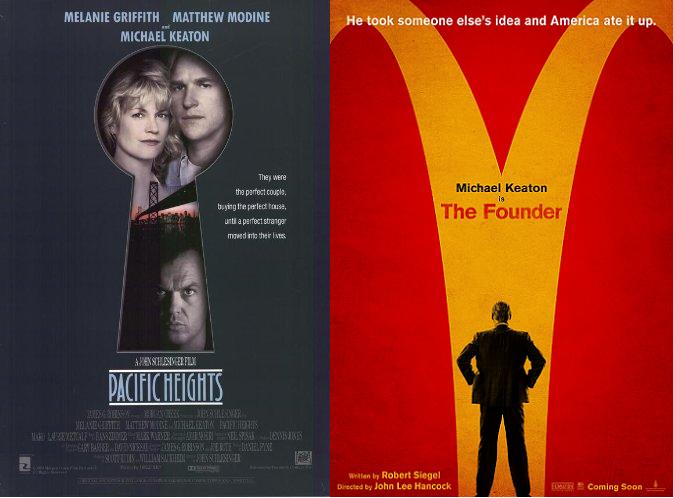
P.T. Barnum couldn't have dreamed up someone like Michael Keaton. Ever since morgue mogul Billy Blaze scat-sang "Jumpin' Jack Flash" in Ron Howard's Night Shift, he could birth a sucker every 30 seconds, possibly even earlier, with his rapacious huckster's charisma. Having owned Beetlejuice and Batman for Tim Burton, Keaton certified his dramatic credentials with 1988's Clean and Sober, but it makes sense that after foiling Nicholson himself on screen, Keaton would cut his own swath at full-on villainy, recalibrating his jumpy charm towards nefarious purposes. Beetlejuice was a lovable louse compared to Carter Hayes from Pacific Heights, a black sheep who has built his own trust fund out of a series of real estate mind games, suggesting a squishy perversion of Keaton's persona.
Alas, Pacific Heights, which stood a chance at doing for psychotic tenants what The Stepfather did for Ward Cleaver wannabes, is just another hopelessly lurid cautionary tale for yuppies, detached and decaying when it should've slapped a new coat of paint on a promising pulp premise.
The latest marks Keaton sizes up for a fall are already in over their heads before the glad-handing even begins. First-time homeowners Drake Goodman (Matthew Modine) and Patricia Palmer (Melanie Griffith) whimsically put their collective savings into mortgaging and restoring a Victorian house in the titular San Francisco district. Their respective jobs crafting Oriental kites and training equestrians won't recover this $750,000 investment fast enough, so they start screening potential renters for a couple of downstairs rooms. At their luckiest, a humble Japanese couple, Mr. & Mrs. Watanabe (Mako, Nobu McCarthy), sign a year's lease and pony up their down payment.
But then along comes danger in a flashy Porsche, and he calls himself Carter Hayes.
A series of dopey mistakes on Drake's end simultaneously hands Carter the key to the studio apartment and plays right into Carter's shifty plans. Not only is his deceitful tenant withholding the security deposit and six months of rent he promised to wire (Drake takes it on faith simply through a flash of hundreds in Carter's wallet when they first meet), but Carter is dodging his landlords, carrying on rackets in the late hours and changing the lock. Drake cuts off the electricity to Carter's room, but it's a brief victory, as soon the police and the justice of peace are accusing Drake of tenant's rights abuse.
Carter seizes on this legal superiority to drive the Watanabes out of their agreement and instigate a row with Drake that results in a restraining order from the squatter evicting the landlord instead of vice versa. With no financial or lawful options left, it's up to Patty to save face and expose Carter for the deranged conman he is before the game begins again.
Screenwriter Daniel Pyne reportedly drew upon his own woes with a manipulative lodger, but by the formulaic finale, I'm sensing the rawness of his real-life situation informs Pacific Heights as deep as, say, Alan Shapiro demonstrated when he made The Crush a couple years later. Though juicy bundles of subtext and irony appear ripe for fermentation, Pyne and director John Schlesinger sour the wine through the rusty thriller mechanics which propel the material. They also grind the actors up and spit them out, too.
Matthew Modine's lack of formidability against Michael Keaton is played at such a hysterical pitch, it stomps on the notion that this is a good old-fashioned manly pissing contest. Drake's take-charge attitude is savagely undercut by the feet-shooting dialogue poor Modine has to bark instead of bargain with. Pyne's banal characterizations of Drake and Patty alike doesn't even ease let alone convince their reversal of power as the former blunders into an obvious trap and the latter composes herself after a miscarriage to be reborn as Nancy Drew. At least Griffith's retaliation has that sense of humor the sidelined Modine is denied in so many words.
The paltry chemistry and lack of genuine idiosyncrasy essentially cripple Modine and Griffith, who are strait-jacketed by the routine shenanigans of Pyne's script. They emerge as a couple of yuppie ciphers rather than relatable dreamers, which makes it all too easy for Keaton to steal the show. And although he is adept as can be, not even Keaton makes it out of Pyne's script with any true perception. The psychology of his character is boilerplate angst at best, a deprived child who preys on the gullible upper class and keeps white trash company in Luca Bercovici's handyman-from-hell and Beverly D'Angelo (unbilled) as a sex object. His schemes never really generate primal urgency, and John Schlesinger's workaday gloss is hardly worthy of De Palma let alone Hitchock or Polanski.
The saddest waste of talent certainly belongs to Schlesinger, and it's not a stretch to surmise the fade away of his once-great career began here, with Eye for an Eye and The Next Best Thing to follow. Shallow material defeats Schlesinger every time, and there's little he can do to give the proceedings any palpability. Whenever he tries to generate atmosphere, it emerges as window-dressing, gritty confinement traded in for gross conformity. When a camera circles around a desperate plea from Patty to her curt lawyer (Laurie Metcalf), it's all for nothing. Though he keeps the pacing taut, Pyne's feeble confrontations give him nothing to bite into. You long for the assurance of someone like Stephen Frears (The Grifters) or Phillip Noyce (Dead Calm) far too often, especially when Schlesinger's thematic malaise descends into tasteless clichés.
Aside from Griffith's giddy payback and an effective glimpse of Keaton shrouded in darkness, spinning a double-edged razor between his fingers, the fleeting pleasures come in the form of Tracey Walter's stymied Orkin man and Tippi Hedren, mother of Griffith herself, as perhaps the most charitable pillar of high society imaginable.
Alas, Pacific Heights is a terminal cheater of a psychological thriller, teasing every time the material threatens to develop an edge. From the way Drake pussyfoots around his unfounded, passively racist suspicions over a prospective tenant (Carl Lumbly, who as Lou Baker remains benevolent enough to let Drake crash with him after Carter files a restraining order) to the limp end-of-innocence coda, this is simply craven without the Wes (ever notice the difference between The Believers and The Serpent & The Rainbow?). For an actor as endearingly wicked as Michael Keaton, it's a shame Schlesinger and Pyne do not share his irrepressible knack for transgression. Instead, Pacific Heights represents the foreclosure of a scream.
Keaton's star power dried up in the 1990s, sadly, after one more round in the Batsuit and a slew of forgettable vehicles, the consensus nadir being 1998's Jack Frost. 2014's Birdman restored his fortunes, however, and he's since been on a roll thus far. The Founder adds to Keaton's second wind by once again revisiting the shyster grifter persona Keaton does so well and, unlike Pacific Heights, creating a more subtle malevolence that unspools enticingly as the film progresses and without trading in the grease gun for the nail gun.
The titular visionary is Ray Kroc, more of an opportunist than a creative genius when he franchised McDonald's away from its creators and settled into their legacy through cutthroat legal maneuvers. Keaton begins the film as pathetic as Willy Loman, but ends the film as a middle-aged Mark Zuckerberg, having successfully rammed the hose down the mouths of both Mac (John Carroll Lynch) and Dick McDonald (Nick Offerman) while the brothers drowned. All it took was one handshake and a trunk load of powdered milkshakes.
And persistence, as a Calvin Coolidge quote recited on self-help vinyl clues you early on before Kroc's epiphany, when the disgraced multi-mixer salesman is holed up in a motel room following another series of rejections. Kroc learns that someone out in San Bernardino has ordered eight of his units and capriciously rides Route 66 all the way out there to understand why such a demand. When he encounters the McDonald's restaurant for the first time, it's the California Gold Rush all over again. He's genuinely taken aback by the scene, where the food is prepped quicker and delivered with more accuracy than the drive-in joints he regularly frequents. He eats his combo meal on bench next to an all-American family instead of the familiar J.D. congregation. It's all too beautiful, and Kroc takes jolly Mac up on an offer for the grand tour.
Keaton's Kroc is spellbound by the brothers' post-Depression success story, as director John Lee Hancock (Saving Mr. Banks, The Blind Side) and writer Robert Siegel (The Wrestler, Big Fan) concoct a rapturous montage (added credit to editor Robert Frazen) of Dick working out the choreography and layout of the Speedee System of fast food preparation on a tennis court. And then comes Kroc's pitch in one word: "America." He looks at the painting of Dick's golden arches, an architectural coup which tanked in Phoenix, and vows to succeed at expanding McDonald's where the brothers were once as luckless as Kroc. This could be as much a symbol of family, community and patriotism as the church and the flag, and the McDonald brothers are sold, though not without the safety of a contract.
Kroc hustles to secure potential franchisees including country club friends, who unscrupulously run their locations into the ground with overcooked patties and overindulgent menus. It's clear to him that only love makes the Speedee System run efficiently, as he looks to his wife Ethel (Laura Dern) for inspiration she's too exhausted to provide. Kroc's ambitions eventually alienate him from Ethel as well as Dick & Mac, who shoot down every cost-cutting measure and unfair profit percentage he needs to float the empire. Also pivotal are chance encounters with Joan Smith (Linda Cardellini), the wife of a potential investor in Minnesota (Patrick Wilson), and business impresario Harry Sonneborn (B.J. Novak), each equipped with foolproof solutions to Kroc's financial straits.
Suffice to say that The Founder itself has been constructed much like a McDonald's burger. Hancock's direction is the bun, a warm 'n' golden if flavorless sandwich necessity. He films the story in such a straightforward way that it lends a certain ambiguity to Ray Kroc, neither self-righteously vilifying nor celebratory of his (mis)deeds. And this MOR approach works given the rest of the ingredients. Ketchup and mustard shots are added in the comparatively unfulfilling elements of Siegel's adept script, particularly the relationships Kroc has with Ethel and Joan. The former is given enough screen time to cook up a subdued, sensitive Laura Dern performance, though Linda Cardellini's presence as Joan feels like a scene is missing. The former Lindsay Weir has come a long way since those small fry days, and she is solid.
The pickles leave the clearest aftertaste, though, when the film focuses on the McDonald twins. You can practically savor the juice as much as John Carroll Lynch and Nick Offerman (sans that Ron Swanson mustache), pitch-perfect as homely entrepreneurs secure in the 8x10 frame whilst Kroc guns for the life-size statue. The integrity and fraternal humor between these bulky character actors is lip-smacking, which makes their betrayal all the more wrenching.
But you can't have a hamburger without the patty, which puts Michael Keaton in the sizzling center of this confection. 35 years after coming up with the idea of edible paper in Night Shift ("Is this a great country, or what?"), there's still a wild man in this ol' warhorse. In a world where our current president is a ruthless, ethically-perverted businessman but also a raging imbecile, Keaton's entertaining/enervating acumen is as refreshing as a McFlurry. This is a dramedic performance that is, by design, its own wicked pitch, and when people can be fanatically conned by lesser men, Keaton's "Founder" is grade-A all-American beef.
Against all odds, The Founder not only goes down (and comes back out) appetizingly, it sticks in your teeth. Now if you'll excuse me, I need to get these toothpicks out my back.
In December 2015, Joel Hodgson closed out the most successful video-based Kickstarter campaign to date with $5.7 million in fan donations to revive Mystery Science Theater 3000, the show he created for Minneapolis UHF station KTMA back in 1988. The runaway success cannot be overstated. Hodgson originally thought he'd hit a three-episode goal of two mil, but the excitement of a fresh take on the beloved series enticed tons of MSTies, myself included.
Put it this way: the closing credits of episode 1101 include a Revival League list hasn't gotten past the people whose first names start with A. The list of contributors is 48,270 strong. It's going to be a long wait to get to the Js, which is especially poignant since Joel has passed on the Gizmonic-brand jumpsuit to a man named Jonah.
Mystery Science Theater 3000 (MST3k for short) survived multiple shifts in personnel and two cancellations from cable stations to reach the massive cult it has developed. There has also been a crate-load of digital video releases from Rhino! and Shout Factory devoted to the original series' ten-season run. There's a lot of passionate devotion to specific episodes, specific hosts, specific Mads, and specific personalities. But series creator Hodgson, who left the series in the fifth season and made a return to shadowrama with Cinematic Titanic, has given his blessings to the new staff living in Deep 13:
The 14 episodes of the eleventh official season open as well they should, with the invitation to "Turn Down Your Lights (Where Applicable)." The premiere even harkens back to the original's model exterior of "the big G," before taking us where no MST3k has gone before: into Gizmonic Institute's very own ground control room. There we are briefed on the hotshot back-jack sky pilot known as Jonah Heston, who is hauling a valuable supply of meteors to help Gizmonic through financial jeopardy. Little does Jonah know that the distress call he just answered will take him on the dark side of the moon, where the descendant of Gizmonic's greatest enemy awaits to carry on her father's legacy of Deep Hurting.
Enter Kinga Forrester of the Moon 13 research station, who has successfully space-napped Jonah with intent to profit off the cinematic torture she will inflict on him. Although she has stars in her eyes, Kinga and her assistant Max, who tries in vain to be called "TV's Son of TV's Frank," download via liquid media one Reptilicus, whose biggest name is Dirch Passer, a legend of his native Copenhagen and the most prolific Danish actor in history. It doesn't get any more esteemed than that.
Mystery Science Theater 3000: The Return, though, does possess an array of nerd-friendly casting choices as well as some choice cameos which I refuse to ruin for you. Podcaster extraordinaire Jonah Ray Rodrigues fills out the yellow jumpsuit with amiable glee, whilst Felicia Day (Dr. Horrible's Sing-Along Blog) and Patton Oswalt (Reno 911!) were sure things the moment the news broke that they were the new Mads.
The real trick is the casting of the robots, as Kevin Murphy, Trace Beaulieu and Bill Corbett lasted long enough in their tenures to leave indelible marks. Murphy established Tom Servo early on via a deep, TV pitchman tone and rapacious self-confidence, whilst Beaulieu was a sharp vocal impersonator (of Peter Sellers and George C. Scott, especially) and always the most audibly puckish of the in-theater gang. The Mike Nelson years showed Murphy, Beaulieu and Corbett more or less speaking in their natural tones, but even those had their distinct personalities.
Baron Vaughn (as Servo) and Hampton Yount (as Crow) don't stand out as much as their predecessors (which also includes Josh Weinstein's original voice of Servo), although Crow's flair for mischief does give Yount an advantage at times. Vaughn's Servo still has that "Hey, world, look at me!" charm, but without Murphy's down-from-the-mountaintop authority. Whereas Jonah Ray shows a disarming ease filling in for Hodgson and Nelson, the real surprise is Gypsy's newly-modified voice, an actual female for once in the presence of Rebecca Hanson (who also appears on-camera as helper clone Synthia). No longer the dim Richard Basehart obsessive of yore, she actually drops by in-theater with "the payload" and gets in a honest belly laugh as opposed to the confused maintenance bot who couldn't hack it during Hercules and the Captive Women.
These are mostly just general impressions based on the handful of episodes I watched thus far. I really want to get a deeper look at the entire fan-funded inaugural season and pull my weight as a reviewer and a fan, even of many of the actors whose names may not ring bells for modern audiences. Besides, Caroline Munro is featured in two of these experiments, and my heart's a-fluttering. Let's begin with a breakdown of the first two installments of MST3k: Moon 13: The Return.
EPISODE I: REPTILICUS
Flimsy plot synopsis: The fossils of a mysterious creature are discovered on a mining excavation and regenerated in a laboratory. Unfortunately, the creature comes alive and wreaks havoc on nearby Copenhagen, leaving men of both science and military uncertain how to stop this "Reptilicus."
Reptilicus is actually a fascinating case in the annals of B-cinema, an attempt by the Great Danes to replicate the "atomic monster movie" formula which worked well in both the U.S. (The Beast from 20,000 Fathoms) and Japan (Godzilla). Danish studio Saga co-produced with American International Pictures and went so far as to film two separate versions of the film that could play to their respective native tongues. However, co-writer/director Sidney W. Pink, who produced the trend-setting 3-D smash Bwana Devil, turned over to AIP head Sam Arkoff a disaster, with comically pronounced Danish accents and equally rickety special effects. Pink filed suit to prevent Arkoff and co-writer Ib Melchior from tampering with Pink's cut of the film, but after many testimonies from others in the industry, the case was dropped and Arkoff's alterations were made.
This producer's cut of Reptilicus is the version screened for Jonah and the returning tag team of Tom Servo & Crow T. Robot, and the riffing here is as exquisite as ever. With a newly-assembled writing team headed by bad movie specialist (hear: The Flop House!) and Daily Show staffer Elliot Kalan, the pitch of the riffs is a return to the awestruck sarcasm of Hodgson's glory days rather than the meaner edge of the Sci-Fi years. The difference is notable in the way the trio tackle the comic relief of Dirch Passer as Petersen, the Danish Andy Griffith (also "Al Capp's Lil' Abner"). No doubt added to provide some slapstick respite in the early stages of the movie, Passer isn't as over-the-top as Droppo or as insufferable as the guys from Attack of the Eye Creatures, but his tomfoolery sticks out like Gypsy's freshly-Midwesternized voice.
Fooling around with a telescope while eating a sandwich, the security-tasked bumbler Petersen prompts this jest from Servo: "And Jethro discovers he is the half-brother of a piece of cheese."
One of Arkoff's major additions to Pink's film was the use of animation for Reptilicus' acid attacks, with green slime trailing down the screen to add unconvincing menace. Its resemblance to Nickelodeon gak is seized upon, as is the realization that Monster Energy may as well be brewed in Reptilicus' stomach (what, no Slurm jokes?). By the time this trick is repeated thrice, Jonah realizes that "The slime doesn't hurt anybody. It just transitions into another scene."
Indeed, it does. We never see the aftermaths or anybody writhing in pain from being doused in Reptilicus' biological weapon. Indeed, the most gruesome sight in the film is a cow's decapitated head to give the impression that the giant reptile has massacred a farm's worth of livestock: "That cow had a month to go before retirement, too!"
Bent Mejding plays the strapping young hero Svend, who initially unearths the remains of Reptilicus whilst mining copper and basically spends the rest of the movie as the resident chick magnet: "Even his collar has a collar!" Dr. Dalby, who devises the means of regenerating Reptilicus through nutrient-supplemented bathwater, invents "Reptiliberry Cherrysaurus" and sleeps on the job at the wrong time, thawing out the creature. The central figure of scientific authority, though, is Professor Martens (Asbjorn Andersen), who has two perky daughters and a heart condition. One of the girls, Lise, chances upon the dried-out monster carcass: "What did you to my [birthday] pony?"
And then there's Gen. Grayson, an American army official played by the very Danish Carl Ottosen. Whether reading his own biography in the paper or proving too numbly masculine to comfort Lise when her father is hospitalized, the zingers that follow him are uproarious.
One of the highlights of the in-theater riffing is Tom Servo's hover skirt, which allows him to fly towards the screen when the opportunity arrives for a close visual laugh, like when he is drawn towards Grayson's slicked-up hair and recoils with disgust: "Did you make a vow not to wash your hair until Reptilicus was dead?" Crow gets his own prop-based humdinger during Reptilicus' attack on Copenhagen, the trio intervene on a possible argument between Gen. Grayson and Prof. Martens and, as mentioned earlier, the feminine Gypsy finally becomes one of the boys ("Now, you're Mr. Filing Cabinet!").
The pop culture references are plentiful, with special nods to Tom Carvel, Blazing Saddles and Pee-Wee's Playhouse, and the music-based riffs diverse and giddy, from Glenn Miller to Prince (saluted twice), Frank Sinatra to Olivia Newton-John, Bobby "Boris" Pickett to the Village People. Even better, the revived series' first original song in the first between-movie host segment is a riotous rap number tracing monsters of all nations. Although there are a couple of noticeable lulls where one would expect an obvious joke, this sit-through of Reptilicus packs plenty of easygoing laughs.
It should be noted that Shout! Factory, who have licensed not just MST3k but a few of the titles featured, Reptilicus included, offered their HD-friendly widescreen transfer of the movie for the show. This is another breakthrough for MST3k, as previous seasons simulated the channel-surfing appeal of these off-guard B-movie riffs by retaining full-frame images suitable for vintage TV sets. In our LCD age, this time we return to This Island Earth grandeur for this entire season. We don't exactly get 2.35:1 Cinemascope (maybe in the future with luck), but here we get real compositions and remastered visuals.
Back in the Joel Hodgson days, they'd lampoon drive-in concession ads by jettisoning hot dogs and popcorn into space. As this new iteration of MST3k now proves, there's no new tradition like an old tradition.
EPISODE II: CRY WILDERNESS
Flimsy plot synopsis: Private school moppet Paul Cooper believes in Bigfoot after befriending him last summer over a dozen cans of Coca-Cola and a transistor radio, but he's naturally the only one. So when Sasquatch sounds a distress call one night, warning Paul that his ranger dad is in mortal danger, the boy runs away and meets up with not just his pappy, but also a way-too-jovial Indian companion and a mercenary big game hunter who also realizes Sasquatch might just be real...real killable.
Boutique label Vinegar Syndrome has anted up this film for the new MST3k as opposed to Shout! Factory. The invention exchanges have been carried over from the original series, and if you are familiar with Patton Oswalt's stand-up, Kinga and Max's latest get-rich-fast scheme is going to be even more of a treat. Jonah comes up with a new Turkey Day device that turns carving the bird into murdering Janet Leigh in the shower. I am also happy to report that I am getting more familiar with Vaughn & Yount's vocal tics as Servo & Crow, although there is a three-headed cameo for those who fancy MST3k's later years.
But the movie is once again the kind of rubbernecking schlock which is where the action is. If Reptilicus brought back memories of Sandy Frank's Gamera and the lower-tier Universal monster movies which were routinely roasted on the Satellite of Love, Cry Wilderness is the successor to J.P. Simon's Pod People. Somehow, Cry Wilderness director Jay Schlossberg-Cohen was given special thanks in the credits to Sleepless in Seattle; if his career is any indication, maybe Nora Ephron was able to make an entire movie out of unused footage from Joe Vs. the Volcano.
Schlossberg was a savvy cinematic recycler whose 1985 omnibus film Night Train to Terror was pieced together from three existing movies: the Cameron Mitchell vehicle Cataclysm (The Nightmare Never Ends), the Schlossberg-produced Dark Side to Love and an unfinished project called "Scream Your Head Off" starring Richard Moll. Cry Wilderness, meanwhile, seems to consist mostly of original 35mm footage shot for one particular movie, but is padded with library-sourced inserts of various wildlife to nudge it closer towards feature length ("At some point in your life, you might have to resort to YouTube to finish your film").
Making Cry Wilderness even more interminable are the stereotyped characters, from the annoying adolescent lead on down to three random bikers who show up apropos of nothing. There's even a swishy-looking mayor who keeps a swimsuit-clad blonde around for show. The saddest case is John Tallman as Jim, the mystical Native American who also doubles as a laugh track. Maybe watching Powwow Highway beforehand kind of kills this goofy characterization for me, as Gary Farmer seemed a lot more natural and humorous playing the spiritually-aware yet childlike Cheyenne in the Buick "pony." That was a really joyful experience, as Cry Wilderness tries desperately to drum up interest between travelogue montages of various critters.
Once you get beyond the footage of antelopes, lemurs and skunks in their natural habitat, there's the little issue of Sasquatch, or "Homo-erectus Galifanakis," to deal with. You will believe the friendship between Paul and his mythical caretaker...until you realize Bigfoot has basically sent the kid to a death trap, himself. Then it stops being whimsical completely. Mr. Cooper's certain doom is a letdown when it finally arrives, and could've easily been avoided had Paul simply stayed away.
Take it from Servo: "Watching this movie is cinematic puberty. Nothing makes sense, and it never goes the way you'd expect."
The riffs come at you at a faster clip in this second episode, such is the incomprehensible nature of this particular slab of nature (even Patton Oswalt is thrown for a loop 45 minutes in). The opening scenes in the boys' school are ripe for Hogwarts call-outs. Paul hitches a ride from a trucker whose nondescript country song of northwest pride makes Jonah feel like he's "living upstairs from Rascal Flatts." A recurring joke stems from one commenter observing that Paul's dad may have to wing him with his rifle for the boy's own good ("Bang!"). The mean hunter in the mesh shirt, Hicks, researches Bigfoot after discovering a suspicious set of footprint: "Embrace the prophecy of Time Life books!" A Werner Herzog impression, some Purple Kush-flavored dope humor and the apparent lovechild of Louis C.K. and Chris Elliot are thrown in also whenever the commentary threatens to lag.
There's even a Rowsdower allusion, although Bigfoot's vocal resemblance to "warwilf" goes unnoticed.
Reptilicus and Cry Wilderness are a great one-two punch to start off MST3k: The Return. The former feels comfortably cheesy and jovial, setting the bar for later episodes to match, whilst the latter takes on a more idiosyncratic B-movie and reaps major dividends. The next installment of this complete series rundown marks the revenge of Ib Melchior and also includes some of the biggest names ever to appear in a MST3k feature since Gene Hackman. Join me again, won't you?


 Working in the basement of their hospital in order to take advantage of a functioning MRI machine, they competitively stop their hearts by lowering their body temperature via a cooling jacket and receiving a fatal hit from the defibrillator. Courtney claims that her astral projection was actually "a little sexual," but good luck sensing this based on the screensaver visuals Oprev preserves. The carnality is strictly TV-PG, as Sophia has a vigorous if ridiculous tryst with Jamie and moony Ray confesses his love to Marlo. Save for Ray, the resurrected med students tap into repressed mental faculties whether it's book knowledge or bread recipes or, in the 25-year-old Sophia's case, standing up to her mother, who demands she Win At All Costs.
 Flatliners flits from one half-assed conceptual triviality to another, freed from gravity just like its cast during those out-of-body experiences. Not since posing as Kitty Pryde for disgraced hack Brett Ratner has Ellen Page been so egregiously squandered. Diego Luna (has it already been 16 years since Y Tu Mamá También?) and Kiersey Clemons (a comedic charmer as seen in Neighbors 2) have too proven themselves overqualified for this tedium, which is more than can be said for small screen ciphers Nina Dobrev and James Norton. The work Oplev and Ripley have done could've been accomplished by any slumming work-for-hires toiling under the Screen Gems banner. There's nothing exquisitely tricky or emotional to make their Flatliners come alive, just 110 minutes which transition into rigor mortis early on and never lets up. It's the kind of stiff which you don't so much as review as perform an autopsy on. And with so many people trying to look on the bright side of a downer year, the sooner we bag and tag Flatliners '17, the better.