This will be my 99th official movie review on this site, so if you are reading this, thanks for your time and support. I already plan on doing something special for my #100, to extend my support to a great talent who I feel deserves the recognition. But going through all I have written so far, I'm surprised to have got this far even if I had to struggle in some regards. For one, I had to retract my presence from social media for a spell because it wasn't doing my soul or my creativity any good. This meant I ended up sacrificing a connection which ran very deep to me, as well as losing touch with several very receptive people. I have been taking steps to getting back in the stratosphere, mostly on the strength of my devotion to writing.
I don't want to get too deep into this, instead resolving to continue to revitalize and strengthen my passion. So on the eve of my celebratory post, here is my latest review:
EAT THAT QUESTION - FRANK ZAPPA IN HIS OWN WORDS
(R, Sony Pictures Classics, 93 mins., limited release date: June 24, 2016)
Growing up in Apache Junction High School, I may have been the only person in my drama class to bring a Frank Zappa CD to the dressing room.
My tastes will still formative and a lot of what I was getting into musically were cult artists. I was big on Paul Westerberg and The Replacements then and still am, but I also picked up on every Mother's Father through a compilation album called Have I Offended Someone? I preferred short, simple songs at the time, and the album at least contained some Zappa tunes for the neophyte: "Dinah-Moe Hummm," "Catholic Girls," "Bobby Brown (Goes Down)," "We're Turning Again," and "Valley Girl." This was barely scratching the surface of Zappa's discography, as the CD contained nothing as old as "Harry, You're a Beast" or "Call Any Vegetable," but it boiled down a lot of highlights from Overnite Sensation to The Mothers of Prevention.
And it did so by culling a lot of Zappa's bawdiest tracks, at least in terms of lyrics. One of the songs was "Jewish Princess," which was condemned by the Anti-Defamation League for such lines as "I don't want no troll, I just want a Yemenite hole." Like I said in the last review, tons of people had Porky's to get their illicit kicks. I chose Frank Zappa.
But Have I Offended Someone? turned out to be a gateway of sorts into Zappa's past, which has enough material for a companion volume devoted to his 1960s work. I eventually started hearing the kind of material Zappa wrote which earned him a reputation as a "composer" instead of "rock musician." The xylophone-heavy, jazz-structured perversions of R&B in which no runaway melody was strident enough to become a bar on Zappa's sheet. The discordant experiments with woodwinds and brass, like chamber-of-hell pop. The multitude of distorted voices spouting some dadaist catchphrase, especially in regards to such buzz words as "creamcheese" and "tinsel cock."
Frank Zappa was a genuine freak in a world eager to compartmentalize him, and the music exceeded his grungy attributes. And when it came to promoting himself on television, he drew blood with his sardonic estimations on a society that knew little about his recorded legacy, but held him in esteem or fear as an eloquent dissenter against the lowest common denominator. In 1981, upon the release of his TinseltownRebellion LP, one talk show host senses "a deep, permanent, irreversible cynicism" within Zappa, but is he really that different from George Carlin or Groucho Marx when you get right down to it? Zappa's immediate response is that he hopes his skepticism will prove contagious. A moment later, Zappa monologues about the subpar state of modern American culture, from designer jeans to schlock rock, a deprivation of identity upheld patriotically, and pathetically, with poison gas and neutron bombs.
Having read The Real Frank Zappa Book hoping to contract some of Zappa's righteous disdain, Thorsten Schütte's Eat That Question - Frank Zappa in His Own Words does the job visually, a feature-length mosaic drawing from videotaped cross-examinations and the occasional live performance. Going as far back as Zappa's boy wonder slot on Steve Allen's show in 1963, where the multi-instrumentalist improvised a deliriously discordant concerto for Allen's house band accompanied by bicycle, Eat That Question seeks to balance Zappa's outspoken public persona with a wider appreciation of Zappa's desired reputation as a composer in a cultural environment where your only chance at livelihood is to write jingles instead of suites.
Although hardly as all-encompassing as one would hope for a man who wrote 300 different arrangements and put out albums at a steady clip, Schütte does cull a chronologically satisfying array of song selections. From a version of "Plastic People" sung to the tune of "Louie Louie" to such Flo & Eddie-period highlights as "Penis Dimension" to a smidgen of "Approximate" from 1974's A Token of His Extreme special (featuring Ruth Underwood on the vibes and Chester Thompson on the drums) to his 1980s work bolstered by the presence of Ike "Thing-Fish" Willis ("Tinseltown Rebellion," "When the Lie's So Big"), Schütte gives you enough of Zappa at his band-leading best. The cherry on top are Zappa's conducting duties for both the London Symphony Orchestra and the Ensemble Modern (the German musicians captured for posterity on 1992's The Yellow Shark).
Lest you think this but a conduit for welcome renditions of "The Air" and "Cosmik Debris" (so good you'll demand another movie to piece together Zappa's musical accomplishments), Schütte gives Zappa a posthumous solo examination of the artist at his most Frank. When he released 1968's We're Only in It for the Money, Zappa ridiculed the "flower power" generation who flocked to San Francisco without mercy: "I'll stay a week and get the crabs and take the bus back home/I'm really just a phony but forgive me, ‘cause I'm stoned." Incidentally, he was still dogged by the perception that he was for the counterculture. Schütte finds the right sound bites to solidify Zappa's distance from the hippie scene, the highlight a notorious anecdote about Zappa's refusal to assist a group of Berlin radicals escalating into a riot during a Mothers concert.
Zappa refrained from habitual drug use, showing zero tolerance for any of his musicians getting high on the road to impede the flow of "entertainment on time." He also turned down numerous offers to play outdoor festivals in France for the benefit of the communist party. "Some people think that I am some sort of a political rebel," he says at one point. "Isn't it strange the fantasies that people have?" The only instance where Zappa was moved by international politics was when his once-blacklisted music helped bring down the Iron Curtain in Czechoslovakia, inspiring Vaclav Havel to fly Zappa over for a hero's welcome and a short-lived appointment to cultural ambassador. This was a rare triumph for Zappa in terms of opposing the forces of reaction; a few years before, he took the PMRC to task for trying to legislate warnings against "obscene" messages and content.
Like Carlin, Zappa frequently debunked the concept of Dirty Words as a barometer of moral impurity, less an affront to America's integrity than the movement of a "fascist theocracy" whose beliefs were so far right as to invoke Attila the Hun. But it's a fight Zappa had to bear arms against as far back as the late 1960s, when MGM Records reps would clandestinely remove a reference to a waitress' pad (in "Let's Make the Water Turn Black") because they thought of the more sanitary definition. A planned orchestral performance of the 200 Motels score at the Royal Albert Hall was canceled at the 11th hour by manager Marion Herrod because of such trigger words as "brassiere" (nowadays, Adele can drop more R-rated words at the same venue and sell at platinum).
Schütte doesn't include snippets of Frank Zappa's few U.S. novelty hits ("Don't Eat the Yellow Snow," "Dancin' Fool," "Valley Girl"), nor his music video for 1981's "You Are What You Is" (immortalized on Beavis & Butt-Head), but we do hear Zappa's international hit "Bobby Brown." The song was a chart-topper in Norway and Sweden, one would guess because of its doo-wop melody and not the perverted black comedy Zappa grafts onto it. Over a 1978 performance of the song in Munich, Zappa confesses his amusement upon learning it was a popular slow dance number despite its references to sadomasochism, date rape and premature ejaculation.
Eat That Question is not the conventional summation one might expect, but that's no excuse to hold out for Alex Winter's planned documentary. Zappa may have equated interviews with the Inquisition, but that didn't mean he wasn't about to shut up, proving dastardly enough to stymie his tormentors. Goaded into revealing the primary audience for his work, Zappa snipes back "That's none of your business." Winning a Grammy for the title song from Jazz from Hell, Zappa isn't the least bit amused until he demonstrates the Synclavier on the morning news and outright praises it for removing the human element.
Every documentary, even piecemeal ones like this, need an arc, and Schütte gets it from Jamie Gangel's candid discussion with Zappa on the Today Show from 1993. 52 years old and wasting away from prostate cancer, the degenerating fruits of his labor finally granting him massive European success, Zappa is as unrepentant, hilariously upfront and caustically bitter as earlier in the documentary. And then comes one of Zappa's final answers, in regards to how he wants to remembered: he simply scoffs, and says "That's not important." To Zappa, it's an egotistical act of gross spending more suited for former presidents than a simple composer.
The enigma of Frank Zappa remains despite all his testimonials which Schütte has assembled. He was passionate about free speech because it allowed him to spend years proving that nothing was sacred, and that he could offend everybody. And being misunderstood and stereotyped and censored for so long, Zappa could have been conditioned to believe that remembrance isn't a top priority. Cultural apathy, rigid conformity, closet fascism...all things Zappa is given the chance to denounce are surely worth the outrage. This is one movie where you should stay until after the closing credits if you really want to honor Zappa's spirit. But Thorsten Schütte, bless him, has made an effort, and all the ugly people can be happy he did.
Eat That Question - Frank Zappa in His Own Words is a perfect introduction for a world that can finally understand what made Frank Zappa so controversial but also a man who is dearly missed in spite of himself. There will always be hungry freaks, daddy, in need of a little motherly love. Let them eat Uncle Meat.
Young man rhythm got a hold on me, too. I got the writin' pneumonia and a bad case of the flu.
Watching Less Than Zero only made me feel groggier, so maybe it's time I aimed in a different direction. How about the sleeper hit of 1982, the definitive guy's movie and the most dubious trendsetter of early 1980s cinema? The film forever associated with locker room peeping, industrial-size rubbers and prank calls to Michael Hunt. The one and only, for better or for worse, it's either this or NyQuil...
PORKY'S
(R, 20th Century Fox, 94 mins., theatrical release date: March 19, 1982)
You know, Bob Clark used to have a pretty impressive resume, just like Dino De Laurentiis. I believe this on the strength of the horror movies he started out with in the early 1970s. Flanked regularly by screenwriter Alan Ormsby, Clark started out with the amateurish but promising Children Shouldn't Play with Dead Things, but the two really came into their stride in 1974, when they blitzed the screens with some highly influential, historically-revered shockers. Before audiences were introduced to Leatherface and his Texas chainsaw, Ormsby and Clark put to screen the grisly true crimes of Ed Gein in Deranged, and also did their previous Romero homage one better with the haunting ghost story/family drama Deathdream (Dead of Night). Those two movies also introduced someone named Tom Savini to the world, perhaps you've heard of him.
And then there was Black Christmas, which shares with Tobe Hooper's classic a preface to the coming ubiquity of the "slasher" film. This formula would be solidified and monetized by the popularity of Halloween and Friday the 13th, so I must give Bob Clark the credit he's due despite whatever opinions I or others may have said. He was an originator, a maker of great independent spook shows and deserved better than to go out on something like those Baby Geniuses stinkers.
And did you know he directed Jack Lemmon to an Oscar-nominated performance in Tribute?
But Clark's ultimate legacy in popular culture might not be AChristmas Story, but a project he allegedly spent 15 years fielding material for, drawing upon his own memories as those of his peers. Yes, we're talking about Porky's now. I was just spermatozoa when this film was spending eight weeks atop the U.S. box office and raking in hundreds of millions from North American audiences. It was the biggest success story in Canadian cinematic history until 2006, when the bilingual Bon Cop, Bad Cop and a Resident Evil sequel(?) usurped it.
To the dismay of Siskel & Ebert (and perhaps myself, to be honest), Porky's made enough bank to ensure an endless series of sniggering, superficial rites-of-passage flicks that are nowhere near the greatness of Animal House and more in league with such desperately raunchy fare as Gorp or The Hollywood Knights. Hell, Porky's wasn't even the first of its breed. You had nostalgia-fueled totems of adolescent irresponsibility as early as Summer of ‘42 and American Graffiti, and there was also Lemon Popsicle. Perhaps it was the audiences getting burnt out on the bastard sons of Friday the 13th that ensured Porky's outrageous success and stream of imitators, a few such as Risky Business and Revenge of the Nerds offering more than the same smug sex jokes. It is a sociological curiosity if not the over-hyped cause célèbre time would convince you.
But I'm not trying to write a term paper, I only want a satisfying film review. So here I am, sneezing my way through every paragraph, to give my take on Porky's. Let's sty one on.
In the great tradition of these "autobiographical" blackout sketch movies, there's not much I can say about the plot as a set-up. The setting is Angel Beach High School in Florida's Seward County, 1954. I assume Bob Clark was simply trying to reach the spot between between Robert Mulligan's 1942 and George Lucas' 1962, but he was 15 years old at the actual time this movie sticks its flag in. The central character is Edward Morris, affectionately/mockingly nicknamed "Pee Wee" (Dan Monahan), and he stupidly strains his member trying to hide his morning wood from his mother on this average school day. No wonder he gets further bent when he busts out the ruler to measure his "progress."
Among his circle of bros, Pee Wee is the most neurotic with his libido. He can't even think right when he's flaccid, let alone hard. This leads to him being gullible on a level that ought to demote him to the level of nerd, only he doesn't have the horn-rims. Recently, he's won the ridicule of Wendy the waitress (Kaki Hunter) for deigning to wear a condom before trying to score. He inadvertently eggs the campus behemoth, Anthony "Meat" Tuperello (Tony Ganios). And he outright hectors the hotshot alphas, Tommy Turner (Wyatt Knight) and Billy McCarty (Mark Herrier), into taking him along on a field trip to the shack of redhead prostitute Cherry Forever (Susan Clark). Naturally, it turns out to be too easy to be true.
Where there's a will, there's a way, so for Pee Wee and pals the path to sexual salvation compels them to Porky's, the fabled redneck dive further out in the Everglades. This time, the joke's on all of them, as Porky Wallace (Chuck Mitchell, four years before berating Lane Meyer) fails to deliver on the action, dumps them out in the swamp water and extorts the rest of their cash with the help of his brother, also the local sheriff (Alex Karras). This development doesn't sit well with Mickey Jarvis (Roger Wilson, previously seen on this site in Second Time Lucky), who alternates between driving back out for revenge and returning home with nastier signs of bodily harm.
The whole of Porky's is as erratic as the synopsis so far, shifting from convivial smut to not-quite-redeeming social value. The Angel Beach Boys finally work out a suitable comeuppance for the Wallaces, but that's saved until the very end. Outside of the blue ha-ha set pieces, there's a subplot for the boys' 23-year-old basketball coach, Roy Brackett (Boyd Gaines) and his pursuit of the luscious Miss Honeywell (Kim Cattrall), whom his mentor Mr. Goodenough (Bill Hindman) refers to as "Lassie," which confuses Brackett until he gets her alone in the laundry room. Also, there's lightweight friction between flagrant bigot Tim Cavanaugh (Cyril O'Reilly) and the Semitic Brian Schwartz (Scott Colomby), who can defend himself verbally and physically.
And then there's Coach Balbricker (Nancy Parsons), the corpulent laughingstock of both the student body and faculty. In a movie where the male leads provide their own laugh track in every scene, Parsons at least gets some deserving chuckles through her nonplussed reactions to their shenanigans. Alas, her prudish devotion to "moral turpitude" descends into psychotic mania, and the broader the character becomes, the nastier Clark treats her, and the more I want to see Parsons as the devious Ida Vincent in Motel Hell.
I want to like Porky's, I really do. The same way that I do Animal House or Slap Shot or Stripes or even Hardbodies! I crave vicarious belly laughs that thumb their nose at authority and explore the multiple ways attempted conquests can go farcically sour. Sometimes going through the "innocent" antics of past generations can be entertaining, hilarious, even insightful. I mean, American Graffiti is a gold standard for lots of reasons. And The 40-Year-Old Virgin, forget about it!
Porky's is also more of an equal-opportunity offender, take that as you will, than the shit it spawned. Yes, there is a lot of ooh-gling and ahh-gling, but at least in the case of Wendy and Honeywell, the girls can give as much as they take. The Angel Beach community feels like a community, where incompatible personalities can unite in some sense of pride (getting one over on Porky) or shame (the generational racism of Cavanaugh). And as the series went on, even Balbricker was humanized somewhat, although she doesn't escape the automatic instinct to mock the obese you find in politically-incorrect sops to the plebeian moviegoers.
It's just that the movie operates on this common tendency among raunchy comedies at the time to filter bygone eras through distinctly modern, unrepentantly vulgar eyes. When it works, you get Animal House, but they can also go way, waaayyyy too far, just look at the Lemon Popsicle series. Bob Clark wants to have his beaver hunt and shoot the ones in the barrel, too. That's how you get such thorny showstoppers as the peephole scene, where the boys reveal their outright hostility to the naked girls on show, who seem to take the voyeurism a little too in stride. It's also where you glean similarly unenlightened attitudes toward blacks and Jews, which at least pays dividends in the performance of Scott Colomby as the ostracized Schwartz, which is more natural than any of the other boys (honorable mention to Boyd Gaines from Fame and The Sure Thing).
Furthermore, the Porky's series as I recall is more about schadenfreude than the joys or dangers of sex. This prevents it from trying to develop a lot of unconvincing sincerity, which I guess beats the alternative as presented by the Lemon Popsicle franchise, but it's still conservative in its own way. By the end, Pee Wee is rewarded with sex after all his mania (again with Wendy, natch), but it's during the end credits and he's the only of the goon squad (read: I don't count Coach Brackett, even if he is one of the boys at heart) to actually make it. There's more fighting than fucking, which I guess says something abut the male ego. And except for a few token exceptions (Pee Wee, Meat, Wendy), the characters are interchangeable and acting is on a strictly sitcom level, right down to the overage actors feigning teenage attitudes (Grease, anyone?). Even Film Freak Central got it wrong when Travis Hoover mistook Mickey for Cavanaugh.
And on the basic level, Porky's is a hangout movie about schmoes who let it all hang out. You'd think something like this would be entertaining in an insinuating, loose manner, but sometimes Bob Clark shows a tendency to let moments stretch out to the point where the humor starts to get less of a reaction. The Honeywell scene drags on...and on...and even with Kim Cattrall baying in heat, Clark could've used a proper editor. It doesn't build to anything unexpected, it's just the joke about why they call her "Lassie." And for a lot of people, apparently that's enough. But it's just not good comedy.
Do I feel Porky's got extremely overrated? Yes, I do. But did I actually cave in and laugh at times? Well...like I said, Nancy Parsons is better at reactive giggles than others, and much of Dan Monahan's overbearing eagerness ("Yes, Virginia, there is a Santa Claus!" after he strips buck naked) delivers the titters. And Susan Clark as Cherry Forever, sizing up the studs in a single file line, she's amusingly salty. And if you had a prophylactic fit for King Kong (although Balbricker is nicknamed "Kong" constantly, another sour running joke), you'd blow it up and start ramming into every foxy lady's groin in sight for the amusement of your friends. It's not entirely an arid desert of comedy, if only because the enthusiasm of getting away with improper behavior is a reliable fantasy.
But to deny the film has problems is to admit to wearing blinders on your eyes. Having engaged in social media, I find myself inundated with a bevy of nostalgia for a period piece set in an era its audience would have little knowledge about. It's not like in 1981 we pined for Patti Page, Hank Williams and The Crew Cuts on our jukeboxes, right? (Well, as the Eighties continued, it certainly felt like a brazen attempt to recapture the Fifties) In the blaze of wisenheimer quips, innuendos and expletives, there are bound to be groaners, from the joke about angel food cake to the dopey deputies of the finale.
Bob Clark would remain proud of Porky's until his untimely death, getting his say in on a special edition DVD release, and its mammoth success remains undeniable. But in 2016, I can't help but feel that this will never turn up on a list of my all-time favorite comedies, eliciting nothing more than a shrug and minor confession of what did strike me as funny. Hardly proportionate to its status as the fifth most lucrative release of 1982 (luckily, Tootsie bested it as the year's blockbuster comedy). Sometimes, bad jokes are simply bad jokes, no matter how loud the canned laughter is. And though I think I prefer Porky's to much of its suckling spawn, that same year brought us Diner, which rings of greater truth and camaraderie. Porky's was a smash, but even though the reasons for it are obvious, I wouldn't want to wallow in that thought for too long.
COLLISION COURSE
(PG, De Laurentiis Entertainment Group, 100 mins., video release date: May 6, 1992)
I have made passing references to Dino De Laurentiis in several of my reviews, twice in my DianeFranklin retrospective and once at the start of my Under the Cherry Moon review, when I listed off a bunch of his more Razzie-worthy releases of 1986. Dino's career managed to outlast Golan/Globus, who profiteered off the De Laurentiis-produced Death Wish, and he also began honorably in the Italian neorealist genre. He produced Fellini's La Strada and Nights of Cabiria. In the midst of all the James Bond knock-offs and barely-remembered war films he shepherded, Dino De Laurentiis was the mover and shaker behind a vast catalog of familiar flicks, including Barbarella, Serpico, Mandingo, Orca, Flash Gordon, Ragtime, Conan the Barbarian, The Dead Zone, Dune, and many others. He worked with Ingmar Bergman, Luchino Visconti, Mario Bava, Robert Altman, William Friedkin, Don Siegel, and John Huston.
What I'm saying is, Dino De Laurentiis, who passed on in 2010, maintains a healthy respectability which his peers did not. Or at least did until the mid-1980s, at which point financial, critical and commercial fortunes began to dwindle precipitously.
In 1984, Dino launched his own production/distribution label, De Laurentiis Entertainment Group, which didn't begin putting out movies for a couple of years. Take that window of the company's inactivity as an omen. Which is a shame, because DEG released Manhunter, Blue Velvet, Near Dark, and Evil Dead 2: Dead by Dawn by the time DEG folded in 1989. You could even trace your nostalgic enjoyment of Transformers: The Movie to Uncle Dino. But Million Dollar Mystery, Date with an Angel, King Kong Lives and Maximum Overdrive (as well as, sadly, my beloved Near Dark) weren't turning huge enough profits. Dino may have had the better legacy, but his own company went bust faster than Cannon Films.
This meant naturally that several projects got abandoned in the wake of DEG's bankruptcy. One of them I've already talked about is, of course, Bill & Ted's Excellent Adventure, which was scooped up by Orion Pictures (irony alert) by 1989 and went on to everlasting popular appeal. Another of these was completed the same year, but came off the shelf in 1992 only to get buried on home video and forgotten by the world at large...except for the fascination of people like Nathan Rabin, Jack Sommersby, Jerry Saravia, and now me.
I'm talking about Pat Morita and Jay Leno in Collision Course.
You read those names right, as in the same Pat Morita who was once Oscar-nominated for Mr. Miyagi, the sensai of the Karate Kid series, and the same Jay Leno, Boston-bred overbite and all, who went from stand-up comedy fame to carrying on after Johnny Carson's retirement from late-night NBC. How does a movie like this find itself in such a maze of obscurity?
Well, thanks to Google News, IMDb, and other reliable online sources, I can tell you that an interview with Jay Leno dated Jun 17, 1987 reported that filming began in Wilmington, NC (at DEG Studios) six weeks prior, but they had trouble keeping a director on the project. There was protest within the DGA, which would go on strike for 12 minutes in July 1987, but this was still a month later. Yet Collision Course reportedly blew through John Guillermin (who directed both of Dino's King Kong movies as well as The Towering Inferno), Bob Clark (who directed From the Hip for Dino before finally seeing through his own buddy cop caper with Hackman and Aykroyd in Loose Cannons), and Richard Fleischer (a regular for Dino from Mandingo to the career-ending Million Dollar Mystery) in its hastened production schedule. This information comes from one Greg Laughlin, a former DEG employee, who dishes further dirt on the Unknown Movies page.
Their final and credited choice of director was Lewis Teague, whose previous credits include Alligator, Cujo and Stephen King's Cat's Eye. The latter was another Dino De Laurentiis production made at the same time Teague was courted by the majors with The Jewel of the Nile, the sequel to Robert Zemeckis' Romancing the Stone. Unfortunately, Collision Course would go wildly over-budget to the point where they barely had enough money for the final day of shooting let alone the entire post-production process. When rising star Leno began promoting the film on national television throughout 1988, there was no flow for a wide American release from DEG. Since he was under contract to appear in two more vehicles but dismayed at the delay of his first starring role, Leno briefly sued DEG for $3 million before the company filed for Chapter 11.
Worse for Leno, nobody bought the distribution rights for Collision Course away from the floundering DEG. Bill & Ted's Excellent Adventure was rescued. Earth Girls Are Easy was adopted by Vestron Pictures (again, irony alert). United Artists scooped up both Stan Winston's Pumpkinhead and Peter Bogdanovich's Illegally Yours. Miramax salvaged Bill Friedkin's Rampage, although Friedkin undertook some controversial alterations before it played theatrically. Collision Course, meanwhile, languished under ownership of Wells Fargo Bank until May 6, 1992, the day HBO Video finally premiered the film on the wave of publicity surrounding Leno's ascension to full-time host of The Tonight Show.
Nowadays, Collision Course is most infamous as the movie with which Steve Martin once pranked Jay Leno. In December 2005, Martin, who was promoting both Shopgirl and Cheaper by the Dozen 2, engaged Leno in a televised game of "Name That Clip," with Leno ponying up $20 if he guessed wrong differentiating each excerpt taken from the two Martin vehicles. The final round was a moment worthy of Paul Rudd's trolling of Conan O'Brien, as Martin snuck in a scene from Collision Course. Leno was embarrassed when he recognized the movie, but Martin insisted that, even though he was right, Leno would still have to pay for making the film.
For anyone who ever rented the tape back in 1992, Steve Martin's stunt resembles a vicarious act of long-awaited revenge.
Collision Course is clearly an attempt to cash in on the 1980s trend of comical cop movies, and I don't mean the Police Academy series. This is more aligned with 48 Hrs., Beverly Hills Cop, Armed & Dangerous, Red Heat, Alien Nation, Downtown, and a handful of other pre-Rush Hour touchstones in the odd couple sweepstakes. The Eddie Murphy movies, in particular, are most pivotal in understanding the career breakthrough Jay Leno likely wished Collision Course had generated back in 1988. Both 48 Hrs. and Beverly Hills Cop launched a beloved entertainer into Tinseltown royalty, playing on Murphy's defiantly vulgar, race-baiting, talking-at-120-wpm personality from the stand-up circuit. You remember those moments:
"[I've] never seen so many backwards-ass country f*cks in my life!"
"I'm your worst f*ckin' nightmare, man. I'm a n*gger with a badge, that mean I got permission to kick your f*ckin' ass whenever I feel like it!"
"Michael Jackson can sit on top of the world just as long as he doesn't sit in the Beverly Palm Hotel ‘cause there's no n*ggers allowed in there!"
"Tell Victor that Ramon...I found out that I have herpes simplex 10, and I think Victor should go check himself out with his physician to make sure everything is fine before things start falling off on the man."
Surely, Leno wasn't as confrontational or blue as Murphy's patter was in the 1980s, and in that same 1987 interview with Leno I found, Leno wanted a movie that was hardly as R-rated as the edgier stuff Eddie made. Maybe he felt he could've done something closer to Chevy Chase in Fletch, instead. Which is bizarre, because Collision Course feels like a watered-down version of 48 Hrs., which was full of white cop vs. sarcastic minority anti-chemistry but in Walter Hill's film, Murphy and Nick Nolte were playing off each other with top-tier precision. But all the racial jibes hurled in Noriyuki "Pat" Morita's direction, despite his deadpan superiority to them, are spouted casually without being even the least bit transgressive or aggressive.
One-liners like "I ought to stir fry your face" and "Would you call a Jap a John Doe?" die on the screen in that patented way familiar to any handful of tone-deaf late-1980s would-be comedies. Maybe it's just a sign of the times the movie wants to capture, a blue-collar Detroit embittered by the rise of Japanese auto industry and the damages done to the economy. But there was an entertaining culture clash comedy about car manufacturers made two years before Collision Course started shooting, which starred Michael Keaton and Gedde Watanabe, and it was called Gung Ho.
Morita plays Inspector Fujitsuka Natsuo, a Tokyo espionage agent sent by his commander Kitao (Soon-Teck Oh) to track down a rogue engineer, Oshima (Danny Kamekona), who has fled to Detroit with the prototype for a spectacular new turbocharger. Oshima plots to make a quick fortune selling it off to mobster Philip Madras (Chris Sarandon), but his goons Scully (Tom Noonan) and Kosnic (Randall "Tex" Cobb) accidentally kill him during a shakedown. In disposing of the body at the nearby junkyard, night watchman Mac (Jack Poggi) witnesses the deed, so Scully fires off a rocket gun to silence him. Turns out he has murdered the former partner of robbery-assigned Detective Tony Costas (Leno), which drives him into a fit of vengeful sleuthing upon which he encounters Natsuo.
Guess what? Costas thinks Natsuo is a criminal, and Natsuo thinks Costas is a thug! Can you imagine what would happen when they realize that they're really both lawmen and have to begrudgingly partner up to take down Madras? Well, it takes a while for the skeptical Costas to accept this, because he tails Natsuo to the one-hour-photo stand and the headquarters of unscrupulous automotive chairman Derek Jarryd (Dennis Holahan). When they finally do work together, the Eastman and the Westerner bungle their way through the investigation until they end up getting one over on Scully both without a warrant and with excessive force. Costas' superior, Lieutenant Ryerson (John Hancock) breaks the act up, orders them off the case and plots to send Natsuo back to his own hardheaded boss. Again, think about the possibilities if these two unlikely friends were to disobey direct orders and retrieve the prototype despite Madras' muscle. Aren't they exciting?
Well, save for a finale which is unexpectedly brutal for a PG movie (to wit: Natsuo doesn't know karate, but he knows ka-razy!), Collision Course is standard procedure for its genre. Even getting past the leaden xenophobia, there are so many clichés on parade (barroom brawling, inebriated bonding, chase-giving cars slamming into fruit carts and flower stands) that Siskel & Ebert could've fueled an entire "They'll Do It Everytime!" episode on just this movie. Costas is a slovenly bachelor for whom Natsuo is like a mail-order Felix Unger. He cuffs the foreigner to the steering wheel to pursue a purse-snatcher, but it's the bound outsmarting the blind. Scully is a God-fearing survivalist wacko who doesn't even graze the heroes despite his arsenal of rocket launchers, automatic rifles and hand grenades. Lewis Teague turns pedestrian on the action scenes, and it's not as if Leno and Morita's banter, written by Robert (The First Power) Resnikoff and Frank D. Namei, tries to compensate with fresh humor.
Morita, who was actually a comedian back when, is at his best when he's most bemused by his inner city surroundings, from the doorbells on front porches to the inequities of the justice system. Leno, meanwhile, may be just a little too low-key to command the screen. Meant to be a fast-talking rogue and ladies' man, his moony (and moon-shaped) face hits the sweet spot between George Clooney and Robert Z'Dar, and there's an unfortunate squeak in his voice that he mistakes for "dramatic." His métier is purely comedic, like when he calms a hysterical woman on a hotel elevator down by screaming, "Shut up, lady! You're not on a game show!" There isn't a solidly-written female in the cast, to be sure, as Leno is counted on to generate chemistry with either Pat Morita or Ernie Hudson (playing Costas' doormat sidekick, Shortcut).
And comic moments are to be found, if fleetingly and frustratingly undone by conventional punch lines. The aforementioned brawl involves Natsuo initially being accosted by a group of affluent bowling alley goons (including Mike Starr in a brief role) before Kosnic's disdain for diplomacy causes all hell to break loose. Indeed, given more dialogue here than in Raising Arizona, Cobb is an amusing lunkhead, while Tom (Manhunter) Noonan, who forever looks like a new age healer brainwashed by the Manson Family, puts a wisecracking touch on his perennially psychotic demeanor early on. But Chris Sarandon, saddled with a John Oates ‘stache, is powered entirely on whatever traces of snark he didn't burn as the delightfully cocky bloodsucker from Fright Night, coming across as a mediocre heavy. And the dismally broad material routinely lets down reliable talents like Morita and Hudson.
Collision Course seems like it should be an all-time stinker on the level of Leonard Part 6 or Mac & Me, but it seems as though this film has thoroughly evaporated since 1992. And rightfully so, as it didn't damage Leno's reputation and was shrugged off by Pat Morita for the next couple of Karate Kid sequels. Lewis Teague, however, had only one more mainstream project in him with Navy Seals before sticking to TV for the remainder of his career, kind of like Jay Leno. Despite the efforts on the internet to condense the film to adequate rubbernecking length, Collision Course is hardly Showdown in Little Tokyo let alone Another 48 Hrs.
It is so, how do the Japanese put it, "wasure rare-gachina."
A MOSQUITO-MAN (Unrated, Big Screen Entertainment Group, 79 mins., DVD release date: January 12, 2016)
Those with fond memories of watching USA's Up All Night programming block ought to get a kick out of realizing that Kimberley Kates (who I previously mentioned in Bill & Ted's Excellent Adventure) produced two feature films directed by the stars of the sitcom version of Weird Science. John Mallory Asher, who played Gary (originally Anthony Michael Hall in the Hughes film), helmed his former wife Jenny McCarthy in Dirty Love whereas Michael Manasseri, who took over the role of Wyatt (first played by Ilan Mitchell-Smith), wrote and directed A Mosquito-Man. The former premiered at Sundance in 2005 but met disastrous critical and commercial receptions in America. Though grossing $12 million worldwide, it scored in the low thousands domestically. A Mosquito-Man, by comparison, is strictly DTV in the wake of the festival-certified Babysitter Wanted, which Manasseri co-directed with writer Jonas Barnes.
Those with the faintest memories of watching USA's Up All Night ought to realize all of the aforementioned films would fit in perfectly with that after-hours schedule.
Dirty Love doesn't seem incongruous next to the tacky T&A romps of yore. Babysitter Wanted is a demonic splatter flick modeled after vintage suspense movies. And the topic of this review, A Mosquito-Man, is such a slick, modernized heir of Troma (among other things) that Lloyd Kaufman himself gets to be one of the victims, dying on the crapper as well he should. And the hero is introduced as employee of a nuclear power plant, which makes this genetically-spliced monster mash closer to the spirit of The Toxic Avenger than The Fly.
Manasseri, best known perhaps as the geeky third wheel opposite the Two Coreys in 1988's License to Drive, plays Jim Crawley, the aforementioned handler of radioactive materials who is emasculated, outsourced and murdered in one day. Not only is Jim passed over for an 11-years-due promotion by Axis Nuclear Power chairman Mr. Kopple (Kaufman), but he's fired as part of the company's new nine-point plan. His car is swiftly impounded and he is denied the bus fare home. And Jim's bitter wife Jackie (Kates) is having an affair with the hotshot who cost Jim his job, Dan Simmons (Ted Myers). When he finally finds a helping hand, Jim ends up a guinea pig for a biological insecticide which turns him into a bloodsucking mutant with a few scores to settle.
This is not the first movie to use this idea, as "Mosquito Man" was also the home video title for a 2005 made-for-SyFy flick called Mansquito (the alternate title of A Mosquito-Man back in 2012 was Sucker). The two movies involve a manhunt/bug hunt involving homicidal hybrid creatures, but Manasseri bucks for a black comic vibe which harkens back to the Sam Raimi stylings of The Evil Dead and Darkman. Although he never truly reaches such pulpy heights, Manasseri certainly tops the most infamous shot from Raimi's debut with a little help from Kimberley Kates. There are also touches of Spider-Man in Jim's newfound ability to flip across the rooftops (the transference does not give him wings) as well as The Crow in the swarm of mosquitoes who guide him on his vengeance. He's able to telepathically command them to do his bidding, demonstrating this to the grizzled detective on his trail.
That would be Shanahan, who is played by Babysitter Wanted vet Monty Bane in a lively variation of a familiar caricature. Whereas in Manasseri's last film he was cast as an imposing figure with no dialogue, Bane instead gets to put his tongue in his cheek and play the intimidating policeman with a droll gusto similar to Tom Atkins (of Night of the Creeps and Maniac Cop). In his desperate attempt to make sense of the string of freak killings, Shanahan calls upon the greedy scientist, Dave (Ricky Wayne, a dead ringer for Jeffrey Combs), who inadvertently created Mosquito-Man, and the funniest incidental moments involve the cagey entomologist and the no-bullshit investigator. When Shanahan finally succumbs to drowning his frustration in liquor, a sudden clue jolts him into action ("We need coffee, ASAP!") It's a strong enough supporting performance that helps carry the movie over its paces.
In the midst of his basic vendetta, Jim finally consummates a romantic union with sweet-hearted co-worker Evelyn (Jordan Trovillion), an aspiring singer-songwriter whose forte is coffee shop country/folk. This is a peculiarly bizarre moment, mostly because their relationship isn't set-up properly at the start, save for a rescue sequence which inaugurates the producer's cut. Jim's surprise mating ritual seems extremely out-of-character and sordid, although as the movie progresses, nice guy Jim struggles with his newfound instincts to the point of once again contemplating suicide rather than homicide. Even Shanahan isn't as demented in his pursuit as someone who unwinds with target practice would indicate, hoping to take Jim alive rather than exercise unwanted military muscle.
Alas, Evelyn is the damsel-in-distress whom Dave abducts in a further display of his unethical megalomania. This results in Jim having to resist an industrial-sized bug zapper, arranged in a force field position surrounding Evelyn, while Detective Shanahan and his rookie sidekick Bowen (Danny Mooney) are locked in a room full of deadly Asian Tiger mosquitoes. Not quite a camp artifact on the level of Sharknado, A Mosquito-Man is at heart an old-fashioned creature feature flick modeled like the introduction to a new Marvel property (an impression the DVD cover art really hammers), with Robert Kurtzman's FX shop molding an impressively icky face for Manasseri, with CG enhancements for the remainder of his features. So while the digital skeeters seem more laughable than some of the leaden digressions into tastelessness, and the movie could have stood to be a bit wittier, but this is fitfully entertaining taken in a "late, late show" environment if not the vaunted stature of a Midnight Movie.
Very special thanks to Kimberley Kates for easing me into writing this review, among other acts of kindness.
The DVD release contains two contrasting cuts of the film. The first would appear to be Kimberley Kates' preferred edit for international markets, as it emphasizes quicker pacing and more rousing options of beginning and end. This also means a truncation of Kates' graphic death scene, much less screen time for Lloyd Kaufman and some unwieldy elisions in dialogue (listen to the conversation between Jim and Dave at the bar). The comedy-centric director's cut, meanwhile, lets Kaufman attempt to steal his handful of scenes more blatantly (including a mothballed golf analogy as well as a direct allusion to Tromeo and Juliet) while also withholding the reveal of the monster at the start for a more downbeat flashback chronology. No cast/crew interviews or commentary, alas, but split amongst the dual platters are a behind-the-scenes gallery and Big Screen Entertainment Group trailer reel.
Under the Cherry Moon, Prince's directorial debut from 1986, was a tough movie to evaluate. I can't possibly give the movie any higher than three out of five stars, which is still kinder than anyone who caught it first-run (excepting J. Hoberman). I watched it multiple times in the wake of Prince's passing and struggled to come up with some kind of critical closure. There's a part of me that really admires Prince for playing up both his glamour and humor, as well as championing Jerome Benton, but I felt something close to nothing towards the coupling of Prince and Kristin Scott Thomas. It didn't live up to the standards Prince set as a musician, but I could at least see it as a lark, and it provided more entertainment than I get from most vanity projects.
The term "vanity project" seems like an oxymoron if you watch enough movies in your lifetime. These days, I even take it as given. Aren't all movies "vanity projects" in one way or another? A writer or director clearly has a point-of-view which they are trying to sell a viewer, frivolous or not. It defines the performances, dictates the wide spectrum of aesthetics and is self-important enough to attract financing and marketing to goad someone into a screening. This is how auteur theories start, when you realize a filmmaker is directly selling you his perspective, sometimes often enough that they become themes. To me, it doesn't become damning until a filmmaker's display of ego is devoid of almost all niceties as wit, style, intelligence, empathy, or just plain amusement.
Which brings me to Prince's Graffiti Bridge, his second and final go at movie directing and one in which he branches out to screenwriting. In the wake of Under the Cherry Moon's mass rejection, this was as straightforward a follow-up to Purple Rain as most people wanted from Prince. It's once again centered around musical and romantic competition between a serious artist and a shameless underling, Prince's "The Kid" and Morris Day as...er, Morris Day. The film's soundtrack was again almost single-handedly attributable to Prince. There are return appearances from Jill Jones (this time as a fickle lover who breaks up with The Kid by removing her panties in public), imaginary letters to the father who "took the easy way out" and a ballad-heralding finale ("Still Would Stand All Time"). It would be the safest possible successor to Purple Rain were it not for the existence of Under the Cherry Moon as well as the fact that in 1990, things were much different for Prince in the six years since his cultural dominance.
By order of the Paisley prophet, The Revolution, Prince's backing band, were no more by the end of 1986, as were Morris Day & The Time. Much like Pete Townshend's Lifehouse/Who's Next, an entire concept for an album ("Dream Factory") was abandoned and the resulting song cycle streamlined into what became the brilliant double-LP Sign o' the Times. Prince was ready to throw another curve in the form of The Funk Bible/Black Album, which was infamously recalled a week before release in a drug-induced epiphany of conscience and replaced soon enough with Lovesexy, which The Artist himself considered "a gospel album." But Prince's commercial prospects were diminishing, with lead single "Alphabet St." climbing as high as #8 U.S. in the summer of 1988 and then dropping swiftly. The A-sides to follow ("Glam Slam," "I Wish U Heaven") tanked. Lovesexy eked out mere Gold-certifiable sales by the end of the year.
Prince was falling behind the popular times as 1989 arrived, especially upon the arrival of what was called "new jack swing," a forceful new R&B sound driven by hip-hop technology. Incidentally, it was former Time members Jimmy Jam & Terry Lewis who pioneered this sound with Janet Jackson's Control (and later Rhythm Nation 1814), which was taken over the top by genre-defining producer Teddy Riley, particularly through collaborating with Bobby Brown on Don't Be Cruel. Janet and Bobby both made forceful proclamations of independence ("What Have You Done for Me Lately," "My Prerogative") and full-on bangers ("Miss You Much," "Every Little Step") under the new jack swing sound, eclipsing Prince's star in the process.
His rebuttal, as quoted from the opening verse of the first song heard in Graffiti Bridge: "Pardon me for living, but this is my world, too."
This is from the defensive "New Power Generation," one of the few tracks written expressly for Graffiti Bridge and the name of Prince's early 1990s backing group, making their debut here. It's Prince's own "My Prerogative" in sound and attitude, showing that he clearly absorbed the "brand new funk" which he instigated through Minneapolis brethren Jam & Lewis. Issued as the third single of Graffiti Bridge's soundtrack, it trailed in the wake of two more successful predecessors, "Thieves in the Temple" and the Tevin Campbell-sung "Round and Round." These were the other debut compositions Prince wrote, as the remainder of Graffiti Bridge's soundtrack had existed in some form, spanning as far back as 1981's Controversy ("Tick, Tick, Bang") to the aborted "comeback" album for The Time, Corporate World, which, like their past releases, was simply Morris Day singing over Prince's music & lyrics (the actual band wouldn't write/play their own material on record until Corporate World was overhauled to become 1990's Pandemonium).
But Prince's multi-instrumental dominance was already made plain on the evidence of the Purple Rain and Parade soundtracks. Graffiti Bridge is historical in Prince's timeline because it is his one and only filmed screenplay (recall that Purple Rain director Al Magnoli co-wrote it with William Blinn and Under the Cherry Moon was penned by Becky Johnston). Originally written with Madonna in mind in the fall of 1987, the unfortunate star of Shanghai Surprise and Who's That Girl rejected the first draft with outright disgust. After courting Kim Basinger during the Batman blitz, Prince reconfigured the film for Vicki Vale herself, but they separated in early 1990. The shooting script was finalized a month later with a new romantic lead in Ingrid "The Spirit Child" Chavez, Prince's companion/muse for the Lovesexy and co-writer of Madonna's 1991 breathy chart-topper "Justify My Love" opposite Lenny Kravitz, whom Chavez sued for muscling her out of a credit.
More than Prince or Chavez, Graffiti Bridge is perhaps best appreciated as a vehicle for the reassembled original line-up of The Time, Jam & Lewis included. The New Power Generation's B-boy gallery can't help but look anonymous against these flashy funksters, whose sassy party-starters are in direct combat with The Kid's more "spiritual noise." The plot of the movie is your basic bad vs. evil showdown: Morris Day is elevated to Big Boy Caprice-level villainy as owner of the Pandemonium club and shareholder of The Kid's Glam Slam hangout, whose patrons are driven away by the less carnal "Love God" messages in The Kid's jams. As Morris extorts, vandalizes and continually one-ups him, The Kid finds solace in a hard knock seraph named Aura (Chavez) and her equally mystical prolix. "It's just around the corner" is her spectral advice, referring to The Kid's potential for redemption and victory.
Having buried his farcically aggressive Christopher Tracy persona from Under the Cherry Moon, Prince straightens out his curls and stubbles up on his glowering Purple Rain presence. He goes from abnormally charismatic to blankly enigmatic in the process, a narcissistic void best filled with production numbers. Prince gets a couple of great moments, particularly the alleyway gyrations of "Thieves in the Temple" and the desperate lust of "Tick, Tick, Bang," but he serves Morris Day & The Time two annihilators with "Release It" and "Shake" (the latter is not a Sam Cooke cover, but rather the missing link between ? & The Mysterians and The Dust Brothers). The fifth highlight belongs to Tevin Campbell, 13 at the time and previously scouted for Quincy Jones' Back on the Block album. He beat Kris Kross and Another Bad Creation to the punch with a confident delivery of the irresistible "Round and Round" (sadly, Tevin vanishes from the film afterwards). His mom, Melody Cool, played by gospel-soul legend Mavis Staples, finds her own tavern's financial assets coveted by Morris as much as those of the man behind the Clinton Club (guess who!).
With its central conflict involving the owners of four different clubs, Graffiti Bridge lives up to its promise as a musical. The problem is that, compared to the performances in Purple Rain, Prince the director approaches them like generic music videos, complete with rudimentary framing/editing techniques, scads of women dancing in cages (including Robin Power, Morris Day's statuesque girlfriend, who is better flattered in the glow of strobe lights) and egregious lip-synch fails. Despite the combined showman powers of Prince and Morris Day, a majority of their performances tend to fall back on flash at the expense of passion. "Thieves in the Temple" and "Round and Round" prove exceptions by going outside the club milieu, as well as showcasing Prince and Tevin Campbell's respective talents. But as fine as the soundtrack is (even with a lyric like "I'm testing positive for the funk/I'll gladly pee in anybody's cup"), Prince can't get the music to explode off the screen the way Purple Rain did over and over again.
There's also the chemistry problem from Under the Cherry Moon come back to haunt Graffiti Bridge, too. Whereas Kristin Scott Thomas at least proved a game foil for Prince's arrogance, Ingrid Chavez's character is explicitly a plot device, a ponderous pixie as light as the white feather she carries around. Even before the character experiences a clumsily-crafted "noble sacrifice" under the wheels of a runaway Jeep, Aura's attempts to give the movie a New Age gravity is likely to stir cynicism, especially when saddled with Prince's wishy-washy characterization and prattling prose. Put this deficiency next to a one-note Prince performance and the result is more superficial than spiritual.
In all fairness, I do not doubt Prince was genuinely trying to create a soulful but sexy plea for brotherhood and sanctification. And much like Under the Cherry Moon, there are plenty of entertaining moments to be gleaned, especially whenever Morris Day glides onto the screen. He's the callous hotshot elevated to Fool, if you get my drift, fumbling a pose by the Porsche, passing around a jar of hot peppers to test his lackeys' fealty or engaging in a "Dueling Banjos"-scored cash contest with right-hand man Jerome Benton. There's even a gay panic gag which slightly works because of Morris and Jerome's extended bug-eyed awkwardness (only for them to retch the laughter away). These are such crack comic talents, even Kevin Smith can recognize.
But Graffiti Bridge is ultimately Prince's vision, first and foremost, and the flow is treacherous. All of his eccentricities, personality shifts and single-minded visions are aired out in this movie even more than in his two previous vehicles. With its back lot recreation of Minneapolis' Seven Corners and Grease/Can't Stop the Music vet Bill Butler's cinematography, Graffiti Bridge posits a waifish-looking Prince as clubland's Saviour, but it's his boundless gifts as a musician/songwriter rather than his limitations as writer/director/actor that convinces you of such. Thus Graffiti Bridge makes a greater impression as a compilation album than a coherent movie, and once Prince devoted himself full-time to music afterwards, even if it meant crusading against Warner Brothers with "slave" on his cheek, his discography truly became his gospel.
And it is through these equally personal but far more soulful and frisky chapters of Prince's career (yes, that includes Emancipation and The Rainbow Children as well as his post-Musicology public revival) which I best recommend you honor the legacy of Prince. Visit the Tidal store and ride the wave of faith. But seek out Graffiti Bridge at your own peril, for it's enough to test your faith in the existence of angels.
UNDER THE CHERRY MOON
(PG-13, Warner Bros. Pictures, 98 mins., theatrical release date: July 2, 1986)
The year is 1986: The Golden Raspberry Awards, in its seventh year of existence since a group of armchair critics declared Can't Stop the Music to be the nadir of 1980, has tabulated its first tie vote. This ceremony, which has since persisted in piggybacking off the Oscars but has proven just as inconsequential as the Golden Globes, seemed to take one good look at the turkey gallery of 1986 and couldn't settle on one "winner." Given how most objective critics at least have a single solitary movie per year to decree their least favorite viewing experience, it seems dodgy that the GRAs would call a draw.
Which one...I mean, two of the year's worst would go neck-and-neck? There were tempting choices, to say the least. Blue City, for instance, was the nail in the coffin for the so-called Brat Pack by virtue of casting Ally Sheedy and Judd Nelson in their most badly-received dual vehicle, although time has not been as kind to St. Elmo's Fire as the Razzie committee was in '85. Why Schumacher & Kurlander weren't creamed with a "Worst Screenplay" nod, I'll never understand.
Maybe Sylvester Stallone, whose Rambo and Rocky sequels were easy Razzie targets the previous year, would come away the victor for the deserving Cobra, an inept attempt at turning the Italian Stallion into the new Dirty Harry from the producers of non-nominee The Apple?
Or what about the dreaded Shanghai Surprise, which was every bit as bad as its reputation when I finally wrote about it?
Hell, maybe John B. Wilson would prank us and spring a dark horse winner? Maximum Overdrive? American Anthem? King Kong Lives? Tai-Pan?
Nope, 1986 was another fish-in-a-barrel year for the Razzies as they unanimously declared both Howard the Duck and Under the Cherry Moon the Worst Movies of 1986. Dino De Laurentiis, you lose again.
But why these two instead of one or the other? Or for that matter, Shanghai Surprise, which unlike Howard the Duck or Under the Cherry Moon has not developed a contrarian cult following and remains as adamantly disliked now as it was then. If it's a question of ego, then George Lucas and Prince would seem small potatoes compared to the combination of Sean Penn and Madonna.
In a word: publicity. The Raspberry committee was well aware of the poor receptions of both in all the various trades and papers, ubiquitous in their flopdom. These were the safest possible bets, and even an institute like the Raspberries took the bait unquestioningly.
The strangest thing about Howard the Duck since its release is that the film has actually been embraced in some horribly nostalgic way. I can't say I have a mental list of the three worst movies I'd single out in 1986, but rest assured that I probably would count Howard the Duck as one of my finalists. It was an affront to the legacy of Steve Gerber's scabrous Marvel comics, a colossal plummet from the brain trusts responsible for American Graffiti and a sad career point for all three principal actors. It was to Lea Thompson what Dirty Grandpa is for her daughter, Zoey Deutch. It was even more regrettable for Tim Robbins than Fraternity Vacation. And though Jeffrey Jones' disgrace as a sex offender remains fresh in my mind, could it be any less queasy-making than the botched interspecies romance between Beverly and Howard?
And Thomas Dolby's soundtrack was clearly a rip-off of what Prince had been doing to perfection ever since 1980.
The news of the passing of Prince Rogers Nelson has left a hole in my heart, to say the least. Of all the 1980s pop icons, from Michael to Cyndi to Madonna and (perhaps) Phil Collins, none of them were ever as consistent as The
Artist Forever Known as Prince. From the moment he dressed himself down
to a trench coat and bikini briefs on the cover of his Dirty Mind LP at the start of the decade, to the musique-concrete funk of his surprise chart-topper "Batdance," Prince satisfied some major sonic rumbles at the height of his fame. He did so-called "new wave" better with his brazen kinkiness, cross-pollinated genres with the precision of a true wunderkind and always kept people stymied at the growth he demonstrated from one project to another, even when the results were maddening.
Yet in 1986, Prince swept the Golden Raspberries with Worst Actor, Worst Director, Worst Original Song, and a joint Worst Picture for Under the Cherry Moon. Jerome Benton, who survived The Time to be with Prince's Revolution band, emerged scathed with Worst Supporting Actor. Newcomer Kristin Scott Thomas and screenwriter Becky Johnston must have narrowly avoided their respective nominations. In short, all the goodwill Prince gained with Purple Rain came crashing down in a rubble of hubris and gross miscalculation.
But the death of Prince has led me to evaluate both his narrative-based feature directorial efforts, Under the Cherry Moon and Graffiti Bridge. I carry a monumental reverence and sadness as I go, well aware of Prince's many notorieties and boundless talents. I can declare to the world (or at least those reading this) that there will never be another Prince in our future, no matter how hard Justin Timberlake, Kanye West or others may try. Even though my primary interest is film, I can listen to Prince's records, especially Sign o' the Times, and hear a genius in every groove.
As for the movie, it...doesn't quite suck like many have said. I'd watch Under the Cherry Moon over Howard the Duck or Shanghai Surprise or Cobra every time. The real dilemma is how much of my enjoyment is from vicarious train wreck fascination or simple allegiance to Prince.
Based on the massive cross-promotional popularity of Purple Rain, Prince decided to switch things up several notches cinematically as well as musically. His subsequent LP, 1985's Around the World in a Day, flirted with Beatles-era psychedelic textures and string arrangements. Legend has it that Prince was incubating this sound in his head even before the blockbuster soundtrack to Purple Rain made the rounds. Furthermore, the impetus was a demo tape cut by Wendy Melvoin & Lisa Coleman, paralleling the friction on screen in the movie. That follow-up's "The Ladder" even included a co-writing credit for the real-life paterfamilias John Nelson, who came out to support his estranged son by this time.
Despite Prince's resistance to established promotional means like pre-release singles, concert tours and promo videos, Around the World in a Day spawned a couple of hits, by turns randy ("Raspberry Beret") and skeptical ("Pop Life"), not to mention fan favorites like "Paisley Park" (the name of Prince's distribution label) and "Condition of the Heart." But the teller is the closing track, an eight-minute grind called "Temptation" which morphs from burlesque to damnation in as wild a manner as only Prince can concoct. Imagine "Automatic" from 1999 interjected with the pitch-shifted voice of God which opened that album:
"Oh, silly man. That's not how it works. U have 2 want it for the right reasons."
"I do."
"U don't, now die!"
"NO! NOOOO!!"
This beginning to see the light ("Love is more important than sex. Now I understand") is baked into the courtship plot of Under the Cherry Moon, as Prince was set off on the great thematic push-pull dynamic which would be blown four sides open with Sign o' the Times. His Royal Badness still dressed in flamboyantly sexy ways and celebrated being "in the mood for drawers," but the time had come for making soul connections. Thus Christopher Tracy, Prince's alter ego, ends up compromising his gigolo ways for deeper courtship of 21-year-old heiress Mary Sharon (Kristin Scott Thomas).
Christopher Tracy, not just the pseudonym Prince was credited as on The Bangles' "Manic Monday," is a piano-plinking lothario who sets his lascivious sights on the unsatisfied debutantes of the French Riviera. Flanked by his fellow Miami émigré Tricky (Jerome Benton), Tracy catches wind of the ultimate grift in the figure of Mary, a prim but not-completely-repressed society child worth $50 million. He crashes Mary's birthday gala with seduction in his eyes and dollar signs on his mind, but in patented princess vs. pauper screwball fashion, Tracy antagonizes himself to her immediately. Tracy and Mary will inevitably make up/out in the manner Prince sang about in the pursed-lipped hit single which inaugurated the film, but not without reprisal from her powerful papa Isaac (Steven Berkoff).
Aside from evoking tradition in Becky Johnston's script, where class and gender conflicts are compressed into snappy repartee, Under the Cherry Moon was beget with the kind of production troubles which doom vanity projects from the word "go." Kristin Scott Thomas was scouted in the waning days of pre-production after Madonna and Susannah Melvoin fell through, whereas Terence Stamp quit two weeks into filming and was replaced by Mr. Berkoff. The black-and-white photography was conceived after filming, thus going further against the expectations set by Purple Rain. Perhaps most controversial was the decision to jettison Mary Lambert, who directed the retro-minded video for Madonna's "Material Girl" amongst a couple of her other MTV staples ("Borderline," "Like a Virgin"), and demote her to "creative consultant."
Whatever the sordid details of his ultimate control over the project, at least Prince had some of his work cut out for him. German DP Michael Ballhaus, who would become a regular collaborator of Martin Scorsese's from After Hours to The Departed, makes a paradise of Nice and displays plenty of fluid compositions which make more sense monochromatically. Esteemed production designer Richard Sylbert and returning costume designer Marie France also excel in their contributions to the candle-lit grottos and outré fashions, giving Prince a convincing Valentino-style makeover (it's a better tribute to the idol than Bolero, for damn sure) and fitting Thomas in sparkling flapper wear. And the background score of Prince & The Revolution originals, released as Parade, is a four-star assemblage of stylistic detours swirling in rococo minimalism ("Do U Lie," "Venus de Milo") and transcendent permutations of Prince's finger-snapping pop-funk ("Girls & Boys," "Kiss," "Christopher Tracy's Parade"). By the time it wraps up with the eulogy "Sometimes It Snows in April," even the more ordinary moments ("Life Can Be So Nice," "Anotherloverholenyohead") can be accepted on their own terms.
Alas, Parade remains a tight 41 minutes long whereas Under the Cherry Moon lasts 100 minutes in a journey not as wholly rewarding. To be clear, it is not because Prince moulds it into the opposite of Purple Rain, cutting way back on the musical numbers (the only performance piece, "Girls & Boys," is rendered diegetic through use of a boom box; everything else is laid over) and pushing harder towards goofy comedy as opposed to the gloomy melodramas which dogged The Kid. This is a Bugs Bunny-style cartoon of himself rather than a diminutive Jimmy Dean, and Prince camps it up with gusto whether making "Bela Lugosi eyes" at his landlady or poking at the racial dissimilarities between him and Tricky ("Butterscotch...chocolate"). Jerome Benton is equally refreshing in a more substantial comedic role than as Morris Day's mirror-toting foil ("I'm my own man, just like Liberace!"). And Mary's first lesson in Ebonics ("wrecka stow," which kinda sounds French) is rightly embraced as a show-stopper.
Purple Rain was tailor-made for Prince's magnetism as a stage performer. There's a reason why the movie ends with three back-to-back songs, benediction demanding an encore. It would seem wise that Under the Cherry Moon instead highlight his boisterous, subversively frisky persona, the kind which appalled AOR-damaged sheep, censorious senators' wives and fuddy-duddy film scribes ("Am I black or white? Am I straight or gay?" and "Don't you wanna play?"). Though Tricky later acts as a mouthpiece for divine union, he's dressed up in the same button-studded ensemble Prince used to promote "Kiss."
Prince radiates challenging such sex appeal, and Kristin Scott Thomas puts up an ample fight against Tracy's irritating disarmament whilst looking just as attractive. Which brings me to the one flaw which ultimately undoes Prince's amnesty as an actor: Christopher Tracy and Mary Sharon hardly make an impression as a romantic couple. Yes, we see them make passes over the telephone. They frolic along the beach and make goo-goo eyes at each other. They engage in heavy petting in a payphone. But Prince's direction and Johnston's script never convincingly thaws out either party's defensive personalities to really attain the romantic union Prince seeks as an alternative to lust.
Mary is presented as a carefree soul who casually flashes spectators at her birthday party [side note: one of Mary's friends is played by Pamela Ludwig, a favorite of teen drama specialist Tim Hunter, known for the classics Over the Edge and Tex] and plays drums impromptu. At first, her relatable animosity towards Tracy is equal parts class contempt and mistrust over his intentions. The movie should progress with her desires for love and independence opening her up to Tracy's idea of "fun" and making her less brittle, but it never happens. She stands up for herself in a compelling diatribe to her mother late in the game, but Mary remains a klutzy mix of virginal cipher and upper-crust cookie.
And then there's Prince.
I'm not a big fan of the Pet Sematary movies, and trading in one pop video director for another probably wouldn't mean a wide gulf in quality. But speaking as a cineaste, I think the best director for Prince was virtually anyone but himself. There comes a point when Tracy should tone it down, just as much as Mary, but again, nothing of the sort. This spells disaster for the chemistry between Prince and Thomas, as the one convincing moment of emotional growth is a poem read off screen ("An Honest Man") as Mary lies alone in the grotto. Prince may have been sincere in his studied allusions to Golden Age opposites-attract movies from America and Europe, but here the will is hardly as strong as the flesh.
Which is a shame, because Prince is gracious enough even at his most overheated to allow his fellow performers moments to bare their talent, most beneficially Jerome Benton. When Tracy and Tricky debate their seduction and business rivalries, Benton is endearingly cocky and deflates tension with a solid one-liner. When Tracy is ultimately felled by the Coast Guard, Tricky seems genuinely mournful even when he mutters a recurring, maternal scold. Putting aside any homoerotic accusations against the buddy dynamic between them, Under the Cherry Moon lives up to its potential whenever Prince and Jerome take the screen together.
All in all, it's impossible to take Under the Cherry Moon seriously, which may have been Prince's intention. Whereas Purple Rain preached that "We are gathered here today to get through this thing called life," the philosophy guiding Under the Cherry Moon is that "Life is a parade" (if not a cabaret, Kander/Ebb-style). Removed from 30 years of infamy and in the light of countless re-evaluations of Prince's inimitable legacy, I feel like Under the Cherry Moon's disastrous reputation seems fairly out of proportion. It's never going to be hailed a masterpiece, as the movie goes from laissez faire to lackluster without as much insinuating bravado as Christopher Tracy himself demonstrates.
But as someone who wouldn't have minded if Jerome Benton had a supporting role in a Kid 'n' Play comedy, one who can contextualize the "Kiss" B-side "Love or Money" (the Worst Original Song of 1986, sez the Razzies) as being a test run for the Camille persona Prince made great on "If I Was Your Girlfriend" and just someone who really wishes Prince the same happiness in the afterworld that the end credits here offer (a music video for "Mountains," complete with Sapphic chanteuses Wendy & Lisa, Eric Leeds on the sax and the mighty Dr. Fink), I can't hate Under the Cherry Moon like I do most of the famous fiascoes that come my way.
The bonus music videos featured on the DVD helped to sway my opinion, since there were no other extras to be found besides the theatrical trailer. The video for the bona-fide classic "Kiss" remains a cheeky blast, with Prince writhing in tight black pants with a veiled dancer in black lingerie, all the while Wendy Melvoin struggles to play straight woman. The other clips are also quite joyful, from a color-corrected re-edit of "Mountains" to a scorching live version of "Anotherloverholenyohead" taped from Detroit (incidentally, the show was held on Prince's 28th birthday as part of the Revolution's soon-to-be-final tour). But the odd gem out is "Girls & Boys," which works in footage of the entire, extended band this time around and ends on a sublimely ridiculous note courtesy of...who else, Jerome Benton.
If the ghost of Prince were to haunt Jerome ("Boo!"), I can only hope that the latter's reaction remains no less than ham slam. Thank you, man.


 Frank Zappa was a genuine freak in a world eager to compartmentalize him, and the music exceeded his grungy attributes. And when it came to promoting himself on television, he drew blood with his sardonic estimations on a society that knew little about his recorded legacy, but held him in esteem or fear as an eloquent dissenter against the lowest common denominator. In 1981, upon the release of his Tinseltown Rebellion LP, one talk show host senses "a deep, permanent, irreversible cynicism" within Zappa, but is he really that different from George Carlin or Groucho Marx when you get right down to it? Zappa's immediate response is that he hopes his skepticism will prove contagious. A moment later, Zappa monologues about the subpar state of modern American culture, from designer jeans to schlock rock, a deprivation of identity upheld patriotically, and pathetically, with poison gas and neutron bombs.
 Although hardly as all-encompassing as one would hope for a man who wrote 300 different arrangements and put out albums at a steady clip, Schütte does cull a chronologically satisfying array of song selections. From a version of "Plastic People" sung to the tune of "Louie Louie" to such Flo & Eddie-period highlights as "Penis Dimension" to a smidgen of "Approximate" from 1974's A Token of His Extreme special (featuring Ruth Underwood on the vibes and Chester Thompson on the drums) to his 1980s work bolstered by the presence of Ike "Thing-Fish" Willis ("Tinseltown Rebellion," "When the Lie's So Big"), Schütte gives you enough of Zappa at his band-leading best. The cherry on top are Zappa's conducting duties for both the London Symphony Orchestra and the Ensemble Modern (the German musicians captured for posterity on 1992's The Yellow Shark).
 Zappa refrained from habitual drug use, showing zero tolerance for any of his musicians getting high on the road to impede the flow of "entertainment on time." He also turned down numerous offers to play outdoor festivals in France for the benefit of the communist party. "Some people think that I am some sort of a political rebel," he says at one point. "Isn't it strange the fantasies that people have?" The only instance where Zappa was moved by international politics was when his once-blacklisted music helped bring down the Iron Curtain in Czechoslovakia, inspiring Vaclav Havel to fly Zappa over for a hero's welcome and a short-lived appointment to cultural ambassador. This was a rare triumph for Zappa in terms of opposing the forces of reaction; a few years before, he took the PMRC to task for trying to legislate warnings against "obscene" messages and content.
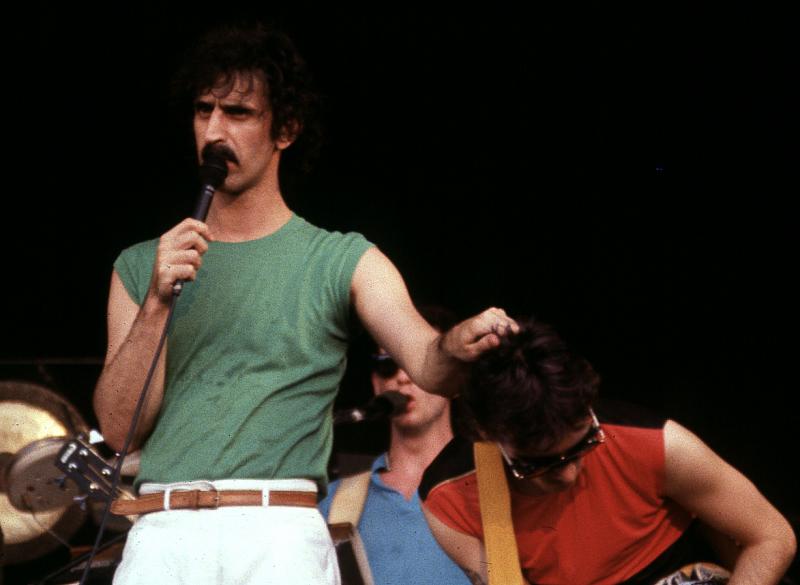 Schütte doesn't include snippets of Frank Zappa's few U.S. novelty hits ("Don't Eat the Yellow Snow," "Dancin' Fool," "Valley Girl"), nor his music video for 1981's "You Are What You Is" (immortalized on Beavis & Butt-Head), but we do hear Zappa's international hit "Bobby Brown." The song was a chart-topper in Norway and Sweden, one would guess because of its doo-wop melody and not the perverted black comedy Zappa grafts onto it. Over a 1978 performance of the song in Munich, Zappa confesses his amusement upon learning it was a popular slow dance number despite its references to sadomasochism, date rape and premature ejaculation.


